
What Are the Biggest Problems AI Authors Face After Writing Becomes Easy?
A practical analysis of the new challenges in quality, differentiation, discoverability, and reader acquisition.
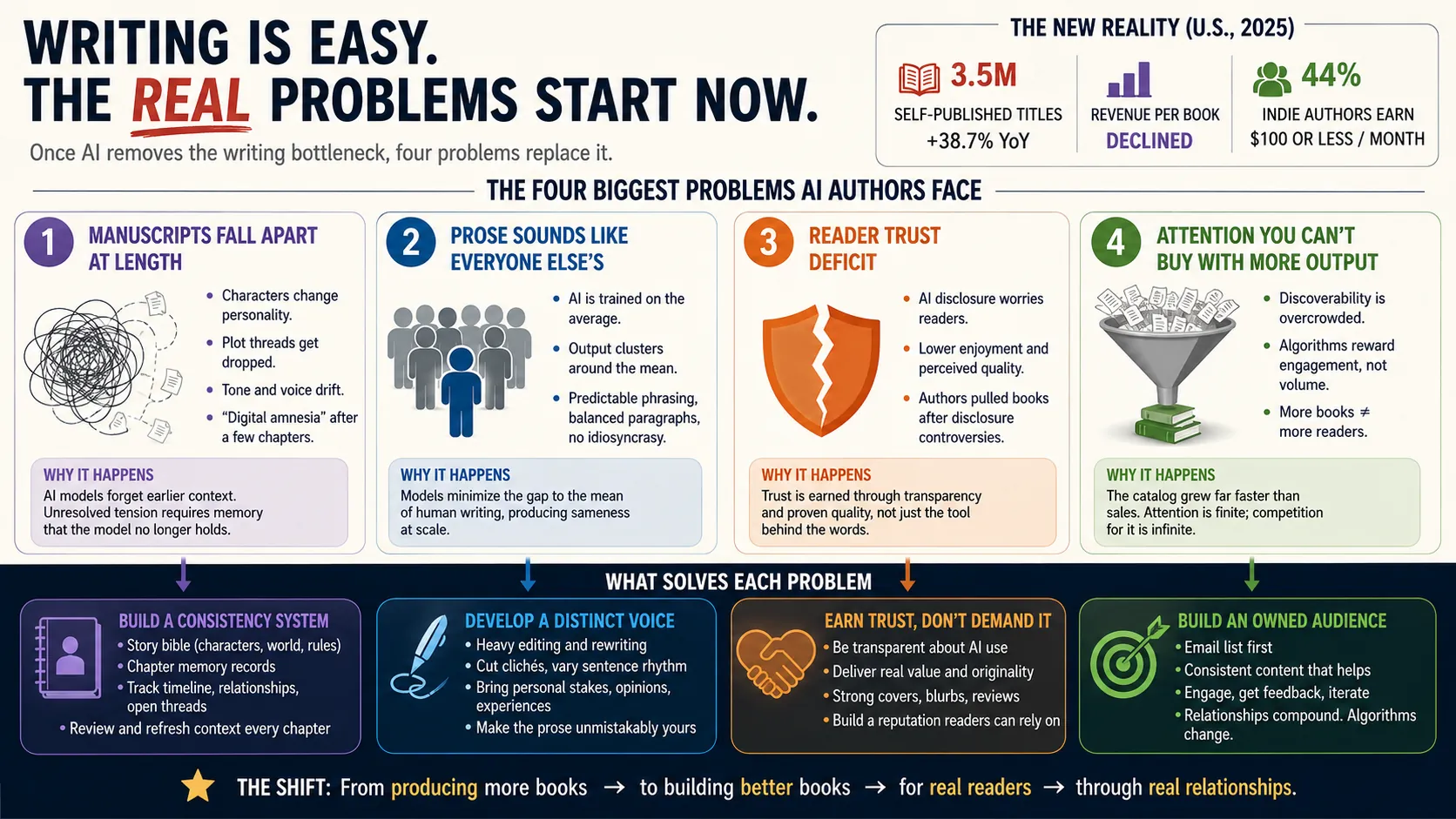
Writing stopped being the hard part. Four other problems took its place.
The reframe: writing was the bottleneck
For most of self-publishing's history, the constraint was output: you could not publish enough books to test a market. AI inverted that — and once the book is out, the constraint moves again to the post-publication work we mapped in you published the book now comes the hard part. Bowker's ISBN data, reported by Publishers Weekly in March 2026, shows self-published output reached 3.5 million titles in 2025 — up 38.7% in a year, roughly 84% of the catalog. A 2026 working paper tracking 14,419 Amazon genre-fiction titles found the catalog "grew far faster than the sales and revenue… and as a result the revenue per book declined."
That dilution now has a name and a number: the NBER's economists measured AI-containing books at more than half of 2025 releases — half the books on Amazon weren't written by a person — and found they are measurably less used.
When attention becomes scarcer than words, the problems worth solving change. Here they are, with the evidence.
Problem 1 — The manuscript falls apart at length
The most common failure is not bad prose; it is a story that loses itself. The Novarrium founder put it plainly on Indie Hackers in February 2026: "Most AI writing tools hit a wall after a few pages. Characters change personality, plot threads get dropped, and the writing voice drifts." His conclusion: "The hardest part wasn't the AI — it was maintaining consistency across 60,000+ words."
The mechanism is documented. Tom's Guide's January 2026 testing found that after a few chapters "characters forget earlier traits, plot threads vanish, and tone shifts randomly. This 'digital amnesia' is baked into the architecture." The symptoms are familiar to anyone editing AI drafts: eye color changes mid-book, a planted fear never surfaces at the climax. Models also resolve tension early, because unresolved tension requires state they no longer hold.
This is a craft problem with an engineering cause. The fix is a system that re-supplies story state every chapter: a story bible plus a per-chapter record of traits, relationships, timeline, and open threads.
Problem 2 — Prose that sounds like everyone else's
The second problem is sameness. Alex Kantrowitz, writing in Big Technology, calls it AI's sameness problem: generative systems are trained to minimize the gap between their output and the mean of human work, so their output clusters around an average. "ChatGPT writes with a characteristic style." Because every author drafts against that same average, the market fills with prose that reads like one author wearing a thousand names.
The signal readers react to is genericness, not the tool. Unedited AI prose has tells — balanced paragraph structures, predictable phrasing, no idiosyncrasy. Wyatt Graham calls the result "machine writing for machines."
The differentiator is the editing pass and the voice behind it. A draft from any model is raw material; the author's judgment — cuts, word choices, pacing — separates it from the average.
Problem 3 — The reader trust deficit
The third problem is structural: readers cannot reliably tell AI prose from human prose, yet suspicion is everywhere. A Stony Brook study reported by the New York Times in July 2026 found readers struggle to identify AI-generated text. The largest recent test — a Villanova University study of 1,682 adults published by Cambridge University Press in Judgment and Decision Making and reported by The Guardian on 5 August 2026 — found readers could not reliably tell AI-written short stories from human-written ones, rated the AI stories more absorbing overall, yet gave their highest scores to any story they believed was written by a human. AI-literate readers spotted AI text more often; readers with literature expertise did not.
Trust is not something readers can audit; the market prices it collectively. And the market is uneasy. A Cambridge MCTD / Institute for the Future of Work survey of 332 literary creatives found roughly half of novelists believe AI is likely to replace their work entirely. "There is widespread concern from novelists that generative AI trained on vast amounts of fiction will undermine the value of writing and compete with human novelists," said report author Dr. Clementine Collett. Authors report books appearing under their names that they never wrote, and fear that mere suspicion could damage their reputation. Books have been pulled from stores post-release over undisclosed AI involvement — the Mia Ballard case, reported via the NYT and BBC, is one example.
This is why disclosure exists (Amazon's KDP requirement, since September 2023) and why it is only a partial answer. It tells the reader the method; it does not restore the trust the environment erodes — and the stakes became unmistakable in August 2026, when a reported $2.4M debut deal collapsed over unverifiable authorship, the case behind your book deal just got rescinded. Honesty about method is table stakes; a sustained author identity is an asset — not a marketing nicety.
Problem 4 — More output cannot buy attention
The fourth problem is the one covered in the audience-building guide: self-published output rose 38.7% in a year while revenue per book fell, and 44% of surveyed indie authors earn $100 or less a month. Even the indie benchmark tells the same story: Amazon's KDP Select Global Fund — the closest thing to an indie-digital scoreboard — paid authors $321 million in the first five months of 2026, up 13.7% year over year and capped by an all-time monthly record of $66.9 million in May, yet the per-page royalty rate has drifted from $0.0058 in 2015 to about $0.0046 as more pages keep entering the pool. When everyone can publish, publishing is not a strategy. The problem is no longer writing books; it is being found — an audience and feedback-loop problem, not a production one. The mechanics of that — the catalog, the gamed signals, and reader suspicion — are broken down in why AI is making book discovery harder.
What solves what
- Manuscripts fall apart? Treat continuity as a system: a story bible plus per-chapter state (traits, relationships, timeline, open threads) re-injected before each chapter is written. Assemble the book from a structure the tool can query, not from its memory — the full mechanism is in character drift: why AI characters change personality.
- Prose sounds generic? The edit is the product: your cuts, voice decisions, and pacing choices are the differentiation. Document your voice the way you document your plot.
- Readers are skeptical? Disclose honestly, keep a quality bar, and build an identity readers can attach to. Trust compounds; suspicion does too.
- Nobody finds the book? Stop adding volume and start building the loop: an owned audience and reader signals that tell you what to write next.
The reframe
Writing was the bottleneck; now the bottlenecks are memory, voice, trust, and attention. AI authors who treat those four as systems — not as problems to be out-published — are the ones with a future in this market. The easy part was always going to be the words. The authors who win this market practice four things the high-volume publishers skip — detailed in what separates successful AI authors.
Continuity is the first problem to solve, because it's the one a system can fix outright. See how Pacegram's story bible keeps traits, timeline, and open threads consistent from chapter one to the last page.
SOURCES
- Publishers Weekly — "Book Output Topped Four Million in 2025" (Mar 2026)
- Chakrabarty, Liu, Ginsburg & Dhillon — "Generative AI floods and dilutes the market for books," arXiv:2607.20349 (working paper, under review; v3 Aug 2026)
- Indie Hackers — Novarrium: "I built an AI that writes full-length novels with consistent characters" (Feb 2026)
- Tom's Guide (Jan 2026), cited in Chapter's "Best AI for Long Form Writing"
- Inkfluence AI — "Best AI for Writing Novels in 2026: 6 Tools Tested"; "Do Readers Care If a Book Was Written with AI? (2026 Data)"
- Big Technology — Alex Kantrowitz, "AI's Sameness Problem" and "Can AI's Sameness Problem Be Solved?" (2025)
- Wyatt Graham — "AI Writing and the Problem of Sameness" (Substack)
- Cambridge MCTD / Institute for the Future of Work — survey of 332 literary creatives (Nov 2025), via TechXplore
- The Bookseller — "AI-generated stories rated higher than human-written ones in new study" (31 Jul 2026)
- The Guardian — "AI-generated stories rated better quality than human-written ones, study finds" (5 Aug 2026); BBC News coverage of the same Villanova University study, published by Cambridge University Press in Judgment and Decision Making (1,682 adults, ages 18–81)
- Amazon KDP Community — "KDP Select Global Fund and All Stars Bonus Update" (May 2026: record $66.9M month); Written Word Media — KDP Global Fund Payouts tracker (Jan–May 2026 sum: $321M); Author Media — "The Digital vs. Physical War" (2026), citing AAP monthly StatShot (industry revenue +2.6% to $4.7B through May 2026, roughly flat in real terms)
- Publishous (Medium) — "There's a Simple Reason Why AI Writing Is Causing So Much Backlash" (Apr 2026), covering the NYT/BBC Mia Ballard case
- The New York Times — "How A.I. Books Sneak Their Way Into Stores" (28 Jul 2026)
- Written Word Media 2025 Indie Author Survey; ALLi 2025 Indie Author Income Survey
Researched August 2026. Statistics are quoted with source and date; the arXiv study is a working paper under review and is labeled as such. Reader-complaint descriptions (generic prose, "reads like a machine") reflect qualitative reporting from industry blogs and surveys, marked as such rather than presented as measured statistics. Updated 18 Aug 2026: the reader-identification paragraph now cites the full Villanova study (1,682 adults; Cambridge University Press; Guardian, 5 Aug 2026), and the market paragraph adds the KDP Select Global Fund figures ($321M Jan–May 2026, record $66.9M month in May) and AAP industry revenue as reported by Author Media.