
Your Book Deal Just Got Rescinded: Provenance Is the New Editing
How a reported $2.4M crime-novel auction collapsed because no one could authenticate how the manuscript was made — and the documentation discipline that protects your next book.
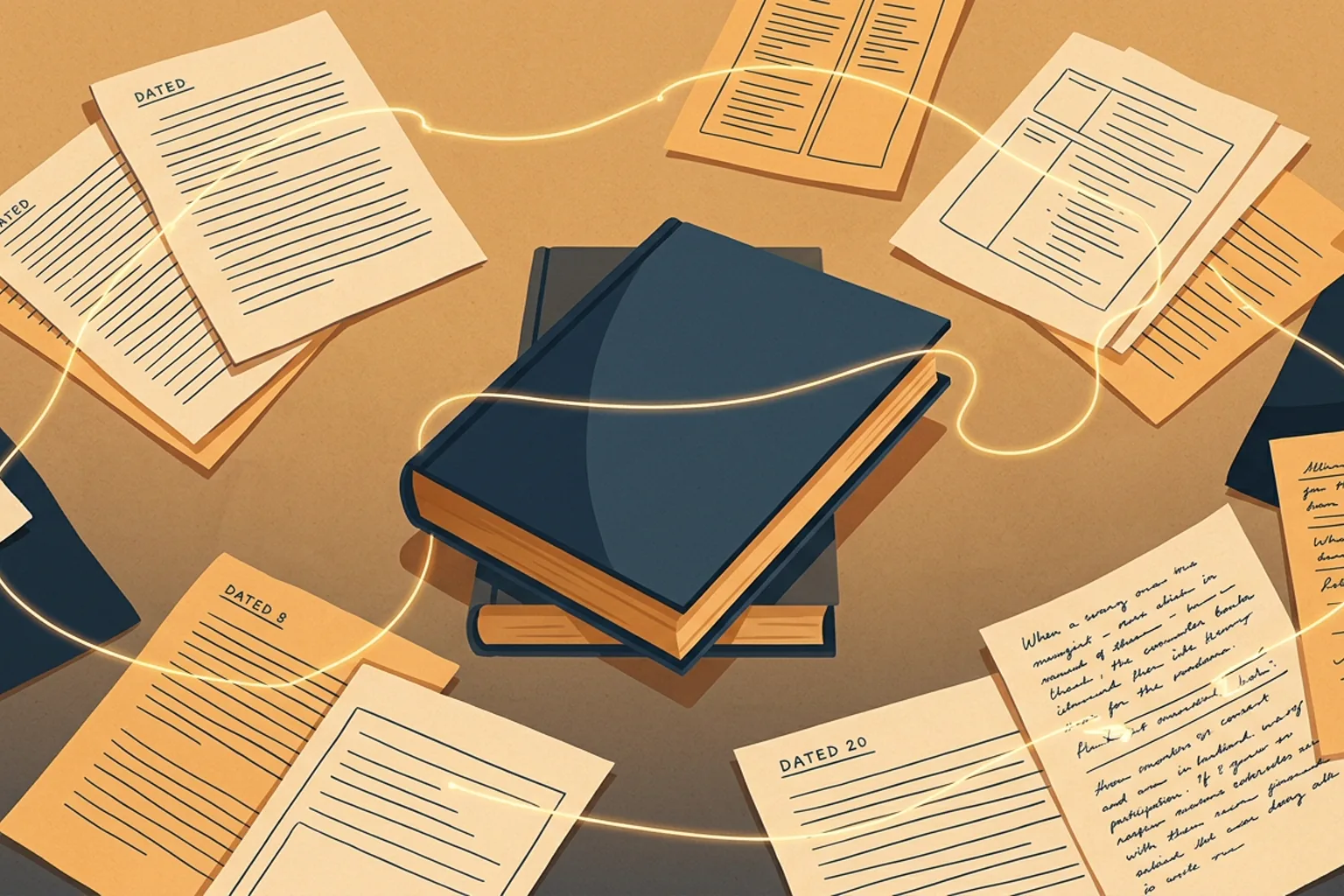
A book without a chain of custody is a book without provenance.
On 29 July 2026, a debut novelist lost a reported $2.4 million deal. The manuscript had just won a 14-publisher auction and drawn praise from nearly every literary professional who read it. The deal did not die because the book was bad. It died because the people buying it could no longer verify how the book was made.
The sentence that ended it is worth memorizing, because it is now the standard your work will be measured against. The agents said they could "no longer authenticate how the manuscript fully evolved from origin to completion."
The case that changed the terms
Jerry Falade is a Nigerian PhD candidate at Southern Methodist University. His crime novel, Call Me, I'll Hide the Body — a chemistry student who disposes of bodies for a cartel — drew 14 publishers into an auction that Minotaur, a Macmillan US imprint, won with a reported $2.4 million bid including a follow-up book. Days later, after a meeting in which "aspects of [Falade's] story changed" under questioning about AI use, his agents Marc Gerald (Europa Content) and Sandy Hodgman (Hodgman Literary) withdrew the manuscript. No public proof of AI involvement has been cited, and Falade denies the claims.
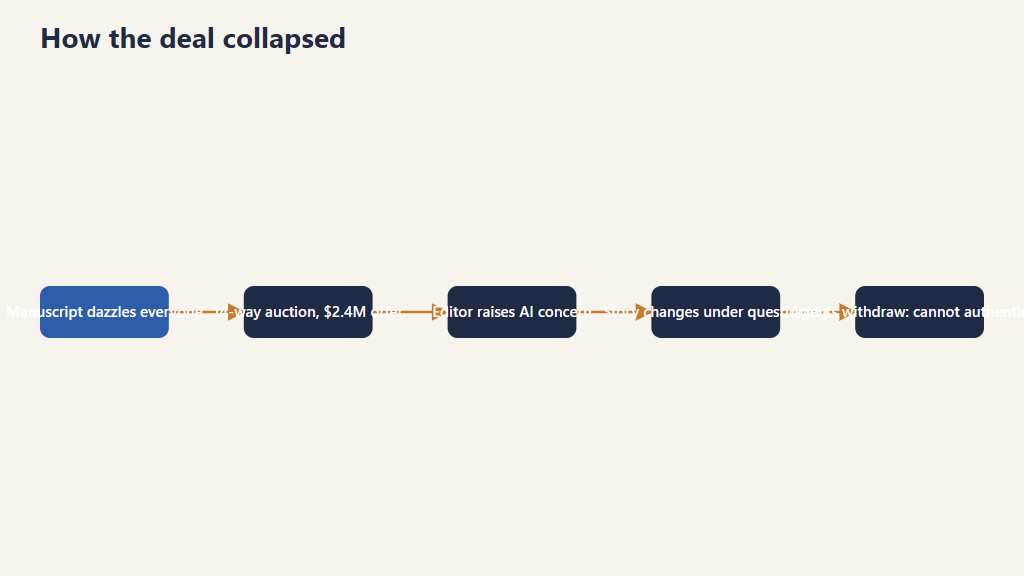
The failure was not the writing. It was the provenance.
He was not the first. Hachette cancelled Mia Ballard's horror novel Shy Girl in March after online AI accusations. H.M. Wolfe's dystopian romance Daggermouth faced the same accusations and denied them. The Commonwealth Short Story Prize dealt with allegations about three of its 2026 winners. Publishing editor Jane Friedman's summary is blunt: the industry is "operating in a world of both confusion and suspicion. No one really trusts anyone anymore."
Since publication: the trade press has confirmed the shape of the collapse — Macmillan, Minotaur's parent, canceled the deal, and Publishers Lunch framed the case as the opening question in a debate over AI guardrails: what verification standard should a publisher require before an auction? The Wall Street Journal covered the cancellation as a bellwether for the industry. No evidence of AI involvement has been produced, and Falade continues to deny the allegations. Whatever the case's resolution, the burden it created is not going away: the question is no longer whether a manuscript is suspected, but what a publisher can require as proof.
Why detection cannot save you
The reflexive answer is "run an AI detector." It does not work. Gerald declined to use detection software because, in his words, "the technology isn't at a place where we have determined it's reliable." That skepticism is earned. In one reported test, software classified passages from books published in 2012 and 2017 — years before generative AI was widely available — as 98% and 99% AI-generated. Detection does not get more reliable with practice: readers identify AI short fiction at chance rates while structural analysis of longer stories approaches 93% — the full reader-preference picture is in the three-study breakdown.
This is the shift no one has fully absorbed: the burden of proof has moved to the author. Once an editor raises the question, "there's no evidence against me" is not an answer. The standard is "prove how this manuscript evolved from origin to completion" — a documentation standard, not a detection problem. Whether or not you used AI, an author who cannot reconstruct their own process is one raised eyebrow away from Falade's situation.
Since publication: the doppelganger wave
The pattern that sank the Falade deal did not stay confined to one auction. A month later, the same trust failure had moved from "was this manuscript AI-assisted?" to "is this book even by the named author?" - and this time it targeted established names.
In the weeks before technology journalist Kara Swisher's next book release, several AI-generated biographies of her appeared on Amazon through Kindle Direct Publishing: unknown authors, AI-generated portrait covers, timed to ride her book's marketing. After Swisher complained directly to Amazon CEO Andy Jassy, many were removed, but dozens of other books by the same authors remained available. The Authors Guild, which observed "AI-generated 'similar' books pop up on Amazon quickly after authors list pre-orders of upcoming books," is pushing Amazon to disclose which books involve generative AI and backs a bill requiring AI companies to label content their tools produce.
The Alliance of Independent Authors (ALLi) reports the same wave from the author side: AI-generated fake books resurfacing on Amazon under real authors' names, prompting renewed trust-and-transparency questions across self-publishing. The argument of this article sharpens accordingly: provenance is no longer only about whether you used AI - it is about whether the marketplace can tell your book apart from an impersonation of it. The documentation trail that proves how your manuscript evolved is the same record that proves the book under your name is yours.
Since publication: the detector backlash
The question that sank the deal has not gone quiet - it has moved from the auction room into the tools themselves. The detector at the center of both the Falade collapse and the Shy Girl cancellation is Pangram, and its maker's own claims are now part of the controversy. The company puts its false-positive rate at about one in 10,000, a precise-sounding number that still only measures statistical patterns in a paragraph, not who wrote it. The same tool flagged passages of Pope Leo XIV's encyclical as AI-written and labeled several 2026 Commonwealth Short Story Prize entries - including one published in Granta - as mostly AI-generated. Wall Street Journal opinion editor James Taranto called Pangram a "defamation machine" after it mislabeled three of his own paper's columns as AI-generated. A detector that misfires on a papal encyclical and a Journal editorial page can flag a stylistic pattern; it cannot say who reported the story or judged a draft good enough to publish.
Falade's own account of the collapse, given to The Guardian, has the texture the first reports lacked: "Within six hours, I had been dropped by my agency, deals were paused, and press releases were being issued." Not a slow legal grind - a single afternoon.
The industry's answer is moving away from detection altogether. HarperCollins CEO Brian Murray told Publishers Weekly he does not believe detection software provides a technical solution, and called on publishers, agents, and authors to develop shared standards for certifying that a book is written by humans - "difficult conversations," he acknowledged - possibly including authors keeping records of their writing process. "This is an industry built on trust and relationships," he said, "and we need to rely on those qualities." He also put a price on the copyright cliff: "An AI-assisted book could very well be treated as a book in the public domain." The law behind that warning is now settled: the Supreme Court declined in March to revisit Thaler v. Perlmutter, leaving in place the rule that works created solely by AI cannot be registered for copyright while human contributions within an AI-assisted work still can.
Editors are writing the new standard into contracts. Editor Mary Kole, in a guest post on Jane Friedman's site, described unknowingly accepting two AI-assisted novels back-to-back and rewriting her client agreement so that clients must disclose any generative AI used to draft, rewrite, expand, summarize, or reorganize a manuscript, identify the affected portions, provide pre-AI material where available, and accept that substantial reconstruction may be reclassified and repriced. Friedman has described the industry as "operating in a world of both confusion and suspicion." The market is answering that confusion with paperwork - which is exactly what provenance is: a paper trail that survives the question.
The rules that already apply
The incentive to build that record is no longer hypothetical. Amazon's KDP now requires authors to disclose AI-generated text, images, and translations at upload, and draws a line that surprises many: content created by an AI tool remains "AI-generated" even after substantial human editing, while AI-assisted work — grammar checking, brainstorming, editing human-written prose — does not need disclosure. Failure to disclose can mean removal or account suspension. The full 2026 rules — what counts as AI-generated versus AI-assisted, the substantial-modification bar, and the enforcement ladder — are in Amazon KDP's AI disclosure rules. When the platform's own disclosure is invisible to buyers, the reader-facing signal has to come from somewhere else — that is exactly the gap the Human Authored seal is built to fill.
The EU went further on 2 August 2026, when Article 50 of the AI Act became enforceable. Providers must embed provenance metadata and watermarking in AI-generated content, and AI-generated text on matters of public interest must be labelled unless it underwent human editorial review with editorial responsibility. Fines run to €15 million or 3% of global turnover. Creative fiction gets lighter labelling — in credits or accompanying notes — but it is still marked. None of this applies retroactively to a finished book. All of it changes how the next one will be verified.
| Who is asking | What they require | Applies to | Cost of failing |
|---|---|---|---|
| Amazon KDP | Disclose AI-generated text, images, translations at upload | Every self-published author | Removal or account suspension |
| EU AI Act Art. 50 | Provenance metadata + watermarking; label AI-generated public-interest text | EU-market publishers and platforms | Fines up to €15M or 3% of turnover |
| Authors Guild Human Authored | Certify the text is human-written; public verification database | Any author who uses the mark | Trademark and fraud liability |
| Literary agents | Authenticate how the manuscript evolved, origin to completion | Traditionally published authors | The deal collapses |
Four different parties now require provenance — with four different failure costs.
Provenance is a workflow, not a form
The practical conclusion is uncomfortable but simple. If you cannot reconstruct how your manuscript evolved — dated drafts, outlines, notes, version history that would survive an agent's question — you are exposed, whether or not you used AI. Build the record as you write, not after the question arrives:
- Write in a tool that keeps real version history, with the outline, scenes, and notes in the same place.
- Let the record be boring and complete: drafts, revisions, dated decisions.
- Decide your disclosure position before anyone asks — for KDP it is a published requirement, for an agent it is a line in a conversation.
- Never claim "no AI" if your definition of AI-assisted work is wider than the buyer's.
The market is already rewarding the other side of this. Readers presume AI involvement until proven otherwise, trust has become the deciding factor in a saturated catalog, and roughly one in five new releases now contains substantial AI text — up from near zero three years ago. The Authors Guild's Human Authored certification exists because authors wanted a verifiable way to claim the opposite. Whatever you believe about AI in writing, you must now be able to say how your book was made — and to show it. Reader distrust is one of the four structural problems we catalogued in the biggest problems AI authors face; this is its compliance layer.
The provenance checklist
- The standard has changed: the burden is "authenticate how the manuscript evolved from origin to completion" — proof, not denial.
- Detection cannot save you: detectors flag 2012 novels as 98% AI; the documentation has to exist before the question.
- Disclosure is already law-ish: KDP requires it at upload, the EU's Article 50 is enforceable since 2 August 2026.
- Build the record as you write — dated drafts, outlines, notes, version history — not after the question arrives.
The reframe
Editing was the discipline that made a manuscript good. Provenance is the discipline that makes it credible: the trail that lets a buyer authenticate "how the manuscript fully evolved from origin to completion." It protects the trust layer that decides whether your name is an asset — the author-entity problem detailed in your book isn't the problem; nobody knows you wrote it — and it is part of the open system that begins the day you publish. A book that cannot be proven is a book that cannot be sold. The agent's email got the future right — "this raises so many questions about the nature of authorship." The authors who answer them first will be the ones still selling.
A book that cannot be proven is a book that cannot be sold.
Provenance is a record you build while you write — and a story bible is exactly that: outline, scenes, and notes in one place, with a history. See how Pacegram keeps your manuscript's structure — and its trail.
SOURCES
- The Guardian — "$2m crime novel deal collapses amid questions over AI use" (31 Jul 2026). https://www.theguardian.com/books/2026/jul/31/crime-novel-deal-collapses-questions-ai-jerry-falade-call-me-ill-hide-the-body
- Moneywise via Yahoo Finance — "Jerry Falade's $2.4 million book deal collapses after his own agent pulls it over AI concerns" (Aug 2026). https://finance.yahoo.com/technology/ai/articles/jerry-falades-2-4-million-200000421.html
- KERA News — "SMU student loses book deal worth over $2 million after allegations of AI use" (13 Aug 2026). https://www.keranews.org/news/2026-08-13/generative-artificial-intelligence-southern-methodist-university-allegations
- Publishers Weekly — "After the Cancellation of 'Call Me, I'll Hide the Body,' What Comes Next?" (Aug 2026). https://www.publishersweekly.com/pw/by-topic/industry-news/publisher-news/article/100983-after-the-cancellation-of-call-me-i-ll-hide-the-body-what-comes-next.html
- Amazon KDP AI-generated content policy (2026) — via univers.studio, Inkrify, and WriterCosmos compliance guides.
- European Commission — "Quick Facts: Transparency rules for AI systems" (Article 50, applicable 2 Aug 2026). https://digital-strategy.ec.europa.eu/en/factpages/quick-facts-transparency-rules-ai-systems ; Travers Smith and Stibbe analyses of the same rules.
- Authors Guild — "Authors Guild Launches 'Human Authored' Certification" (2025) + Human Authored FAQ. https://authorsguild.org/news/ag-launches-human-authored-certification-to-preserve-authenticity-in-literature
- RevRYL / Chakrabarty, Ginsburg, Dhillon, Liu — "Generative AI Floods and Dilutes the Market for Books," arXiv:2607.20349 (22 Jul 2026). https://arxiv.org/abs/2607.20349
- Ford Mountain Publishing — reader trust and AI presumption (2026), via prior article ledger.
- WriterCosmos — trust as the deciding factor under AI saturation (2026), via prior article ledger.
- Mother Jones — "I Asked AI to Write a Novel. It's Not So Bad." (Aug 2026), noting Macmillan US canceled the crime-novel deal over AI suspicions
- Publishers Lunch via The Wall Street Journal — "Seven-Figure Book Deal Cancelled Over AI Suspicions Raises Questions About AI Guardrails" (Aug 2026)
- The Decoder — "Kara Swisher battles AI-generated doppelgänger books on Amazon" (Aug 2026). https://the-decoder.com/amazon-has-problems-with-ai-generated-books
- Self-Publishing Advice Center (ALLi) — "AI-Generated Fake Books Resurface on Amazon" news podcast (Aug 2026). https://selfpublishingadvice.org/podcast-ai-generated-fake-books
- PYMNTS — "The Real Question Isn't Whether AI Wrote It" (19 Aug 2026). https://www.pymnts.com/news/artificial-intelligence/2026/the-real-question-isnt-whether-ai-wrote-it
- Publishers Weekly — "Brian Murray Addresses AI Authorship Issues" (Aug 2026). https://www.publishersweekly.com/pw/by-topic/digital/copyright/article/101002-brian-murray-calls-for-industrywide-solutions-to-issues-around-ai-authorship.html
- janefriedman.com (guest post by Mary Kole) — "After Editing Two AI-Assisted Manuscripts, I Rewrote My Client Agreement" (13 Aug 2026). https://janefriedman.com/after-editing-two-ai-assisted-manuscripts-i-rewrote-my-client-agreement
- Mayer Brown via PYMNTS — Thaler v. Perlmutter: SCOTUS declined to revisit (Mar 2026); purely AI-generated works uncopyrightable, human contributions in AI-assisted works remain protected.
Researched 17 Aug 2026 via Tavily (queries on the Falade case, KDP AI disclosure policy, EU AI Act Article 50 transparency rules, and the Authors Guild Human Authored certification). The Falade case is presented as reported: the deal was withdrawn after the agencies said they could no longer authenticate how the manuscript was made; no public proof of AI involvement has been cited and the author denies the claims. The $2.4M figure is the widely reported bid (Moneywise); the Guardian reported "more than $2m". AI-detection test results (98–99% on 2012/2017 books) are presented as reported by the Falade team via Moneywise. KDP and EU requirements are summarized from 2026 policy documentation and legal analyses; EU fines and the 2 August 2026 effective date are per the European Commission and law-firm summaries. The "provenance is a workflow, not a form" framing and the four-item documentation checklist are this article's recommendations, not sourced claims. No first-hand authorship experience is claimed. The author is the founder of Pacegram, a story-architecture tool for novelists; this article contains no product comparisons or promotion. Updated 18 Aug 2026 with subsequent reporting: the trade press confirmed that Macmillan (Minotaur's parent) canceled the deal, Publishers Lunch raised the AI-guardrails question, and The Wall Street Journal covered the cancellation; the "since publication" paragraph reflects those reports. Updated 23 Aug 2026 with the doppelgänger-book wave: the Kara Swisher case (The Decoder), the Authors Guild disclosure push, and ALLi reporting on fake books under real authors' names. Updated 25 Aug 2026 with the detector-backlash chapter: the six-hour collapse timeline (Falade to The Guardian, via PYMNTS), Pangram's false-positive incidents (papal encyclical, Commonwealth Prize entries, three WSJ columns — Taranto's "defamation machine"), HarperCollins CEO Brian Murray's call for industry-wide standards and author record-keeping (Publishers Weekly, quotes verbatim), Mary Kole's rewritten client agreement on Jane Friedman's site, and the Supreme Court's Thaler v. Perlmutter standing (Mayer Brown via PYMNTS).