
Best AI Novel Writing Tools & Assistants in 2026, Compared by What Actually Matters
Pricing and feature research for authors deciding which tool will survive a full manuscript.
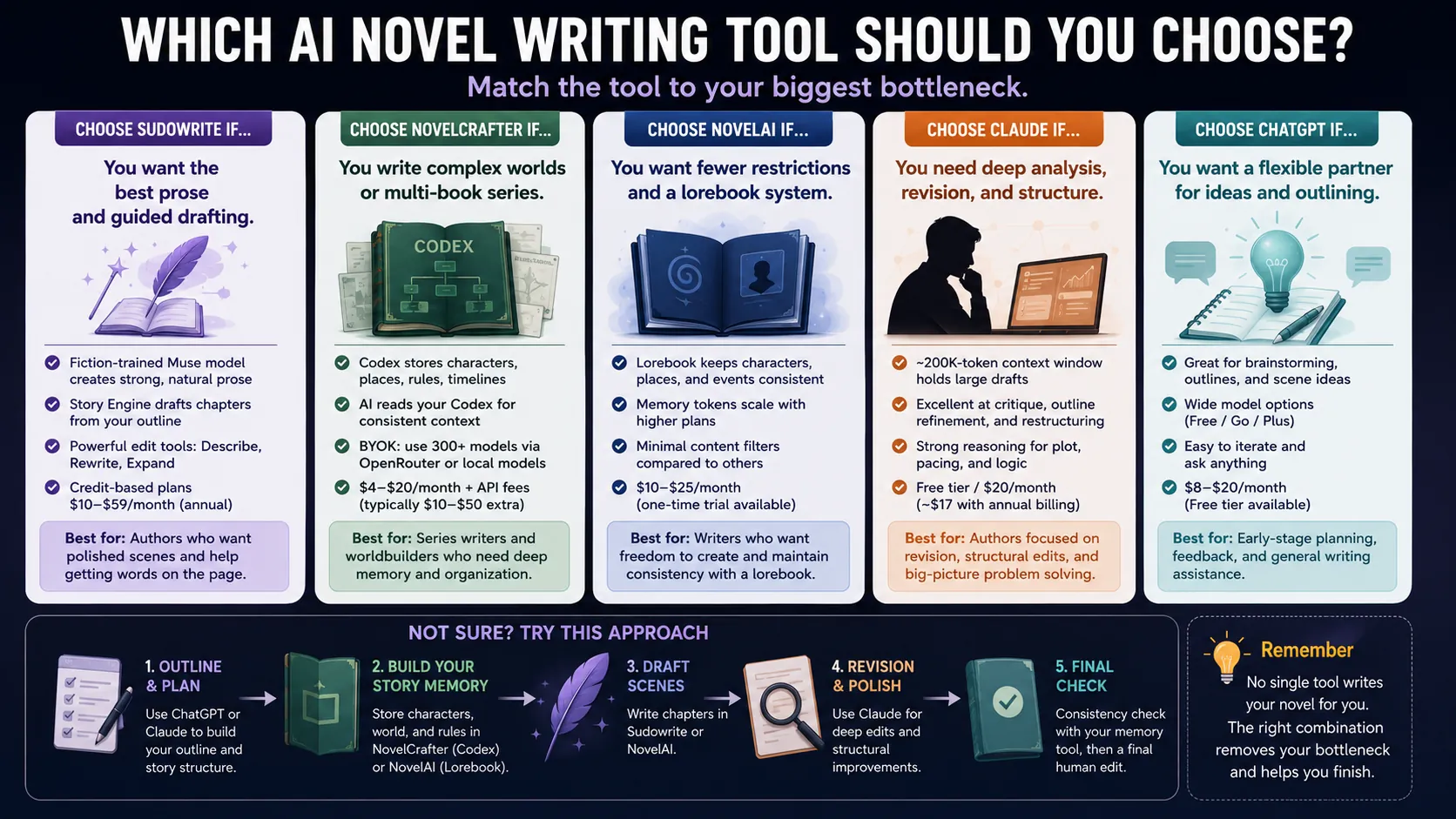
The tools that finish novels aren't the ones with the best sentences — they're the ones that remember the story.
The wrong question
Most "best tools of 2026" lists are written by vendors who rank their own product first — and the current search results are dominated by exactly that pattern. Treat any list, including this one, as evidence to check rather than a verdict to accept. The better question is: which tool removes the bottleneck in your process?
Full disclosure: I'm the founder of a novel-planning tool, and it is deliberately left out of this ranking — how its story-bible approach compares with Sudowrite is covered in a separate guide.
Across independent reviews and author reports, five criteria separate tools that help finish a novel from tools that produce fragments: (1) whether the prose model is trained for fiction, (2) how the tool remembers the story across chapters, (3) how much structure it provides versus how much control it demands, (4) content restrictions, and (5) what it actually costs per month.
Assistant or tool — the word that decides what you buy
People search for an "AI novel writing assistant," a "book writing assistant," or a "fiction writing assistant" — the software industry mostly sells "tools." The difference is more than vocabulary. An assistant implies a partner that works inside your process; a tool implies a system you adapt to. The two words also carry different expectations: an assistant is supposed to remember what you told it last week, while a tool is allowed to be neutral machinery.
In practice, "assistant" and "tool" describe the same product class in 2026 — the question that separates them is whether the product remembers your story. Every dedicated assistant in this guide (Sudowrite, NovelCrafter, NovelAI) is built around some form of story memory: a story bible, a codex, a lorebook. Every general chatbot is not. So when a search says "assistant," it usually means: I want a writing partner that holds the story while I work. That is the bottleneck this guide ranks by — and it is why the same criteria apply whether you call them tools or assistants.
The shortlist, by cost and memory
| Tool | Monthly cost (Aug 2026) | How it remembers the story | Best for |
|---|---|---|---|
| Sudowrite | $10–$59, credit-based | Story Bible + chapter context | Polished prose, guided drafting |
| NovelCrafter | $4–$20 + API fees | Codex (your own wiki) | Series, worldbuilding-heavy fiction |
| NovelAI | $10–$25 | Lorebook + memory tokens | Unrestricted writing, focused drafting |
| Claude | Free / $20 | 200K-token context, per session | Revision, structural analysis |
| ChatGPT | Free / $8–$20 | Conversation context only | Brainstorming, outlining, feedback |
Sudowrite builds on Muse, a model fine-tuned on published fiction, and is the most consistently rated prose generator of the group. Its Story Engine drafts whole chapters from an outline, and the editing tools — Describe, Rewrite, Expand — are useful well past the first draft. Pricing is $10/$22/$44 a month on annual billing ($19/$29/$59 monthly), with credits instead of words: 225K, 1M, or 2M per month. There is no free plan, only a one-time trial.
NovelCrafter is less a writer than a writing studio. A Codex holds every character, location, and rule you choose to record, and the AI reads it for context — which is why series and worldbuilding-heavy writers favor it. The subscription is cheap ($4–$20 a month), but AI runs on your own API key, so the real bill is subscription plus token usage; authors report $10–$50 a month on top depending on model and volume.
NovelAI runs its own Kayra models with minimal content filters, which matters for horror, dark fiction, and explicit romance that other tools sanitize. Its Lorebook does the memory work, and the paid tiers ($10/$15/$25) mainly scale memory tokens and image-generation credits. Writing itself is not metered by the word.
Claude (free tier, or Pro at $20/month — about $17 on annual billing) is the strongest general-purpose revision partner: a 200K-token context window lets it read a large portion of a manuscript in one pass. Working novelists most often use it to analyze structure and continuity, not to draft chapter after chapter.
ChatGPT (free; Plus $20/month; Go $8/month) remains the default starting point because it is free and genuinely capable. Its weakness is the same as any chat tool: no persistent story memory, so long-project consistency depends entirely on you re-supplying context. We go deep on exactly where that breaks in ChatGPT for novel writing, on what the free tiers of these tools actually deliver in free AI novel writing assistants, and on the working method that keeps a book consistent.
What you actually pay
The sticker price hides three billing models. Sudowrite's credits expire at the end of each cycle — only the top tier rolls unused credits over — so an idle month is a wasted month. NovelCrafter bills twice: a subscription plus whatever your chosen model charges per token. NovelAI and the general-purpose tools are flat: you pay once, and writing volume does not inflate the bill.
What's actually free in 2026
"Free" is the most common modifier in searches for AI novel writing assistants, so it is worth being precise about what free access actually buys. As of August 2026:
| Tool | Free tier | What the free access actually is |
|---|---|---|
| ChatGPT | Yes | Genuinely usable free tier (limited messages per rolling window); best for brainstorming, outlining, feedback |
| Claude | Yes | Free tier with the 200K-token context window and daily limits; the strongest free option for revision and manuscript analysis |
| NovelAI | Limited | A light free tier for experimenting — not enough to draft a book |
| Sudowrite | No | One-time 14-day trial only; no recurring free plan |
| NovelCrafter | No | 21-day trial; cheapest paid tier starts at $4/month |
The honest summary: free tiers are enough to test a workflow, and none of them is enough to draft a 90,000-word novel on its own. The genuinely capable free tiers are the general-purpose chatbots — which brings you back to the same structural trade-off: they are free because they remember nothing about your story. "Free" has a second cost worth noticing too: the general chatbots' free tiers have weaker data-privacy defaults than the paid fiction-specific tools, most of which do not train on your content.
ChatGPT or a dedicated novel tool?
ChatGPT is where most people start — it is free, its prose is genuinely good, and it excels at brainstorming, outlining, and dialogue experiments. The limitation is structural, not a version problem: ChatGPT has no persistent story memory. Between sessions it forgets your protagonist's eye color, and output quality degrades past a few thousand words, because the conversation context is the only thing anchoring it. A large context window (128K or more) does not fix this — a novel is 90,000 words and hundreds of story facts, and re-supplying them every session is exactly the work you wanted a partner to remove.
Dedicated tools solve that problem by design: Sudowrite's Story Bible, NovelCrafter's Codex, and NovelAI's Lorebook are memory systems that persist across sessions. That is why the 2026 author consensus is not "ChatGPT versus a dedicated tool" — it is both, used for different jobs: brainstorm and outline in a general assistant, draft and hold the story in a dedicated one. Independent reviews and vendor-run tests (Novarrium's 25-chapter consistency test, March 2026) reach the same conclusion: for a full novel, the memory system matters more than the prose model — the finding this entire comparison keeps returning to.
Three follow-ups cover the practical questions this comparison raises: what an AI novel writer can actually do, — capabilities, the continuity catch, and real 2026 costs — what free AI story writers really deliver before you pay for anything, and whether Claude Projects plus a story bible is enough to hold a long book together.
Choose by your bottleneck
- Choose Sudowrite if prose quality is your blocker and you want the closest thing to a fiction-trained co-writer.
- Choose NovelCrafter if you write series or worldbuilding-heavy fiction and are comfortable with API setup.
- Choose NovelAI if you write material other tools censor, or you prefer a lorebook-driven, low-guidance environment.
- Choose Claude if you already have a draft and need structural, continuity, and line-level analysis.
- Choose ChatGPT if you are starting out and want a free tool for brainstorming and outlining.
- Writing in book language? If your project is framed as a book rather than a novel — or you are testing whether an AI book generator can write the whole thing — start with our book-language guide before you pay for anything.
The working stack
Almost no working novelist relies on a single tool. The pattern that recurs in 2026 author reporting is a two-tool stack: one tool that drafts prose, one general assistant that analyzes and revises. Budget for the process, not the product — and remember the finding that runs through this series: tools generate, but the author's job is structure, memory, and editorial judgment. The same holds at the finishing end: the paratext tools that produce a dedication, a blurb, or a copyright page exist to keep a book from looking unfinished. For a long manuscript, a tool that remembers the story is worth more than one that writes prettier sentences — a story bible is how you make memory a system rather than a hope.
The window-versus-memory distinction is the whole argument behind why a context window isn't a story's memory — and why every serious tool here pairs a model with a structured bible.
For the direct head-to-head, Pacegram vs Sudowrite compares the BYOK-style outsourcing platform against the bundled story-architecture tool.
If your bottleneck is the story falling apart at length, structure-first planning is the fix — and it's what Pacegram is built around. See how story bible planning keeps a long manuscript coherent while you pick the drafting tool that fits you.
SOURCES
- Sudowrite — "Cost of Writing a Novel with AI: Full Breakdown (2026)" (official blog, 13 Jul 2026)
- NovelCrafter — "Our Plans and Pricing" (official pricing page, 2026)
- Felo.ai — "Sudowrite Review 2026" (pricing checked against official documentation)
- Built&Written — "Sudowrite Review 2026: Pricing, Limits, Alternatives"
- checkthat.ai — "Sudowrite Pricing 2026" and "Novelcrafter Pricing 2026: Plans, Costs & AI Fees"
- WeavAI Blog — "NovelAI 2026 Review" (23 Apr 2026); PixAI Blog — "NovelAI Review" (2026)
- Laterpress — "Best Writing Tools for Fiction Authors (2026): AI and Beyond"
- CreativIndie — "Best AI Writer 2026: Honest Picks I Actually Tested" (May 2026)
- eesel AI — "I tested the 5 best AI novel writing software platforms in 2026"
- morphllm.ai — "ChatGPT vs Claude Pricing (2026)"; LumiChats — "ChatGPT Plus vs Claude Pro 2026"; AI Pricing Guru — subscription comparison (Jun 2026)
- ScribeCount — "Novelcrafter for Indie Authors"; PlotForge — "How Much Does NovelCrafter Cost? True BYOK Pricing Breakdown" (17 Apr 2026)
- Inkfluence AI — "Best AI for Writing Novels in 2026: 6 Tools Tested" (May 2026; vendor content, used for landscape only)
- CreativIndie — "Best AI Writer 2026: Honest Picks I Actually Tested" (May 2026; free-tier reality table)
- operatorway.com — "Best AI for Story Writing in 2026: 5 Tools Tested" (trial lengths: Sudowrite 14-day, NovelCrafter 21-day, NovelAI limited)
- ainycity.com — "17 Best AI Tools for Writing Novels in 2026" (Claude free tier with 200K context)
- Novarrium — "We Tested 4 AI Novel Tools for 25 Chapters. All Failed But One." (Mar 2026; vendor content, used for the ChatGPT consistency finding only)
Researched 11 Aug 2026 via Tavily. Pricing was checked against official pricing pages (Sudowrite's blog, NovelCrafter's pricing page) and corroborated with multiple current reviews; ChatGPT/Claude prices come from June 2026 pricing guides. Pricing is volatile: all figures are "as of August 2026" and should be re-verified before purchase; annual-billing discounts are noted where documented. Credit-to-word conversions and API-fee estimates ($10–50/mo for NovelCrafter) are author-reported estimates, not official figures. No first-hand product testing is claimed; the landscape sources include vendor content, which is labeled as such and used only for context. The author is founder of Pacegram, a novel-planning tool; Pacegram is deliberately excluded from this ranking, and its relationship to Sudowrite is covered separately. Updated 18 Aug 2026: added the assistant/tool framing, the free-tier reality table, and the ChatGPT-versus-dedicated-tools section; free-tier and trial facts verified against multiple August 2026 reviews (CreativIndie, operatorway, ainycity), with Novarrium's consistency test labeled as vendor content.
Whichever tool you pick, it only helps if the story has a plan — learn how to write a novel outline before you draft. How to write a novel outline.