
Why Are AI Authors Struggling to Build Audiences Even When They Publish More?
The evidence for why volume stopped building audiences, and what still compounds for AI-assisted authors.
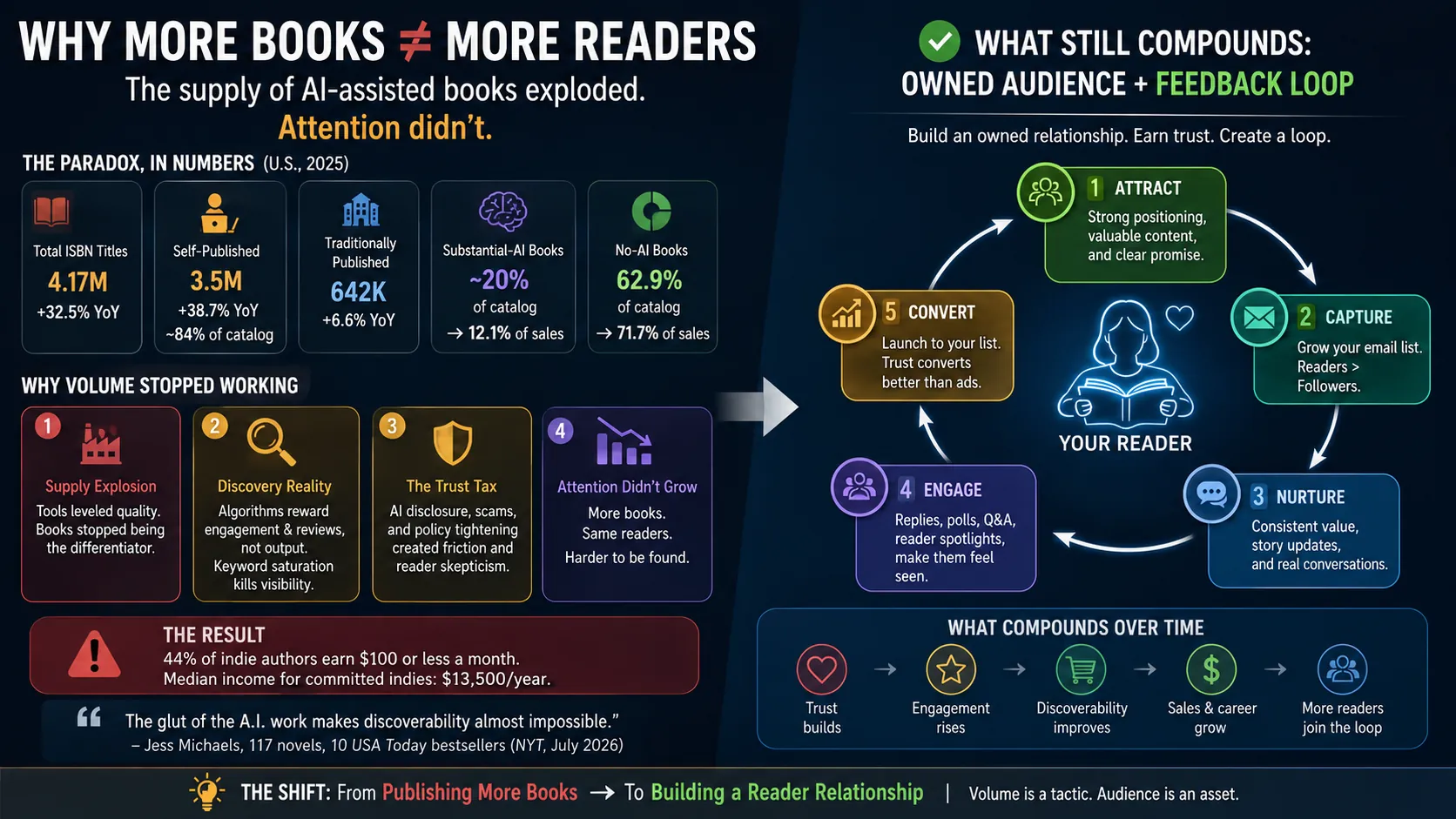
More titles than ever are being published. Fewer of them are being found.
The paradox, in numbers
Start with supply. Bowker's ISBN data, reported by Publishers Weekly in March 2026, shows more than four million books were published in the U.S. in 2025 — up 32.5% in a year. Self-published titles drove nearly all of it: 3.5 million, up 38.7% from 2.5 million in 2024, and roughly 84% of the ISBN-registered catalog. Traditional output rose a modest 6.6%, to 642,242 titles.
Now demand. A 2026 working paper tracking 14,419 Amazon self-published genre-fiction titles (2023–26) concluded that "the catalog grew far faster than the sales and revenue… and as a result the revenue per book declined." Books with substantial AI text made up about 20% of the catalog but earned 12.1% of sales; books with no detectable AI text were 62.9% of titles but 71.7% of sales.
The scale of the flood now has a harder number behind it: the NBER's working paper on AI and creative output found AI-containing books topped half of all 2025 releases, with monthly output roughly tripling since 2022 — half the books on Amazon weren't written by a person.
Written Word Media's 2025 survey: 44% of indie authors earned $100 or less a month; only 8% earned more than $10,000. ALLi's 2025 survey put the median income of committed indies at $13,500 a year. The complete income landscape — including what the top AI books actually gross — is in how much AI authors actually make in 2026.
This is structural, not personal. Once writing is easy, the bottleneck moves elsewhere — for the four problems that replace it, see the biggest problems AI authors face now.
| Measure (U.S., 2025) | Value |
|---|---|
| Total ISBN-registered titles | 4.17M (+32.5% YoY) |
| Self-published titles | 3.5M (+38.7%), ~84% of catalog |
| Traditionally published titles | 642,242 (+6.6%) |
| Substantial-AI books: catalog share → sales share | ~20% → 12.1% |
| No-AI books: catalog share → sales share | 62.9% → 71.7% |
| Indies earning ≤ $100/month | 44% |
| Median income, committed indies | $13,500/yr |
Why volume stopped working
1. You're adding supply to the cheapest part of the market
Words were never the scarce resource. Bowker's Andrew Kovacs told Publishers Weekly the likely driver of the 2025 boom: "every aspect of the publishing process once available only through traditional publishers can now be obtained from the self-publishing service providers at a comparable level of quality." When everyone can produce at the same quality level, the book stops being the differentiator.
2. Discovery runs on engagement signals, not output
Amazon's store is an algorithm trained to surface popular, well-reviewed books. Keyword and category saturation degrade search signal-to-noise and drag down ad conversion — the full mechanics are in why AI is making book discovery harder. Most readers meet your book as a thumbnail and a blurb; metadata — categories, BISAC codes, keywords — is the gate. Volume doesn't win that gate.
3. The trust tax
In September 2023, Amazon lowered KDP's daily new-title limit to three per day and began requiring AI-content disclosure (The Guardian; Authors Guild). Enforcement has tightened since. The Authors Guild documents a wave of scam AI "biographies" of authors like Stephanie Land and Kara Swisher. Distributor Ingram may decline books "created using artificial intelligence or automated processes." Amazon says the disclosure checkbox itself doesn't affect search ranking or visibility — the cost isn't the form; it's the environment every book publishes into.
4. Attention didn't grow with supply
Readers are finite; demand didn't shift with the catalog. Romance author Jess Michaels (117 novels, ten USA Today bestsellers) told the New York Times in July 2026 that sales were so dismal she might stop publishing: "The glut of the A.I. work makes discoverability very difficult." When supply inflates and demand holds, revenue per book falls — arithmetic, not a verdict on your writing.
5. Volume without a feedback loop compounds blind
This is analysis, not a measured statistic. If you publish fast and nothing comes back — no signal about which premise, cover, or blurb moved readers — you scale in the dark. You're not iterating; you're repeating.
What still compounds
Owned audience
Email remains the most direct channel — Reedsy's Ricardo Fayet calls it "the number-one way to grow and reach your fan base." ALLi's 2026 data: 30% of indies sell direct, another 30% plan to. A list you control survives algorithm changes. Platform followers are rented; a list is owned.
Building one from zero is the subject of how AI authors build a loyal audience.A feedback loop
The advantage isn't writing faster — it's learning faster. ARC feedback, launch surveys, review patterns, ad data: each is a signal for what to write next. Authors who build this loop compound; authors who only produce don't.
Distinct identity
The same working paper notes some pen names acquire "a kind of brand name recognition." That is the durable version of volume: readers returning to you, not to a random title.
A discoverable backlist
ALLi's 2025 survey found a strong book-count/income correlation — but that holds for authors who already have a loyal readership. Volume works when it amplifies a relationship. It doesn't create one.
Where to spend the next hour
- No title built a base? Pause output and build the list first.
- Launches stay quiet despite a list? The bottleneck is the loop — collect and act on launch signals.
- Invisible in search? Fix metadata (categories, BISAC, keywords) before producing more.
- Spreading thin across platforms? Choose the channel you can sustain — one well-run list beats five abandoned platforms.
The reframe
Output was the moat when output was scarce. When supply is effectively infinite, the moat is the relationship: readers who know you, trust you, and can find your next book no matter what the algorithm does. Publish more if you can — but never without an audience to land on, or a loop to learn from. The authors winning this market aren't the ones producing the most. They're the ones learning the fastest.
The four practices that separate them are in what separates successful AI authors.Backlist only compounds once someone's actually looking for your name. Consistency and quality across a catalog is what earns that — not the number of titles in it.
Building a backlist worth returning to takes a consistent, structure-first process, not just faster output. See how Pacegram keeps a growing catalog coherent while you focus on the audience side.
SOURCES
- Publishers Weekly — "Book Output Topped Four Million in 2025" (Mar 2026)
- Chakrabarty, Liu, Ginsburg & Dhillon — "Generative AI floods and dilutes the market for books," arXiv:2607.20349 (working paper, under review; v3 Aug 2026)
- The Guardian — "Amazon restricts authors from self-publishing more than three books a day after AI concerns" (20 Sep 2023)
- The New York Times — "How A.I. Books Sneak Their Way Into Stores" (28 Jul 2026)
- The Authors Guild — "AI Is Driving a New Surge of Sham 'Books' on Amazon"; "Amazon Adds to KDP Generative AI Policy, Caps Daily Self-Publishing Uploads"
- ALLi — 2025 Indie Author Income Survey; "The Truth About Self-Publishing in 2026"
- Written Word Media — 2025 Indie Author Survey (n=1,346)
- Reedsy — "How to Build an Author Email List in 6 Simple Steps" (Ricardo Fayet, updated Nov 2025)
- Jane Friedman — "How AI-Generated Books Could Hurt Self-Publishing Authors"
- Hidden Gems Books — "How AI Is Changing Self-Publishing" (2025)
Researched August 2026. Figures are quoted with their source and date. The arXiv study is a working paper under review and is labeled as such; its "substantial AI text" threshold is >25% detected AI prose. The section on feedback loops is explicitly reasoned inference, not a measured statistic.