
What Separates Successful AI Authors From Those Who Simply Publish More Books?
The emerging role of audience intelligence, content strategy, experimentation, and continuous learning.
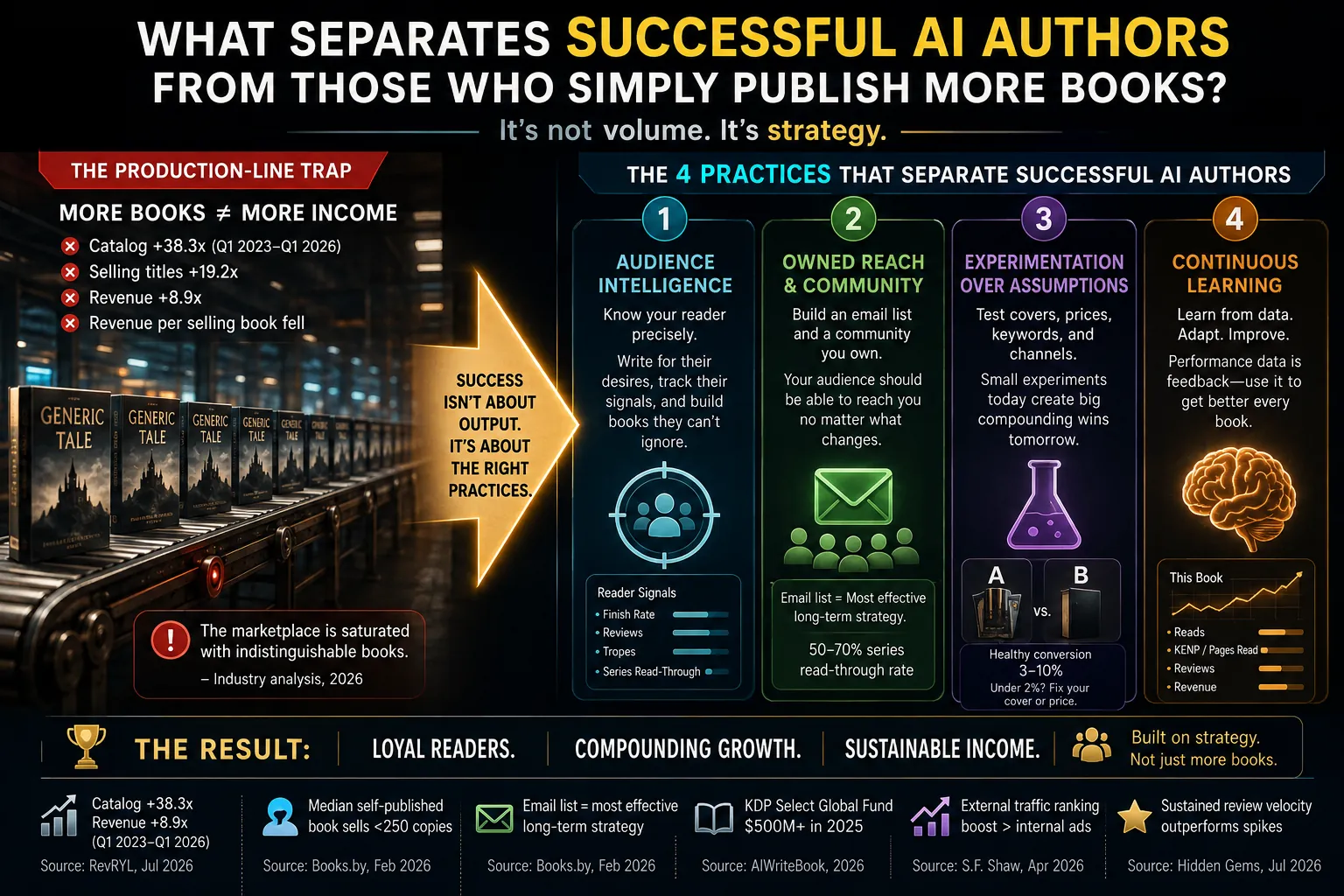
Volume feeds the pile. Audience intelligence pulls one book out of it.
The production-line trap
The data on AI publishing volume is unambiguous. In the study of 14,419 Amazon genre-fiction titles behind arXiv:2607.20349, the cumulative catalog grew 38.3 times between Q1 2023 and Q1 2026, the number of titles actually selling grew 19.2 times — and quarterly revenue grew only 8.9 times. Revenue per selling book fell, for AI books and human books alike. Meanwhile the median self-published book still sells fewer than 250 copies, a figure that has not budged since AI tools arrived, even as US self-published output reached 3.5 million titles in 2025 (the audience side of this problem is analyzed in why AI authors struggle to build audiences). As one 2026 industry analysis puts it, "the marketplace is not saturated with books. It is saturated with indistinguishable books." Publishing more feeds that sameness; it does not escape it — and the same market forces are covered from the discovery angle in why AI is making book discovery harder.
Factor one: audience intelligence
The authors who escape it pick a reader, not a genre. Precision targeting — a specific kind of story that a specific kind of reader recognizes — is outperforming broad-market positioning in 2026, and it is the strongest practical answer to indistinguishability. That means choosing the niche before the book, writing to its expectations, and reading the signals afterward: which titles readers finish, which reviews repeat, which tropes they name. AI authors have an advantage here — the production speed to test niches quickly — but only if the choice is intentional rather than random. Narrow positioning only compounds once the systems that decide by name can recognize it — the author-entity layer is your book isn't the problem; nobody knows you wrote it.
Factor two: content strategy
The second separator is the difference between a catalog and a pile. Series readers convert at high rates — commonly 50–70% from book one to book two — and in Kindle Unlimited, where authors are paid per page read (about $0.004–$0.0045 per page in early 2026), a 300-page book read cover to cover earns roughly $1.35, and a series that pulls readers through multiplies that per reader across every book. The economics favor books that feed a series, a world, or an author brand — not standalone titles scattered across niches. For the full income picture — medians, royalty math, and what AI books actually gross — see how much AI authors actually make in 2026.
The other owned asset is the email list. Across 2026 guides it is consistently named the most effective long-term strategy for indie authors: unlike social reach, it cannot be taken away by an algorithm change, and every launch compounds on the subscribers already collected. Consistency beats frequency — one genuine update every two weeks outperforms daily thin promotion. Building that list and the walls around it is the subject of how AI authors build a loyal audience.
Factor three: experimentation
Successful authors treat launch variables as tests. A healthy conversion rate on a listing is roughly 3–10%; if you sit below 2%, the diagnosis is usually the cover or the price, and the fix is a change, not another title. The same logic applies to channels: the effective pattern in 2026 is two or three channels done well — email plus one discovery channel — rather than presence everywhere.
The ranking layer rewards this discipline too. Amazon's current algorithm weights sustained conversion and organic review velocity over sudden spikes, and external traffic — readers you bring from an email list, a newsletter swap, or a community — now carries a ranking boost that practitioner reporting calls stronger than internal ads. Brought traffic converts into the branded searches that signal market gravity.
Factor four: continuous learning
The final separator is the loop itself. Amazon's ranking logic has moved from A9 to A10 with more weight on traffic source and sustained engagement, review velocity is measured over time rather than at launch, and the policy environment shifts continuously. Authors who treat each release as a data point — what converted, what the retention numbers said, which channel earned its cost — compound experience with every book. Authors who repeat the same launch learn nothing and fall further behind. The successful group, in the words of Mireya, marketing director at HMD Publishing, is the one that remembers "writing the book is only 50% of the journey. The other 50% is connecting that book with readers who will love it."
What to do this week
- If you publish more than one book a month, stop and choose a reader — one niche, one recognizable promise, before the next title.
- If you have no email list, start one — a reader magnet, one platform, a year of commitment.
- If a title underperforms, change the cover or the price before adding another title — under 2% conversion is a listing problem, not a quantity problem.
- If you are in Kindle Unlimited, write for the series, not the single — retention and catalog read-through are the economics.
- If your launches rely on spikes, replace them with sustained exposure — swaps, communities, and owned reach beat one-day bursts.
The reframe
This guide is the constructive answer to the four problems catalogued in the biggest problems AI authors face — the first of which, why every AI novel hits a wall after page ten, is a craft problem that structure-first drafting solves. The separating factor is not speed or volume — it is the decision to treat authorship as a reader business with a feedback loop. That difference is available to anyone, AI-assisted or not.
Volume without a feedback loop is not a strategy — it is the most expensive way to discover that you built an audience for nobody.
The four practices above are the audience side of the journey — the book still has to hold together once readers find it. See how Pacegram's story bible keeps a long manuscript consistent while you build the reader relationship.
SOURCES
- RevRYL — "AI Isn't Writing Better Books Than You. It's Just Writing More of Them." (23 Jul 2026; summary of the Stony Brook / Columbia / Michigan study, arXiv:2607.20349)
- arXiv:2607.20349 — working paper, v3 Aug 2026 (14,419 Amazon genre-fiction titles, 2023–2026)
- Books.by — "AI Tools for Self-Publishing [2026 Guide]" (Ash Davies, Feb 2026); "How to Market a Self-Published Book: 12 Strategies That Actually Work"
- Ford Mountain Publishing — "Navigating Publishing in 2026: From Self-Publishing to Visibility"
- S.F. Shaw — "Amazon KDP Algorithm Changes 2026: 11 New Rules for Authors" (15 Apr 2026)
- Hidden Gems Books — "How AI Is Changing Self-Publishing" (17 Jul 2026)
- AIWriteBook — "Kindle Unlimited Strategy: Maximize Your Page Reads" (2026)
- Vappingo — "KENP and Kindle Unlimited Page Reads: What You Earn" (2026)
- Page Publishing — "Best Book Publicity Strategies for Self-Published Authors in 2026"; WriteLight Group — "The Author's Guide to Book Marketing in 2026" (Feb 2026); HMD Publishing — "How to Market a Self Published Book: The Complete 2026" (quote: Mireya, Marketing Director); WriterCosmos — "Successful Self-Published Authors 2026"
- Publishers Weekly, Mar 2026 — Bowker ISBN data (self-published output 3.5M titles in 2025, +38.7% YoY)
Researched 13 Aug 2026 via Tavily. The article synthesizes the working-paper dataset (arXiv:2607.20349, via its 2026 journalistic summary in RevRYL and the working paper itself), industry guides, and practitioner reporting on Amazon's current ranking behavior. Figures are labeled where they come from a reported study or industry report rather than official first-party data. Pricing/rates (KU per-page, conversion benchmarks) are as reported in early-to-mid 2026 and change over time. No first-hand author-business testing is claimed; recommendations are criteria-based. The author is founder of Pacegram, a story-architecture tool for novelists; this article contains no product comparisons or promotion.