
Why Is AI Making Book Discovery Harder for Independent Authors?
How content saturation, algorithmic competition, and audience behavior are reshaping modern publishing.
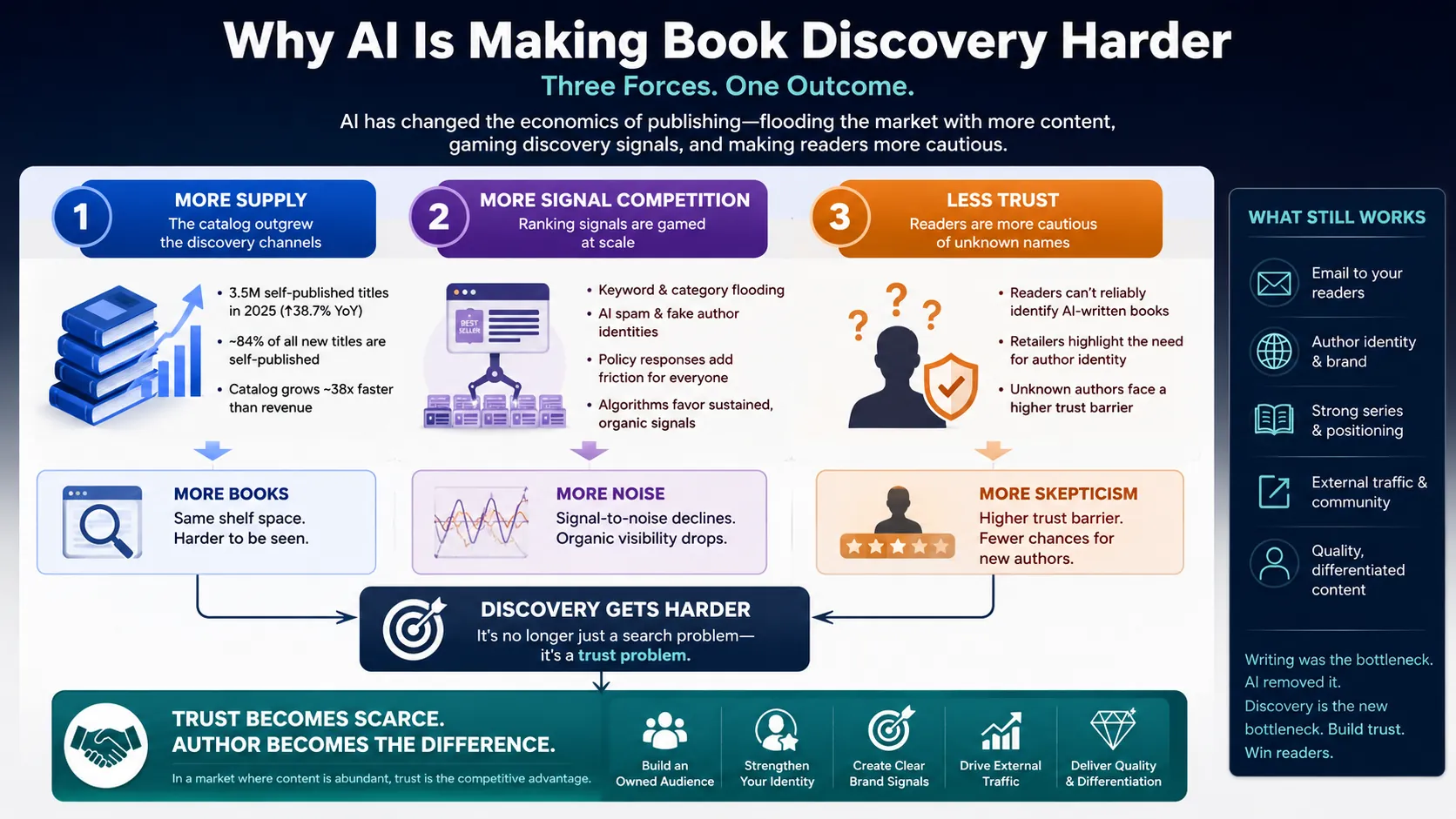
More titles compete for the same screen positions. Trust decides which one gets clicked.
The reframe: discovery is a signal problem, not a search problem
Bowker's ISBN data, reported by Publishers Weekly in March 2026, shows self-published output reached 3.5 million titles in 2025 — up 38.7% in a single year and roughly 84% of the entire catalog. A 2026 working paper analyzing 14,419 Amazon genre-fiction titles (arXiv:2607.20349) found roughly one in five contained substantial AI text, and the catalog grew far faster than revenue — by the study's figures, about 38 times as many titles against 9 times the revenue from early 2023 to early 2026.
Search-result pages and browse categories did not grow at that rate: every new title competes for the same screen positions. Industry surveys consistently rank discoverability as the single biggest challenge for self-published authors — 78%, by one 2026 roundup.
The signals algorithms rank on are being gamed at scale
Amazon's marketplace is, at its core, an algorithm trained to surface popular, highly-reviewed content — and, as Hidden Gems Books noted in July 2026, "it can be gamed at scale." The gaming happens in the metadata layer indie authors depend on — keywords, categories, descriptions. When low-quality AI publishers flood those keywords with dozens or hundreds of titles, the signal-to-noise ratio degrades and organic discovery drops with it. Hidden Gems calls the result "discoverability erosion": your book becomes harder to find organically even though nothing about your book changed.
In 2025, 404 Media documented AI-written mushroom-foraging guides on Amazon that could not reliably distinguish edible from toxic fungi — some under fake identities, including a "Dr. Kimberly Thorpe" whose 37 health titles cited credentials a university registrar could not confirm. Amazon removed the flagged titles only after journalists intervened — the same slot that surfaces a good indie novel can surface dangerous junk when signals are manufactured.
Amazon's response has been policy, not curation. Since September 2023 it caps new titles at three per day and requires AI disclosure, reserving the right to remove books that create a disappointing customer experience. By 2026 it weights sustained, organic review velocity over sudden spikes and penalizes unreadable, keyword-stuffed titles. They slow the flood but do not stop it: reporting from the German Kindle Unlimited market in March 2026 estimated 10,000–40,000 AI-declared titles enter KDP monthly, with enforcement "inconsistent."
The cost of this policy treadmill falls disproportionately on legitimate authors: the cap is a minor inconvenience to the operations it was meant to stop, and a genuine source of anxiety for authors who had nothing to do with the problem. Disclosure adds compliance work for everyone.
Reader behavior: suspicion raises the cost of being unknown
The third force is the reader. Readers cannot reliably tell AI prose from human prose — a Stony Brook study reported by the New York Times in July 2026 — yet they are surrounded by stories of AI impostor books. When Jane Friedman found titles falsely attributed to her in 2023, a fellow author told her she had reported 29 illegitimate books in a single week.
Suspicion changes behavior in ways that matter for discovery — retailers now treat authorship as a question. Barnes & Noble CEO James Daunt, defending his stance on labeled AI books in May 2026, said what matters is "clarity around who the author is and whether they're a real person" — and admitted that among the chain's 300,000 titles, "the chances are that some of those may be AI." When even the store cannot tell, readers fall back on names they trust: established authors, series, recommendations from people they know.
For an unknown independent author, that is the new economics of discovery: the scarce resource is no longer the page position but the reader's willingness to click an unfamiliar name in a market they have learned to be cautious about. Discovery stops being "will the algorithm show my book" and becomes "will a reader trust this name enough to try it." This reader-trust deficit is one of the four problems that replace writing once it gets easy — see the biggest problems AI authors face now — the underlying law is that a wealth of information creates a poverty of attention: everyone can write now thats exactly the problem.
What still works — and for whom
- If you have no audience yet: Kindle Unlimited can buy a first 90 days of exposure in genre lanes — but KU's economics reward catalog depth and prolific output, precisely the lane AI scales fastest. Treat KU as a test, not a plan.
- If you have any reader list: external traffic is among the highest-leverage ranking signals on Amazon — and the only one you own. A single email to your own readers does more for a launch than another round of metadata tweaking.
- If you compete on metadata alone: you are competing in the flooded lane. Lead the listing with the reader outcome rather than the writing process, and let verifiable authorship do the trust work the algorithm cannot.
- If you want durable discovery: build the loop I described in the audience-building guide — an owned list and reader signals that tell you what to write next. Thirty percent of self-published authors already sell direct, and another 30% plan to; the fallback channel is becoming the first one.
- If you want the single-book diagnosis: the market forces above explain the pile — this guide walks through why one specific book is invisible, with the fix order.
The reframe
Writing was the bottleneck, and AI removed it. Discovery was the next bottleneck, and AI is now flooding it — with supply, with manufactured signals, and with reader suspicion. The authors who get found are not the ones who optimized the catalog; they made themselves findable outside the algorithm — a known name, a verifiable identity, an audience that does not need a star rating to be convinced. In a market where discovery runs on trust, the author is the discovery channel. The known-name requirement behind that is the subject of your book isn't the problem; nobody knows you wrote it.
The four practices that separate the authors who win from the high-volume publishers are in what separates successful AI authors.Discovery used to be a search problem. AI turned it into a trust problem — and the author is now the discovery channel.
Discovery wins on the audience side — but the book still has to hold together once readers find it. See how Pacegram's story bible keeps a long manuscript consistent while you build the audience that makes you findable.
SOURCES
- Publishers Weekly — "Book Output Topped Four Million in 2025" (Mar 2026)
- Chakrabarty, Liu, Ginsburg & Dhillon — "Generative AI floods and dilutes the market for books," arXiv:2607.20349 (working paper, under review; v3 Aug 2026)
- Hidden Gems Books — "How AI Is Changing Self-Publishing" (17 Jul 2026)
- 404 Media — "Life or Death: AI-Generated Mushroom Foraging Books Are All Over Amazon" (2025)
- Los Angeles Times — "Barnes & Noble clarifies stance on AI-written books after blowback" (20 May 2026); Business Insider and NBC News coverage of the same statements (May 2026)
- AI Business — "The AI-generated Books Trend is Getting Worse" (2023; includes Jane Friedman's reported account and Theia Institute commentary)
- Amazon KDP policy summaries — three-per-day cap and AI-content disclosure (effective Sep 2023); Inkfluence AI — "Amazon KDP AI Policy 2026: What to Disclose" (May 2026)
- Literary Queens — "Navigating the AI Slop: Dominating the Evolving German KU Market for Indie Authors" (Mar 2026)
- BestWriting — "43 Self-Publishing Statistics for 2026"
- Darkroom Agency — "How Amazon SEO Works: The 2026 Listing Optimization Guide"; S.F. Shaw — "Amazon KDP Algorithm Changes 2026: 11 New Rules for Authors" (Apr 2026)
- getebook.ai — "Kindle Unlimited Strategy: How Indie Authors Actually Earn $5K+/Month" (2026); Inkfluence AI — "Gumroad vs Amazon KDP for AI Ebooks (2026 Comparison)" (May 2026)
- The New York Times — "How A.I. Books Sneak Their Way Into Stores" (28 Jul 2026)
- ALLi 2026 direct-sales survey data
Researched August 2026 via Tavily. Statistics are quoted with source and date; the arXiv study is a working paper under review and is labeled as such, with the 38x/9x figures attributed as the study's reported figures. Algorithm-behavior claims (keyword-stuffing penalties, external-traffic weighting, review-velocity weighting) reflect practitioner and industry reporting from 2026 and are labeled as such rather than presented as official Amazon documentation. The German-market estimate (10,000–40,000 monthly AI-declared titles) is single-outlet reporting and is labeled accordingly. No first-hand product testing is claimed.