
You Published the Book. Now Comes the Hard Part.
Why AI authors are discovering that writing is only half the battle.
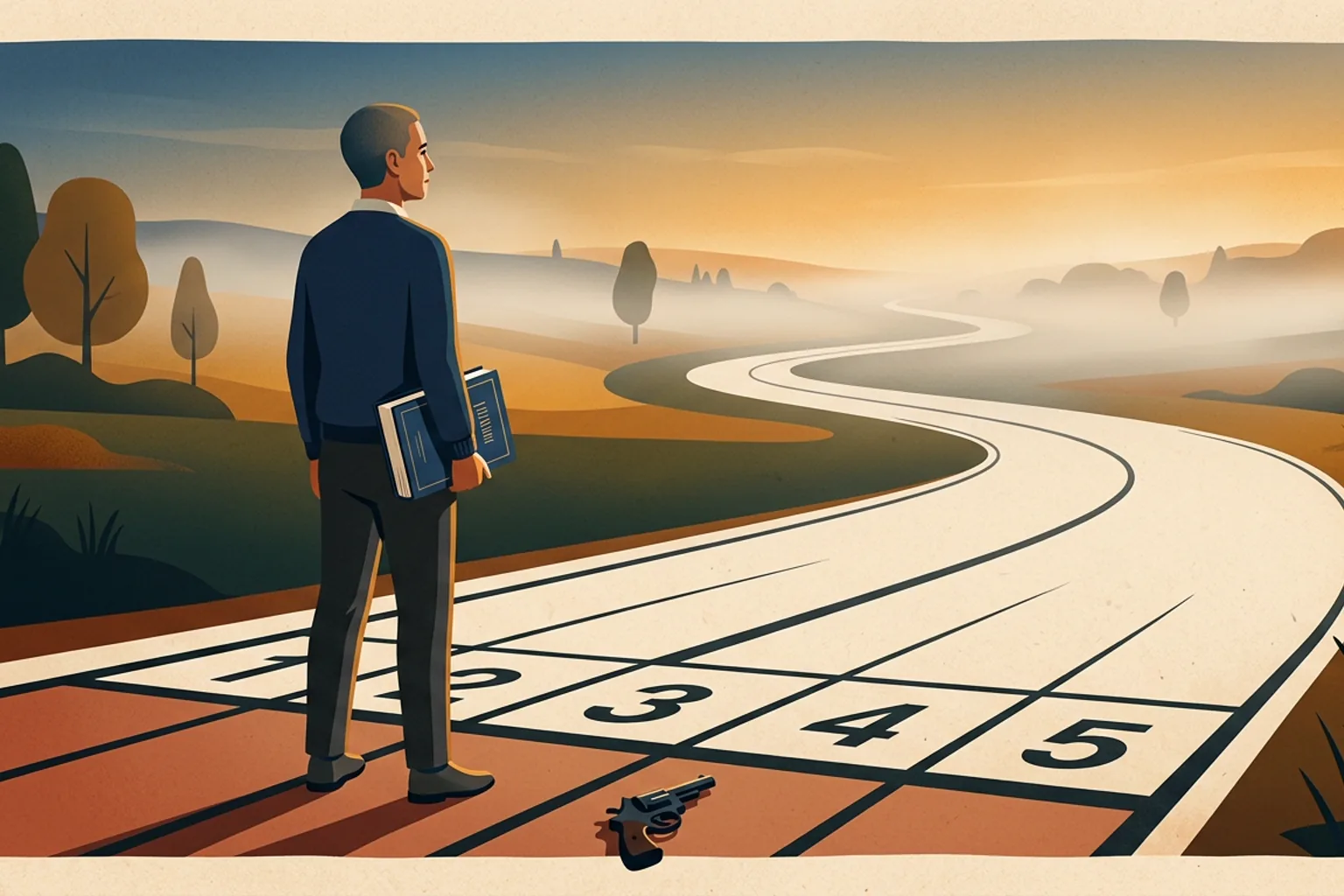
The book behind them is done. The road ahead is empty and long.
The finish-line fallacy
Most of us built our mental model around the wrong bottleneck. When a manuscript took months of labor, reaching "The End" felt like the whole job — and AI made that belief more dangerous, not less. The production economics collapsed: roughly 3.5 million self-published titles carried ISBNs in 2025 against about 10,000 from traditional houses, and total US output passed 4.17 million titles, up 32.5% in a single year. By 2026, about one in five new releases contained substantial AI text — near zero three years earlier. Catalog growth ran 38.3× while revenue grew 8.9×. None of that lowered the barrier to being read. The flood did not make finding readers easier; it made it harder — the supply shock at the center of the biggest problems AI authors face.
Where the hard part actually is
Ask self-published authors to name their single biggest challenge and 78% say discoverability. Another 65% say marketing. The numbers behind them are blunt: the median self-published book sells fewer than 250 lifetime copies, and 90% sell fewer than 100. Income has the same shape — 35–40% of self-published authors earn between $1 and $999 a year, 10–15% earn nothing at all, and only 1–2% reach six figures.
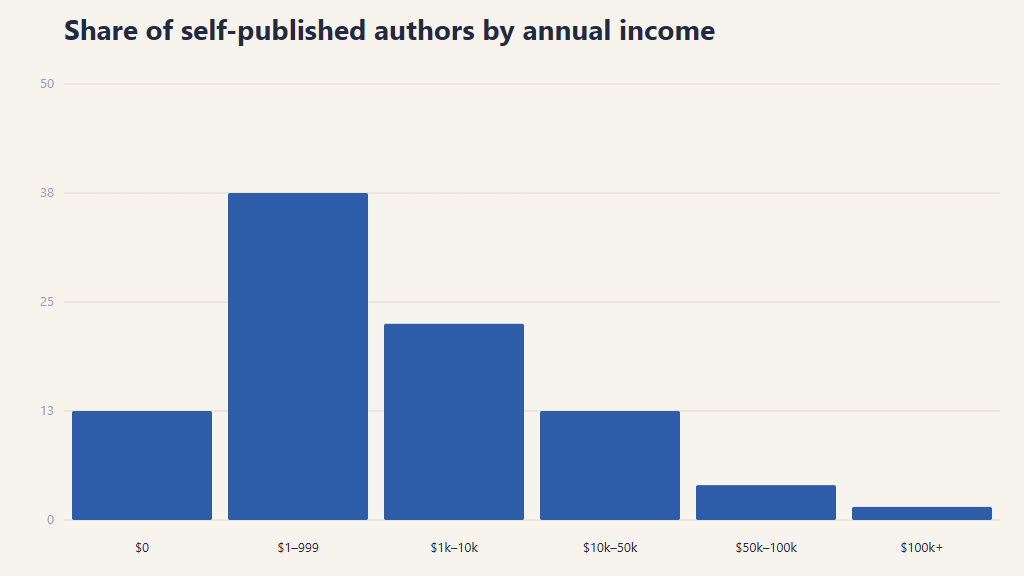
Books.by 2026 income bands, plotted at range midpoints: the distribution is the hard part, in one chart.
The contrast that matters sits inside that distribution: authors who publish regularly and market deliberately earn a median of $12,000–15,000 a year, while the median across everyone else is under $1,000. The difference between those two rows is not talent. It is whether the second half of the job got done. Crucially, none of this moved after AI tools became mainstream; median sales are unchanged since before they were widely available. The books did not get worse. The job they require got bigger.
Why the second half is structurally harder
This is the part the finish-line model gets wrong. Writing is a closed system: you control the inputs — outline, scenes, prose — and the output follows. AI collapsed the cost of that system, which is why publishing felt like success. What comes after publication is an open system. You do not control the inputs (marketplace algorithms, recommender behavior, reader attention) and you cannot force the outcomes. The scarcity argument anticipated this decades ago: a wealth of information creates a poverty of attention — the law we examined when we asked why attention is the scarce resource now that everyone can write. You are no longer competing with other manuscripts; you are competing with everything that demands attention. And the tool that collapsed your writing cost cannot collapse this one: no AI tool will find your readers for you. Add the trust layer — readers now presume AI involvement until proven otherwise — and the open system grows another wall.
| Dimension | Writing the book | After publication |
|---|---|---|
| System type | Closed — you control inputs and output | Open — algorithms, platforms, readers decide |
| Outcome control | High — effort maps to result | Low — you can do everything right and still wait |
| What AI changed | Collapsed the cost of producing the book | Nothing yet — an audience is still built by hand |
| Payoff shape | Linear — finish, ship, done | Compounding — delayed, builds over months |
| Failure mode | An unfinished manuscript | An unfindable book |
The job changes shape at publication — from a system you control to one you negotiate with.
What the second half looks like in practice
The industry has converged on a 90-day frame: launch week is "actually the starting gun," not a one-day event, and the campaign extends well past release. In practice that means sustained effort with a real time cost — hours of audience research, daily social content, ad-platform testing. Many authors discover this only after release; as one guide dryly puts it, the realization lands right after the celebratory prosecco. It is also the axis on which outcomes actually split: the difference between obscurity and success is marketing execution, not quality. The retail context is thinning at the same time: big retailers carry fewer independent titles, not because of quality but because they prioritize fewer, larger books. Meanwhile the direct channel — highest margins, full ownership of reader data — is the fastest-growing segment. The practical build-out of that post-publication loop is what we called the Four Walls framework for a loyal audience.
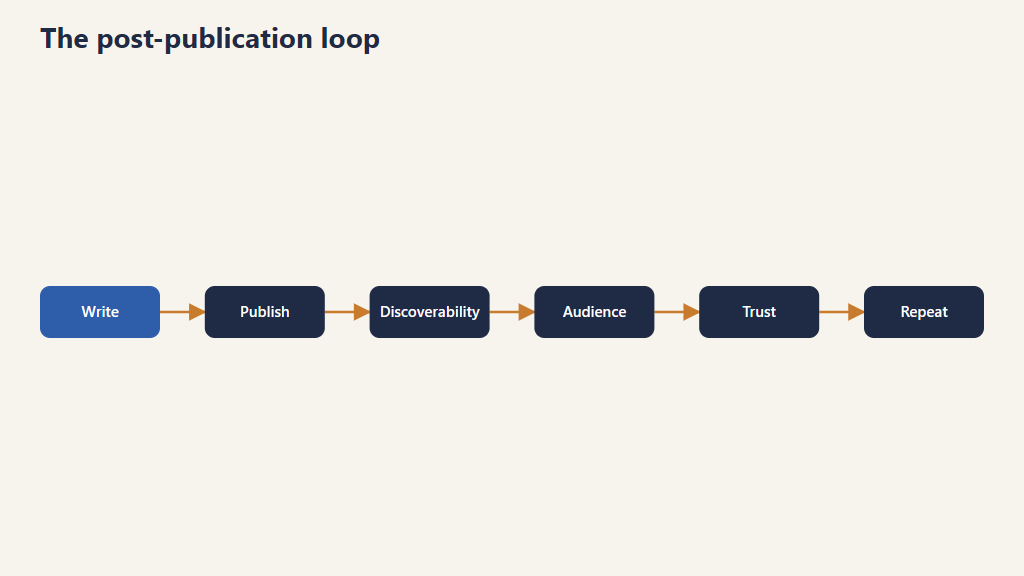
Publication starts a loop, not a finish line.
The reframe
The question to carry into every release is not "is the book good?" — that is settled at publication. The question is "who knows this exists, and why would they trust it?" Authors who navigate the second half treat the book not as a destination but as a membership card into a reader relationship — the entity and trust layer we detailed in your book isn't the problem; nobody knows you wrote it. The book itself is, in the blunt phrasing of one assessment, "the least important part of the process" — the work is in becoming findable, being present, and compounding trust over time.
The release-day reframe
- Writing was the closed system — AI collapsed its cost, and that is why publishing felt like arrival.
- Publication starts an open system — algorithms, platforms, and readers decide; no tool can force it.
- Run the 90-day campaign — launch week is the starting gun, not the finish line.
- Ask the one question that matters: who knows this exists, and why would they trust it?
Writing was half the battle, and you already won it. The second half does not begin after the book; it begins the moment the book is live — and it now includes being able to prove how the book was made, the provenance discipline we mapped in your book deal just got rescinded. Treat release as a starting gun rather than a finish line, and you stop ending your effort — you start the loop that a career is built on. The income side of that loop, with the honest numbers, is in how much AI authors actually make in 2026. Each pass through it compounds: a known name sells the next book to readers who already trust it, and the loop feeds itself.
Publication is not the finish line. It is the starting gun.
The second half starts the moment the book is live — and a consistent story is what keeps the first half worth doing at all. See how Pacegram's story bible keeps a long manuscript coherent while you build the audience that carries it.
SOURCES
- BestWriting — Self Publishing Statistics (2026). https://bestwriting.com/self-publishing-statistics
- RevRYL / Chakrabarty, Ginsburg, Dhillon, Liu — "Generative AI Floods and Dilutes the Market for Books," arXiv:2607.20349 (22 Jul 2026). https://arxiv.org/abs/2607.20349
- Books.by — AI Tools for Self-Publishing (2026); Self-Publishing Income (2026). https://books.by/guides/ai-tools-for-self-publishing ; https://books.by/guides/self-publishing-income
- WriteLight Group — The Author's Guide to Book Marketing in 2026 (Feb 2026). https://writelightgroup.com/2026/02/authors-guide-book-marketing-2026
- ManuscriptReport — AI Book Marketing: Complete Author Guide (2026). https://manuscriptreport.com/blog/ai-book-marketing-complete-guide
- BookBaby — The Year in Book Selling (2025/2026). https://blog.bookbaby.com/how-to-self-publish/self-publishing/the-year-in-book-selling
- David Gaughran — How To Self-Publish A Book In 10 Steps (2026). https://davidgaughran.com/lets-get-digital-how-to-self-publish-guide-free
- Book Launchers (Julie Broad) — 5 Hard Truths Self-Published Authors Must Face in 2026 (Dec 2025). https://www.youtube.com/watch?v=9ESFP981WtE
- Tim Denning — on why self-published books fail without an audience (2026), via prior article ledger.
- Ford Mountain Publishing — discoverability and attention (2026), via prior article ledger.
Researched 16 Aug 2026 via Tavily (queries on post-publication marketing, income reality, AI-author discoverability, and marketing-vs-quality failure data). Income chart plotted at the midpoints of Books.by's published ranges and labeled as such; the catalog-vs-revenue and AI-text-share figures come from the arXiv:2607.20349 study as reported by RevRYL, consistent with the ledger used in prior articles. The WriteLight "starting gun" and Books.by "no AI tool will find your readers" phrases are quoted verbatim from those sources. The closed-system/open-system distinction is this article's original synthesis — an explanatory frame, not a sourced statistic. No first-hand marketing testing is claimed. The author is the founder of Pacegram, a story-architecture tool for novelists; this article contains no product comparisons or promotion.