
Character Drift: Why AI Characters Change Personality (and How to Stop It)
The shy protagonist becomes a loud extrovert by chapter twelve. The villain's eye color changes three times. Drift is the most common failure in AI-assisted novels — and it is not a prompt problem.
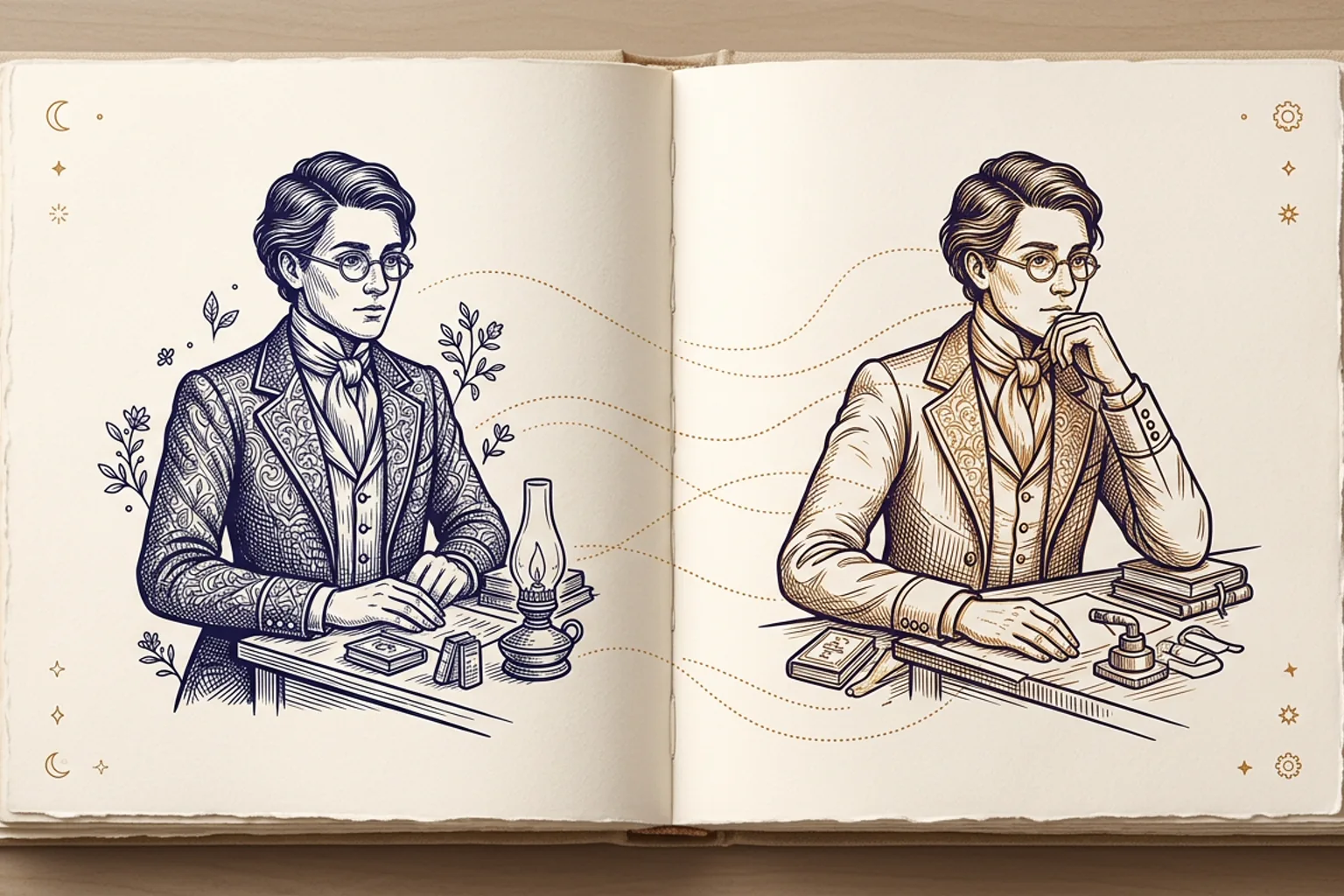
The prose stays consistent. The person does not.
Push an AI past chapter ten and you will recognize the moment. The character who was hesitant and quiet is suddenly delivering rousing speeches. The detective develops telepathy no one mentioned. The orphan's parents appear in chapter eleven. The prose is fine. The person is not the same person.
Character drift is the number one consistency failure in AI-assisted fiction, and readers now catch and punish it — "the main character had green eyes in chapter 3 and brown eyes in chapter 18. The author clearly didn't even read their own book." One star. The book is not the only thing being judged; the author is.
What character drift actually is
Drift is not one failure but four compounding ones: physical description drift — the villain's eyes change color, the hero's scar migrates; personality drift — the shy protagonist becomes an extrovert, the composed detective turns volatile; motivation drift — characters act against the goals that were set up in act one; and knowledge drift — characters know or forget things they should not.
The root of all four is the same limit: a language model has no persistent memory, and a bigger context window does not give it one — a window that holds your manuscript is not your story's memory.
The danger is that drift is self-reinforcing. By the time it becomes noticeable it is embedded across chapters — the AI is no longer contradicting your original character; it is being consistent with its own drifted version, which makes it harder to diagnose and fix than a single bad chapter.
The capability gap that makes drift inevitable — and the honest limits of every AI novel tool against it — is covered in what an AI novel writer can actually do.
Why it happens: the stateless writer
The mechanism is architectural, not psychological. When you ask an AI to write the next chapter, it operates as a stateless function: it has no built-in memory of what it generated yesterday, what your character looks like, or what you established in chapter one. It works only with what you put in the current prompt.
Within that limitation, two forces produce drift. The first is statistical defaulting: when a specific detail has fallen out of the available context, the model fills the gap with the most statistically ordinary trait — which is why characters drift toward generic personalities and conventional descriptions. The second is recency bias: when your character sheet says green eyes but the last several chapters describe brown, the model follows the more recent, more prominent context. The sheet exists; it loses the tug-of-war.
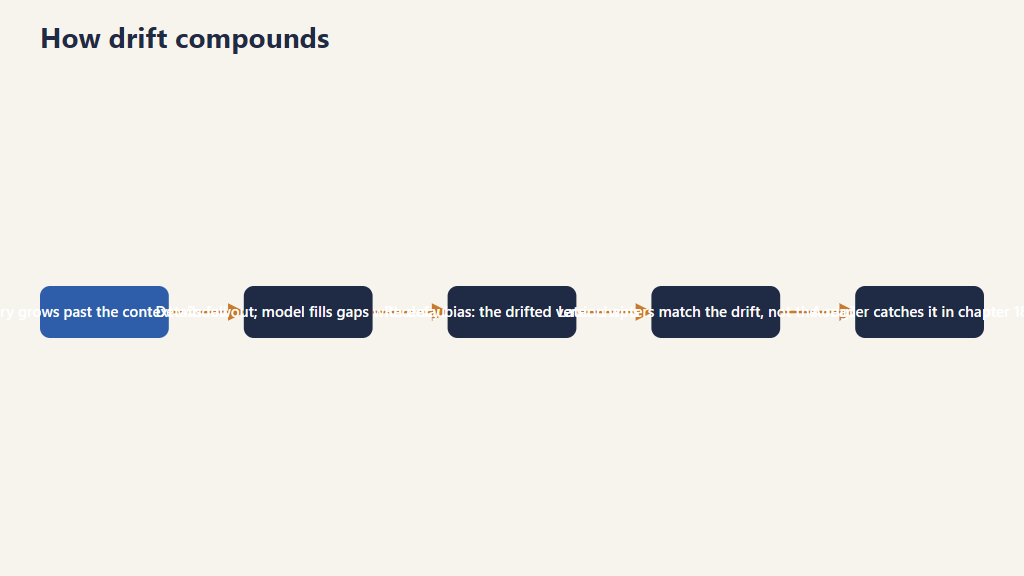
Drift is not a one-time mistake. It compounds, chapter over chapter.
You have probably seen this failure in the wild: a novelist on the OpenAI forums reported ChatGPT forgetting a character mid-chat — even after the character file was re-uploaded and the model told to read it, it still described the character wrong. The reference was present. The recency bias won.
Why the fixes that don't work fail
This is why the common advice is incomplete. "Keep a character sheet" is right in principle and unreliable in practice: a sheet is passive reference. Nothing forces the model to prioritize it over conflicting narrative context. "Just write a better prompt" fails the same way — the problem is not the instruction, it is the absence of enforced context.
The same pattern appears across every generative medium. In AI illustration, "hair colors change, outfits morph, facial features drift" is the number one complaint; in video, a character can grow a new face between scenes, and the blunt advice is: don't rely on the model to keep track of anything. You, the human, are the continuity department.
The fixes that work
The fixes that survive real manuscripts all do the same thing: give the model a stable, prioritized reference that outranks whatever is drifting.
Keep the character bible short. Five to seven key anchors — physical details, three to five core personality traits, the long-term goal, the short-term goal, and the fear. Twenty-plus details get ignored; a compact sheet survives. Add three anchor scenes — claustrophobia demonstrated in an elevator is worth a paragraph of adjectives.
Paste the description word for word into every generation. Do not paraphrase it — paraphrase is where drift begins, because each retelling drifts slightly and the deltas accumulate.
Run the three-test rule on every chapter: would this character actually say this? Do their choices match their goals? Are physical and logistical details consistent? It takes minutes per chapter and catches the weirdness before a reader does.
For series, feed the end of the previous book — or a summary plus the bible — back into the generation context, so the sequel inherits the established voice and state.
Change one thing at a time when debugging a drifting scene: fix the reference and rewrite the prompt simultaneously and you will never know which change worked.
| Fix | What it does | Why it works |
|---|---|---|
| Short character bible (5-7 anchors) | Physical anchors, 3-5 core traits, motivations and fear | A compact sheet survives context; 20+ details get ignored |
| Identical description, word for word | Paste the same text into every generation | Removes the drift between paraphrased versions |
| Anchor scenes | 3 scenes that lock behavior early | Traits shown, not just stated |
| The 3-test rule per chapter | Dialogue, action, and continuity checks | Catches drift in minutes, per chapter |
| Series lock-in | Feed the prior book's end + bible into the sequel | The model inherits established voice and state |
| Enforcement-based tooling | The story bible is injected and enforced per chapter | A passive sheet loses to recency; enforced context doesn't |
The fixes all do the same thing: give the model a stable reference that outranks whatever is drifting.
The structural difference
There is a limit to hand-maintained fixes. Every one of them — the sheet, the paste-back, the per-chapter tests — is manual context management. The stronger answer is structural: a system where the story bible is a living document that every chapter is drafted against, injected into every generation and enforced rather than merely referenced, so the book stops depending on your clipboard discipline. That is the difference between managing drift and not having it in the first place. The working method around these fixes is laid out in how to use an AI novel writing assistant, and the failure mode itself is dissected in why every AI novel hits a wall — one of the four structural problems catalogued in the biggest problems AI authors face.
The honest summary: drift is not a sign of bad prompting. It is the default behavior of a stateless tool asked to write a book. The authors who finish books that hold together are the ones who stopped asking the tool to remember — and built the memory somewhere else.
Key takeaways
- Drift is architectural: a stateless model fills lost details with defaults and follows recent context over your character sheet.
- It compounds — the AI becomes consistent with its own drifted version, so catch it early.
- Fixes that work: short bibles, word-for-word descriptions, anchor scenes, the three-test rule, series lock-in.
- A passive sheet loses to recency bias. Enforced context is the structural fix.
Drift is not a sign that you prompted badly. It is the default behavior of a stateless tool asked to write a book.
When a draft reaches this point, the question is whether the words are worth keeping — and they usually are. The rescue workflow for a 45,000-word draft shows how to bring it back without starting over.
The character bible only works if the drafting system actually reads it. Pacegram holds characters, world, and voice — and drafts every chapter against them.
SOURCES
- WriteAIBook — "AI Character Consistency for KDP: Fix Chapter Drift" (Feb 2026). https://www.writeaibook.com/blog/how-ai-novel-generators-handle-character-consistency.html
- Novarrium — "AI Character Consistency: Why AI Forgets Your Characters". https://novarrium.com/blog/ai-character-consistency
- Novarrium — "Self-Publishing an AI Novel? Fix This First." https://novarrium.com/blog/self-publishing-ai-novel-consistency
- Novarrium via Indie Hackers — "I built an AI that writes full-length novels with consistent characters." https://www.indiehackers.com/post/i-built-an-ai-that-writes-full-length-novels-with-consistent-characters-heres-what-i-learned-f0d3211a8a
- Neolemon — "How to Keep Multiple Characters Consistent in Storybooks with AI". https://www.neolemon.com/blog/keep-multiple-characters-consistent-in-storybooks-with-ai
- "Consistent AI Characters: My Proven 5 Step System" (YouTube). https://www.youtube.com/watch?v=f7g9smAe-xY
- OpenBlueprint via Quora — "How do you maintain character consistency in AI-generated videos?" https://www.quora.com/How-do-you-maintain-character-consistency-in-AI-generated-videos
- James Gill — "ChatGPT couldn't write my novel for me" (LinkedIn). https://www.linkedin.com/pulse/chatgpt-couldnt-write-my-novel-me-james-gill
- OpenAI Developer Community — "Novel writing and addressing the limits of ChatGPT". https://community.openai.com/t/novel-writing-and-addressing-the-limits-of-chatgpt/419138
Researched 18 Aug 2026 via Tavily (queries on AI characters changing personality, character-consistency failures, and drift fixes). The four-dimension taxonomy and the "stateless function" mechanism are synthesized from Novarrium's engineering analysis and corroborated by WriteAIBook's workflow guide; the recency-bias mechanism is directly supported by the OpenAI forum case. Cross-domain evidence (illustration, video) is used deliberately to show the mechanism is model-level, not tool-level. The fix table synthesizes WriteAIBook, the visual-AI continuity-ladder method, and Novarrium's enforcement distinction; the "enforcement vs passive reference" framing is this article's synthesis of those sources. The review-quote example ("green eyes… brown eyes") is presented as the reported example of the review pattern, not a verbatim published review. No fabricated quotes, statistics, or sources. The author is the founder of Pacegram, a story-architecture tool for novelists; the enforcement distinction is where the article's own subject is relevant, and it is stated as a recommendation.
Because drift fixes start with locking characters where the plan is checked, start with a proper novel outline before the first chapter. How to write a novel outline.