
How to Write a Novel Outline: 5 Methods That Survive a Long Draft
By Elias Rowan · 27 August 2026
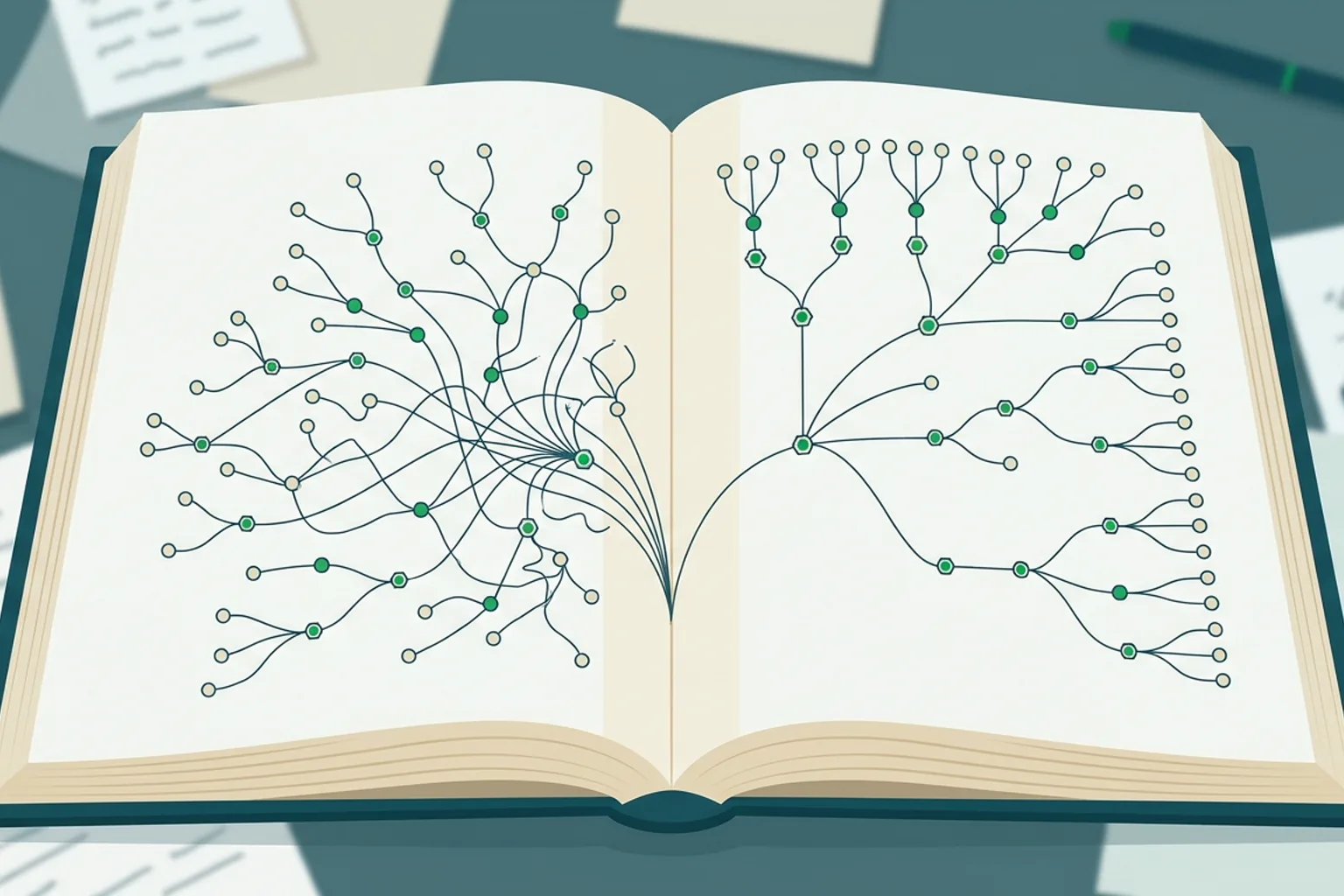
The outline is the only structure that survives a 90,000-word draft. Here are the five methods that actually work, how to choose, and why outlining matters more than ever now that so much drafting is done with help from a machine that forgets.
The outline is the only structure that survives a 90,000-word draft. Here are the five methods that actually work, how to choose, and why outlining matters more than ever now that so much drafting is done with help from a machine that forgets.
An outline is a plan for a story that is longer than your working memory can hold. Every method below is a different answer to that one problem: how do you lock in decisions so they stop needing to be remembered? Choose the one that fits how your mind works, and let the story grow against structure instead of hoping it survives by luck.
Key takeaways
• A novel outline is a decision ledger, not a summary. Its job is to make choices you only want to make once.
• There is no objectively best method — method choice should follow whether you're more comfortable front-loading work into planning or back-loading it into revision.
• The four named frameworks — Three-Act, Save the Cat's 15 beats, the Snowflake, and scene cards — cover the real range from freest to most rigid.
• Most published novelists use a hybrid, and combining methods is normal, not a failure of commitment.
• Outlining stops being optional the moment a draft outlives a single attention span — and that is doubly true when the prose is being drafted with AI, whose own context limits make the outline the load-bearing structure.
Table of contents
- What an outline actually is
- The four named methods (and the spectrum between them)
- How to choose the method for you
- The mechanism: why an outline keeps a long draft alive
- When AI does the drafting, the outline becomes the memory
- A worked example: outlining one novel all four ways
- Common mistakes (and how to avoid them)
- Frequently asked questions
- Methodology
What an outline actually is
Try to hold a 90,000-word novel in your head at once. You cannot. Nobody can. A novel is not one idea held in attention; it is a sequence of roughly two to four hundred scenes whose pieces must stay consistent with each other across weeks or months of writing.
The outline exists because of that gap. It is the place where the decisions that cost the most to change — the premise, the central conflict, the protagonist's arc, the ending — get made once, on purpose, instead of discovered by accident in chapter forty. Every good method is a system for making those expensive decisions, and for recording them in a form you can consult while your attention is on the sentence in front of you.
Once you see the outline as a decision ledger rather than a scanty summary, a lot of the mythology around it dissolves. It is not about removing surprise from writing. It is about removing the need to remember — which is the same core insight behind why AI novels hit a wall after page ten. Surprise can still live in a scene; the outline just means you don't have to re-decide the hero's core trait every other chapter to keep them consistent.
There is a sharper, recent version of this point. Mechanical models trained to complete text have the same memory limitation as a human at a desk — only worse, and hidden. When a machine drafts the prose, the outline stops being a nice-to-have for the human author and becomes the only thing standing between a coherent book and a collection of well-written scenes — and it changes what you would even call an AI book generator honestly. I will come back to that.
The four named methods (and the spectrum between them)
Before the methods, one correction. Writers are often sorted into two camps — "plotters" who outline and "pantsers" who don't. It is a false binary. Almost everyone sits somewhere on a spectrum between total plotting and total pantsing, and the useful question is not "which camp are you in" but "where on that spectrum does your best work come from". The four methods below do not represent four types of person; they represent four dial settings you can turn up or down.
The Three-Act Structure divides a novel into setup, confrontation, and resolution, each anchored around one or more turning points. It is the loosest of the named methods because it says nothing about how many scenes you need or what each one must do — it only fixes the big shape.
This is the right dial if you want structure without restraint: you know the inciting incident, the midpoint, the act-two break, the climax, and the resolution, and you discover everything between them as you write. It suits writers who want a skeleton but not a cage, and it is a genuinely useful starting point even if you eventually tighten it with beats or scene cards.
Save the Cat, from screenwriter Blake Snyder, expands the Three-Act shape into fifteen named beats, each with a function and a rough position in the story: Opening Image, Theme Stated, Set-Up, Catalyst, Debate, Break into Two, B Story, Fun and Games, Midpoint, Bad Guys Close In, All Is Lost, Dark Night of the Soul, Break into Three, Finale, and Final Image. It identifies where the second act's dreaded sag falls and gives you emotional guideposts to thread through the middle.
The beats are more specific than the Three-Act but still general enough to apply across genres — the machinery for screenplays translates to novels, with room for subplots, internal monologue, and more points of view. Novelists who say outlining killed their story's surprise usually mean the wrong method; the beat sheet gives you a rhythm, not a transcript.
The Snowflake, created by Randy Ingermanson, grows a novel from a single sentence outward in ten steps: a one-sentence summary, then a paragraph, then character sheets, then a fuller paragraph per earlier sentence, then character descriptions, a synopsis, character charts, a scene list, scene descriptions — and only then the first draft.
Its genius is that it front-loads in the opposite direction from a beat sheet. Where Save the Cat starts with the story's shape, the Snowflake starts with the premise and the characters and lets the structure emerge as it branches outward. It is the most individually tailored method, prized by writers who want the premise to grow into a book before committing to a rigid scaffold.
The scene-card method plans the most: each scene of the novel becomes a card — a beat, a location, the characters present, the point of view, what changes by the end of the scene — and the outline is the full ordered deck. Movement between scenes is planned too, so pacing is decided up front rather than by instinct. If you want this dial in a ready-to-fill form, our book outline template turns every scene card into a single question — why does this scene need to exist — so the plan is explicit before you draft a word.
This is the dial for writers who want to draft fast and clean because the plan is complete, or who suffer from saggy middle acts and need the connective tissue visible before they write it. It is also the closest to what long-form AI drafting needs, because the outline is carrying almost the entire load of consistency — more on that below.
None of these is correct in isolation. The Editor World guide puts it plainly: "most experienced novelists use a hybrid — a beat sheet to establish structure, expanded Snowflake-style into a synopsis, then broken into scene cards for the actual drafting". Combining methods is normal. The outline is a tool, not a tribe to join.
How to choose the method for you
Ask three questions, in order.
One: how much do you trust your instincts mid-draft? If you can hold a story's shape in your head and only drift occasionally, the Three-Act or a light beat sheet carries you. If the middle always collapses on you, you need the middle spelled out — scenes cards or a full beat sheet instead of a bare Three-Act.
Two: where do you prefer to spend your effort? Outlining is front-loaded work: you spend weeks planning so the draft comes out clean. Discovery writing is back-loaded: you start the draft immediately, then spend a long time reworking it in revision. Neither is lazy. The right choice is the one you can sustain for a full manuscript.
Three: how does your premise want to be grown? A premise that lives in its characters rewards the Snowflake's outward growth. A premise that is fundamentally about shape and pacing rewards the beat sheet. Let the material decide the method, not fashion.
There is no objectively best method — only the one that produces an outline you can actually draft from, in time you can afford to spend planning. The warning worth heeding is different: set a deadline for outlining. Left unchecked, a detailed outline can become the project itself, and you spend months planning a book you never begin. An outline that costs more to build than it saves in drafting has failed its job.
The mechanism: why an outline keeps a long draft alive
Understanding why outlining works makes you better at choosing and using the methods.
The core reason an outline protects a long draft is that it converts living memory into durable record. Every time you do not have to re-decide something, you free attention for the prose. The research on how even powerful text models handle long context is a sharp illustration of the underlying human problem — and it is the mechanism behind such problems as character drift and the gap between context window and story memory. any system — brain or model — recalls the start and end of a long stretch far better than the middle, and the failure lands exactly where a novel's second act sits. Performance on long inputs degrades not because the material is absent but because using it reliably at length is genuinely hard.
An outline is the workaround for that. It is an external store of the decisions that matter, so that whether you are writing page 40 or page 400, the same corrected version of the story is available to you. This is why character consistency problems crop up in the middle of a draft — the hero's eye color changes, a motivation quietly rewrites itself — and why an outline, by fixing the anchors once, prevents the most expensive class of error entirely.
The deeper framing comes from the writing community's own vocabulary. Writers describe discovery writers as "long-form plotters" — writers who in effect plan, but during revision rather than before it, doing the same consistency work later, at higher cost. The outline does not add work to writing. It moves the expensive part of the work to the point where it is cheapest to do.
When AI does the drafting, the outline becomes the memory
Everything above becomes more urgent — and more literal — when the prose is drafted with AI.
Here is the specific reason. A language model generates text the way it does partly because of what it can hold at once, and a 100,000-word novel is roughly 130,000 to 150,000 tokens — too much for the model to "remember" the way it remembers a prompt. Even with large context windows, research shows the model recalls the start and end of the material far better than the middle, and performance degrades as the input grows even when retrieval is perfect. And crucially, "there is no mechanism inside an LLM that says this is a hard constraint" — nothing in the generation process enforces that the hero's eye color stays fixed between chapters.
This is not a hypothetical. In a 2026 trial of four leading AI tools over twenty-five chapters, every tool produced consistency errors by around chapter fifteen — most commonly a character trait that silently changed. Automated tests confirm the same pattern: consistency errors cluster in the middle of long narratives, with even the best model still erroring considerably.
So the outline, for an AI-assisted draft, is not advice. It is the mechanism. The academic work on long-form story generation makes the point directly: coarse or rigid outlines are a known failure source for long-form AI, and the successful systems fuse the plan and the writing together, keeping story state outside the generation step itself. That is exactly what a human-written outline does — it holds the decisions the machine cannot hold, so the machine can spend its attention on prose.
The practical rule for an author drafting with AI: decide more in the outline than you would for a solo draft, not less. Fix the character anchors, the thematic spine, and the scene-by-scene plan before any prose is generated. Then every generated scene is checked against the outline rather than against a memory neither you nor the model can be trusted to hold. This is why a tool can generate 50,000 words and still not a good book — the draft outgrew its plan. You are, in effect, writing the book twice — once thin in the outline, once full in the draft — and that duplication is precisely what stops the draft from collapsing under its own length. The specifics of making an outline do that job for a machine — what it must carry, and how to feed it scene by scene — are in how to outline a book for AI.
A worked example: outlining one novel all four ways
Take a premise: a retired codebreaker is pulled back when an encryption she designed twenty years ago starts appearing in ransom demands. The setup is identical. The outline method changes where the work happens.
Three-Act: You fix the inciting incident (the first ransom demand is signed with your encryption), the midpoint (she realizes the attacker is a protégé she trained), the act-two break (she's falsely implicated), and the climax. Everything between is discovery. Two plot threads she cares about might collapse in act two — but with only the big shape fixed, you spend revision finding and fixing them.
Save the Cat: You map the fifteen beats onto the same story — the Debate is "do I go back?" the Midpoint is the protégé reveal, All Is Lost is when she's blamed. Now the middle act has explicit emotional guideposts, so the sagging structure is gone before you draft it.
Snowflake: You start with the one-sentence premise and grow it: a paragraph on the codebreaker and the mentor-protégé relationship, character sheets for both, a synopsis, then a scene list. You discover the thematic spine as the snowflake expands, and you don't pin the rigid scaffold until the story feels fully grown.
Scene cards: You write forty cards, each a scene with its POV, setting, and what changes. The daughter who inherits the encryption is written in as its own subplot thread. Pacing is decided up front. The draft is slower to plan and fastest to write — and it is the only one of the four that is complete enough to hand to an AI as a reliable contract before generation.
All four improve the same book; they just move the effort.
Common mistakes (and how to avoid them)
Treating the outline as a cage. An outline is a plan, not a verdict. When writing reveals a better ending, the plan should change.
Building the outline forever. Set a deadline. An outline that never becomes a draft is a hobby, not a plan.
Berating yourself for parts that don't fit one method. Hybrids are the norm; keep the beat sheet for shape and scene cards where you need them.
Confusing the outline's job. It is a decision ledger, not a summary. If reading your outline doesn't tell you why a scene exists, it isn't carrying its weight. If you are looking at an already-written draft, the fix is to build the outline afterward and not throw away your AI draft — restructure it, don't discard it.
Handing an AI an empty or vague outline and expecting consistency. The machine has no internal hard-constraint mechanism. An AI-assisted novel needs more structure decided up front, not less — the same reasoning behind why an AI novel writing assistant should be directed from a plan, and why tools are compared on how well they preserve the story rather than raw prose quality.
Frequently asked questions
How long should a novel outline be?
From a single page to thousands of words, depending on method and novel. A beat sheet can be sketched in an afternoon; a full Snowflake or scene-card outline can take weeks to months. Length matters less than completeness for the decisions that are expensive to change.
Is it better to outline or to pants?
Neither is objectively better — it is a spectrum, and most writers sit in the middle. Outlining front-loads the consistency work; pantsing (discovery writing) back-loads it into revision. Choose where you prefer to spend the effort, and expect to switch for different projects.
What is the difference between a plotter, a pantser, and a plantser?
Writers who outline before drafting are plotters; writers who discover the story while drafting are pantsers (or discovery writers); "plantsers" blend both. These are dial settings, not identities.
Why do my characters change personality in the middle of my novel?
The middle of a long work is where both human and machine memory strain most: it is exactly there that recall is weakest and consistency errors concentrate. Fixing the character's core traits once, in an outline, prevents the most expensive class of error.
Does an outline work for AI-assisted drafting?
Yes — and it becomes nearer to mandatory. AI has no internal mechanism that enforces hard constraints like "the hero's eye color stays fixed," so the outline, written outside the model, must carry that load. Decide more in the outline for an AI-assisted draft, not less.
- Liang et al., Generating Long-form Story Using Dynamic Hierarchical Outlining with Memory-Enhancement (arXiv:2412.13575). https://arxiv.org/abs/2412.13575 — read directly.
- Editor World, How to Outline a Novel: Three Methods That Work. https://www.editorworld.com/article/how-to-outline-a-novel
- The Wordling / Randy Ingermanson, The Snowflake Method: 10 Steps. https://www.thewordling.com/the-snowflake-method
- NovelPad, Book Outlining Techniques: Save the Cat, Snowflake, Three-Act+. https://novelpad.co/blog/book-outlining-techniques
- AuthorFlows, Save the Cat Beat Sheet: 15 Story Beats Guide. https://www.authorflows.com/blogs/save-the-cat-beat-sheet-complete-guide-15-story-beats
- The Creative Penn / September C. Fawkes, Outlining/Plotting Vs Discovery Writing/Pantsing. https://www.thecreativepenn.com/2022/09/30/outlining-plotting-discovery-writing-pantsing
- Aliventures / Ali Hale, Plotting vs Pantsing: How Much Should You Plan?. https://www.aliventures.com/how-much-planning-novel
- Liu et al., Lost in the Middle (arXiv:2307.03172). https://arxiv.org/abs/2307.03172 — read directly (reused).
- Yu et al., Context Length Alone Hurts LLM Performance Despite Perfect Retrieval (arXiv:2510.05381). https://arxiv.org/abs/2510.05381 — read directly (reused).
- my-book.ai, Why ChatGPT Can't Write Your Novel in 2026. https://my-book.ai/en/blog/why-chatgpt-cant-write-your-novel-in-2026
- Can Good Writing Be Generative? (arXiv:2601.18353). https://arxiv.org/abs/2601.18353
- Novarrium, We Tested 4 AI Novel Tools for 25 Chapters. https://novarrium.com/blog/ai-writing-tools-keep-contradicting-themselves
- WriteAIBook, How AI Novel Generators Handle Character Consistency (2026). https://www.writeaibook.com/blog/how-ai-novel-generators-handle-character-consistency.html
- Inkfluence AI, Best AI Tools for Writing Long Novels in 2026 (100K+ Words). https://www.inkfluenceai.com/blog/best-ai-tools-long-novels-2026
Methodology
How this was compiled. This guide synthesizes long-form fiction-outlining practice (Three-Act, Save the Cat, Snowflake, and scene-card methods) with current research on long-story generation and text-model context limits. Named methods were checked against their primary or recognized sources: Blake Snyder's fifteen-beat sheet, Randy Ingermanson's ten-step Snowflake, and the academic outline-and-memory framing. Long-context and consistency claims draw on prior verified evidence in the Pacegram evidence library, reused under the site's evidence-continuation rule.
Source range. New research conducted 27 August 2026 across outlining-method field guides and a peer-style preprint on long-form story generation; reused evidence spans 2023–2026 studies and 2026 industry tests.
What is not claimed. No claim is made that any single method outranks the others, or that outlining guarantees a successful novel. The claim about AI consistency limits reflects the cited sources and current model behavior as of the research date; model capabilities are moving targets and should be re-verified. The worked example is illustrative.
Update schedule. The AI-specific sections reference volatile, fast-moving model capability. They are flagged for review quarterly, or whenever a significant advance in long-context generation is announced.
Pacegram — Structure then Write — Start free