
Pacegram vs Sudowrite: Two Different Layers of the AI Novel Workflow
An honest comparison of the story-architecture platform and the prose-generation tool — including which one you need first.
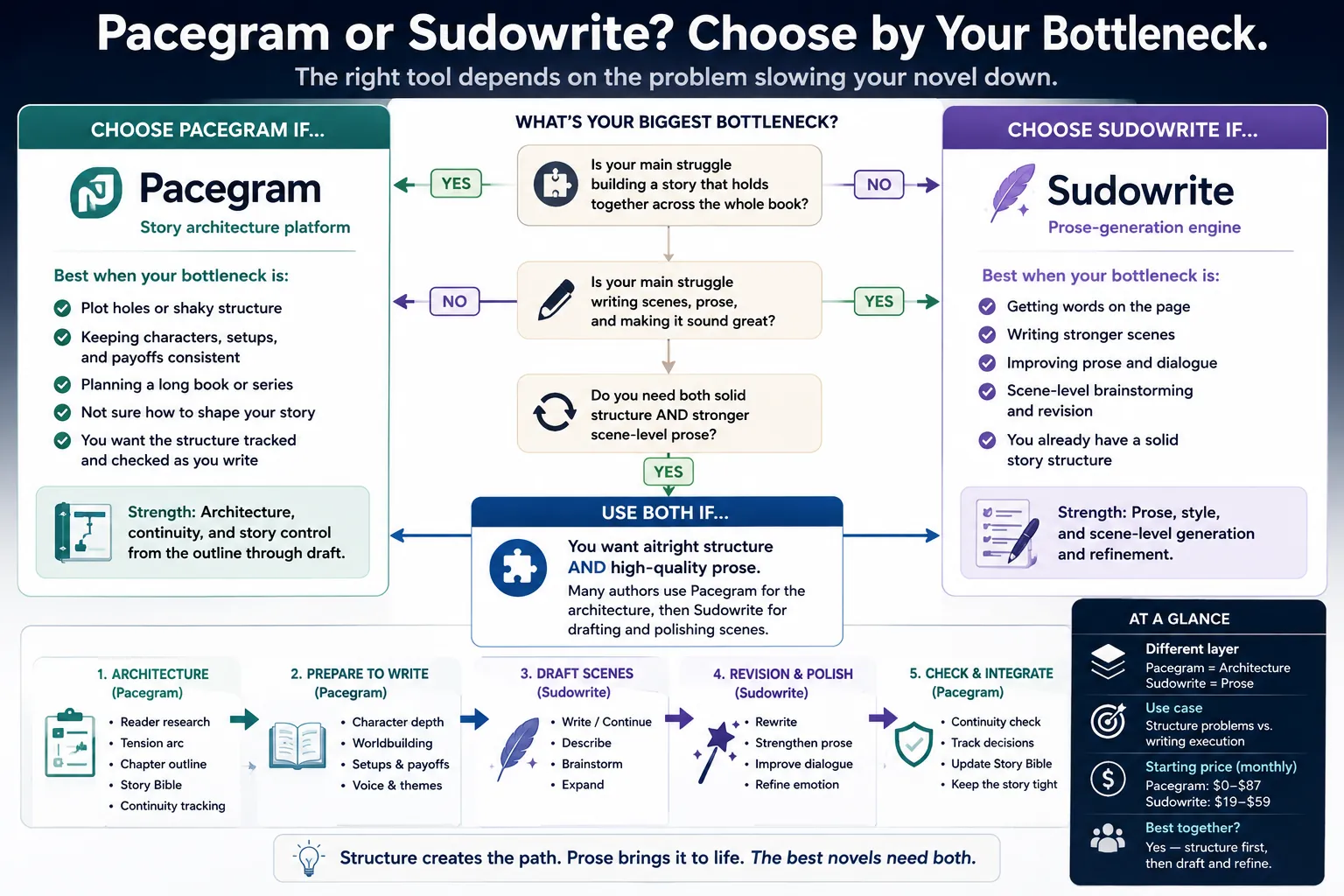
The comparison isn't prose versus structure — it's which layer your book breaks at.
The wrong question
"Pacegram vs Sudowrite" reads like a head-to-head, but the two products solve different problems at different stages of the pipeline — the same trap authors hit with Sudowrite vs NovelCrafter, which reviewers eventually admit "are not really the same product type." Before comparing features, establish what each tool is designed to do. This comparison uses five criteria: the layer each tool optimizes, how each keeps the story consistent, the structure workflow, revision depth, and true cost. For the wider landscape and verified pricing across the whole category, see the best AI novel writing tools in 2026.
What each tool actually is
Sudowrite is a writing tool first. Its core is Muse 1.5, a model Sudowrite says is "built just for fiction," wrapped in generation and revision features — Write (continues a scene in your voice), Describe (sensory detail), Rewrite, Expand, and Brainstorm. Its Story Bible takes you "from idea, to outline, to beating out chapters, to thousands of words," and the model references it while generating. Independent reviewers call the Story Bible the heart of the tool — the "source of truth" for continuity — but one that works only if you maintain it: keep it updated as your decisions become canon, because a vague bible lets the model fill blanks that may change your intent. Pricing is $19/$29/$59 a month, or $10/$22/$44 on annual billing, with credits that expire monthly except on the top tier. There is no free plan, only a one-time trial.
Pacegram is a structure tool first. Its own positioning is that "stories don't begin with words; they begin with structure": research what readers are saying about your genre, architect the tension arc and chapter outline, define the voice, then draft. The Story Bible is not an optional input the model references — every character, motivation, and continuity detail is tracked and checked as you write, and the platform tracks setups and payoffs across the entire novel. The workflow includes a living outline (restructure an arc like moving chapters on a table), inline editing, and retail-ready DOCX export for KDP and Bookvault. Pricing is Free (10 AI credits, one book project), Beginner at $38/month, and Professional at $87/month. Pacegram is new and has no independent review coverage yet; its description here is based on official materials.
Where they overlap
The middle is where the comparison gets honest. Both tools have a Story Bible, both outline before drafting, and both generate prose. The difference is center of gravity: Sudowrite's value concentrates in generation and revision, and its story bible exists to feed the model. Pacegram's value concentrates in the architecture layer — drafting is downstream of the structure, and consistency checking is the point. In practice, Sudowrite rewards the writer who maintains the bible; Pacegram tries to do the checking for you. (If you want to see what a well-built bible looks like, our story bible template is free.)
| Criteria | Sudowrite | Pacegram |
|---|---|---|
| Center of gravity | Prose generation + revision | Story architecture + consistency |
| Story memory | Story Bible referenced by model; manually maintained | Tracked and checked as you write; setups/payoffs tracked |
| Structure workflow | Guided: idea → outline → beats → prose | Reader research → tension arc → living outline → draft |
| Revision tools | Write, Describe, Rewrite, Expand, Brainstorm | Inline editing, restructure |
| Export | Basic text export | KDP/Bookvault-ready DOCX, cover prompt |
| Entry price | $19/mo ($10 annual); trial only | Free plan; Beginner $38/mo |
| Maturity | Years of reviews, established user base | New; no independent reviews yet |
Choose by your bottleneck
- Choose Sudowrite if you need the strongest scene-level prose and sentence-level revision tools, and you will maintain your own story bible.
- Choose Pacegram if your drafts keep drifting — characters, motivations, setup-payoff promises — and you want the structure enforced while you write.
- The honest answer for many authors is both: use Pacegram to hold the story architecture and Sudowrite to draft and revise scenes against it. That means two subscriptions, worth it only if both bottlenecks actually hurt you. If neither subscription is earning its keep, the whole alternatives landscape is covered in Sudowrite alternatives for novel writing.
- If you are early in a project, start with the architecture layer; if you already have a draft that needs line work, start with the prose layer.
Limitations, stated plainly
Sudowrite's credits expire monthly (except Max), there is no free tier, export is basic, and reviewers note that heavy use can flatten prose. Pacegram is unproven by third parties, its prose-generation depth has no independent testing, its Professional tier is expensive at $87/month, and per-plan AI credits cap heavy use. Neither tool replaces editorial judgment — Sudowrite's own guidance says to treat AI as a drafting partner and budget most of your time for editing.
Methodology and disclosure
Pricing and features were checked on August 11, 2026 against the official homepages of both products and corroborating third-party reviews; prices change, so verify before buying. I am the founder of Pacegram and have not used Sudowrite hands-on: the Sudowrite description relies on its official materials and the independent reviews cited, and the Pacegram description relies on official materials because no independent coverage exists yet.
New to the head-to-heads? Pacegram vs Sudowrite — the other comparison, on who maintains the story bible.
If your drafts keep drifting — characters, motivations, promises — the structure layer is where that gets fixed. See how Pacegram's story bible tracks and checks continuity while you write.
Frequently asked questions
Are Pacegram and Sudowrite competitors?
Not in a head-to-head sense — they operate at different layers of the same pipeline. Sudowrite is a prose-generation engine first: a fiction-trained model (Muse) with a Story Bible attached that you maintain. Pacegram is a story-architecture platform first: reader research, a tension arc, and a Story Bible that is tracked and checked as you write, with drafting downstream of the structure.
Which one should I choose?
Choose by your bottleneck. Choose Sudowrite if you need the strongest scene-level prose and sentence-level revision tools, and you are willing to maintain your own story bible. Choose Pacegram if your drafts keep drifting — characters, motivations, setup-payoff promises — and you want the structure enforced while you write.
Do I need both Pacegram and Sudowrite?
Only if both bottlenecks actually hurt you — it means two subscriptions. If you are early in a project, start with the architecture layer; if you already have a draft that needs line work, start with the prose layer.
How do their prices compare?
Sudowrite runs $19/$29/$59 a month (or $10/$22/$44 on annual billing) with credits that expire monthly on the lower tiers, a trial only, and no free plan. Pacegram offers a free plan (10 AI credits, one book project), Beginner at $38/month, and Professional at $87/month. Neither tool replaces editorial judgment.
SOURCES
- Pacegram — official homepage, pacegram.com (extracted 11 Aug 2026)
- Sudowrite — official homepage, sudowrite.com (extracted 11 Aug 2026)
- Sudowrite — "Cost of Writing a Novel with AI: Full Breakdown (2026)" (official blog, 13 Jul 2026)
- Kindlepreneur — "Sudowrite Review: The Good, the Bad, and the Weird Parts"
- RivalFlow — "Sudowrite Review: Can This AI Writing Tool Really Help You Write a Novel?"
- OpenPR / KAKE — "Pacegram Introduces AI Story Architecture That Tracks Story Setups and Payoffs Across an Entire Novel" (company press release, 2026)
- Felo.ai, Built&Written, checkthat.ai — Sudowrite pricing/feature corroboration (2026)
- Medium (The Startup) — "Sudowrite vs NovelCrafter: Which AI Writing Tool Is Better for Fiction Writers?"
- Laterpress — "Best Writing Tools for Fiction Authors (2026)"; CreativIndie — "Best AI Writer 2026" (May 2026)
Researched 11 Aug 2026 via Tavily. Pricing is volatile: all figures are "as of August 2026" and should be re-verified before purchase; annual-billing discounts are noted where documented. Credit/plan limits are from official pages and corroborating reviews. No first-hand product testing is claimed. Affiliation is disclosed: the author is founder of Pacegram; the Pacegram description is based on official materials only (no independent coverage exists yet), and the Sudowrite description is based on its official materials plus the independent reviews cited.