
ChatGPT for Novel Writing: Where It Works and Where It Breaks
It's the first AI tool most novelists try. It's genuinely great at the work before a book exists — and it breaks at the one thing a novel needs most: memory of the book behind the page.
The prose stays good. The story comes apart — because nothing is holding it together.
ChatGPT is where most novelists start with AI, because it is where most people already are. You type, it writes, and for a while it feels like a miracle. Then, somewhere around chapter ten, the book starts arguing with itself — a character changes name, a subplot vanishes, the timeline quietly contradicts. The prose is still good. The story has come apart.
The reported experience is remarkably consistent. ChatGPT is excellent at some parts of a novel and structurally unable to do the rest. The useful skill is knowing which is which before you spend a month learning the difference.
What ChatGPT genuinely does well
The novelist Elisa Lorello, in a widely read exchange with publishing veteran Jane Friedman, called ChatGPT's outlines a game-changer: give it a premise and characters, and it produces a workable outline in seconds — "fluid and flexible," place-holding plot points, freeing her creative energy for the manuscript itself. She used it to draft 35,000 words across two novels in three weeks, on the back of generated outlines.
That pattern holds across nearly every serious account. Brainstorming a premise. Asking "what should happen next?" by pasting the prior scene — a freewriting technique. Beat sheets and chapter plans. Drafting scenes in short, self-contained chunks, which the computer-scientist novelist Dave Germain codified as 250-word tasks per chat. Revision passes, where you paste a chapter and get line-level feedback. And the administrative work around writing: timetables, schedules, structure.
None of these need the tool to remember anything beyond the session in front of it. That is the secret: short sessions, low context load, text in and text out.
| Novel task | Verdict | Why | Better handled by |
|---|---|---|---|
| Brainstorming premises and what-next scenes | Works | Short session; low context load | Any assistant; paste the prior scene |
| Outlines and beat sheets | Works | Lorello: the game-changer; place-holds plot points | A document you own and can edit |
| Drafting scenes in 250-word chunks | Works, with caps | Short chunks fit the effective window | You assembling chunks into chapters |
| Dialogue experiments | Fragile | Nuance drifts without guardrails | Scripted dialogue the AI must keep 100% |
| Multi-chapter consistency | Breaks | Details fall out of the context window | A persistent story bible + drafting against it |
| Character continuity across a novel | Breaks | Even re-uploaded character files get misread in long chats | Character sheets injected per chapter |
| Full-manuscript editing | Breaks | Scale exceeds practical context; 30-50% time lost juggling | Chapter-level passes with fresh context |
ChatGPT is a strong pre-writing and revision tool and a fragile book-length drafting tool.
Where it breaks
The failures are all one failure wearing different coats: the context window. ChatGPT can only "remember" what fits in its working context at once — an analysis of the Plus tier puts it at roughly 32K tokens, about 24,000 words or eighty pages, while the larger Pro window runs to around 192,000 words. Even on the paid plans, a 60,000-word novel does not fit in the desk. Something is always falling off the edge.
Novelists on the OpenAI forums describe the consequences in detail. One writer used a separate chat per chapter; as each chat grew, the model "forgot" details set up at its start, and at one point misdescribed a character even after the character file was re-uploaded and the model told to read it. Another thread asks for the feature the novelists all want — timeline views, character indexes, lore folders, canon markers — because the "maximum length for this conversation" wall destroys continuity mid-story. And the degradation is not specific to ChatGPT: users report the same wall in every long-context assistant, often at the most pivotal moment.
So the pattern of failure is: details fall out of context, the model invents replacements with total confidence, and the author — not the tool — is the one who notices. Character drift, timeline contradictions, vanished subplots, fluctuating voice. The tool holds none of the book. You hold all of it, manually, forever.
The workarounds people actually use
Because the failure is structural, the workarounds are all forms of context management. Seasoned users converge on the same handful:
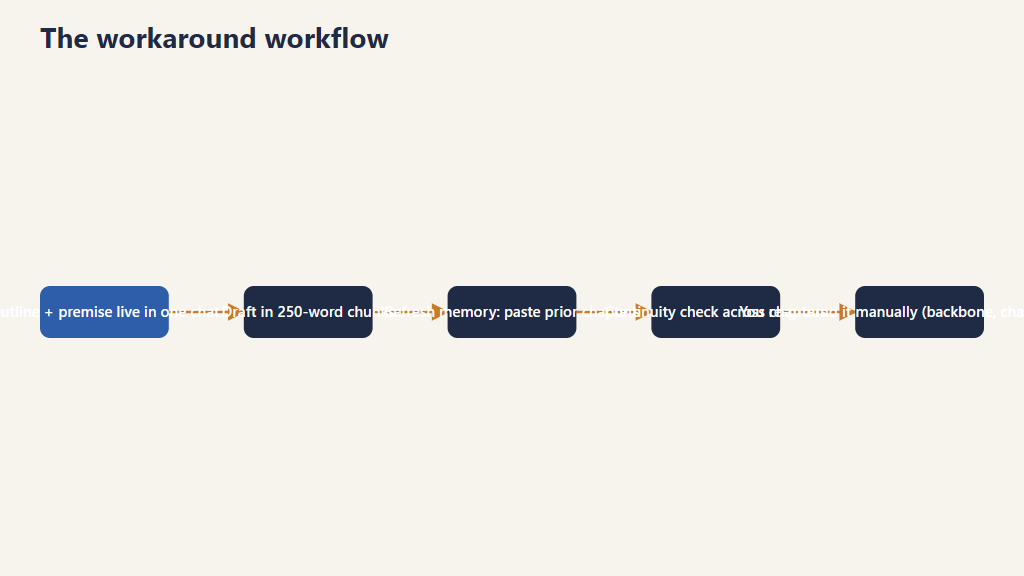
Every step exists because the tool holds none of the book itself.
One chat per chapter, never one chat for the whole book. Draft in small chunks — a scene, not a chapter, and certainly not a novel. Refresh the model's memory by pasting the previous chapter (or a summary) at the top of each session. Keep a backbone document the AI is forbidden to alter — Germain's pattern is "keep 100% of the original X but write the accompanying Y," which pins dialogue and plot beats against the model's inventiveness. Maintain character files and re-inject them per chapter. And check consistency by hand, in batches, across chapters.
These work, up to a point. But notice what they share: every step exists because the tool itself holds no memory of the story. You are the story bible. You are the continuity department. On the Plus tier, one analysis estimates writers spend thirty to fifty percent of their time juggling context instead of writing — pasting, summarizing, re-loading the same style guide and outline into each new chat.
The structural difference
There is a cleaner line between ChatGPT and the tools built for book-length work, and it is not prose quality. It is whether the story lives inside the system or inside your head.
A chat assistant generates text against whatever is in the window. A story-architecture system holds the book — characters, plot, world, voice — in a persistent structure, and drafts every chapter against that structure instead of against the current chat. The workarounds above are, in effect, the manual version of that structure: hand-maintained files, hand-pasted context, hand-checked continuity. The tools exist so the book stops depending on your clipboard discipline.
None of this makes ChatGPT useless. It is arguably the best pre-writing and revision tool most novelists can reach — free tier included, as the free assistants breakdown shows. The honest framing is the one the evidence keeps returning to: brilliant at the page in front of you, no memory of the book behind you. Choose it for the work it wins, and give the book itself a home that remembers. For the wider field, the tools and assistants we compared in 2026 score ChatGPT against NovelCrafter, Sudowrite and Claude on exactly this axis. And the failure mode itself — the wall past page ten — is dissected in why every AI novel hits a wall.
Key takeaways
- Use ChatGPT for what it wins: outlines, brainstorming, scene chunks, revision feedback.
- The break point is context: roughly 80 pages of effective working memory on the standard paid plan.
- Every workaround — one chat per chapter, paste-back refresh, backbone documents — is manual context management.
- If you hold the story in your head and your files, you are the tool's memory. Decide whether that is the job you want.
Brilliant at the page in front of you, no memory of the book behind you.
A system that holds the book — characters, plot, world, voice — while you write is what turns a chat assistant into a novel pipeline. See how Pacegram keeps your story in memory, chapter after chapter.
Frequently asked questions
Is ChatGPT good for writing a novel?
For the parts that fit a short session — brainstorming, outlines, scene chunks, and revision feedback — yes, genuinely. It breaks at the parts that need memory: multi-chapter consistency, character continuity, and full-manuscript editing, because the effective context window is roughly 80 pages and the tool holds none of the book itself.
Why does ChatGPT forget details in long novels?
Because it can only “remember” what fits in its working context at once — roughly 32K tokens, about 24,000 words or eighty pages, on the standard paid plan. As a chat grows, details fall out of context and the model invents replacements with total confidence. The author — not the tool — is the one who notices.
What workarounds do ChatGPT novelists actually use?
They converge on the same handful: one chat per chapter, draft in small chunks, paste the previous chapter or a summary at the top of each session, keep a backbone document the AI is forbidden to alter, maintain character files and re-inject them per chapter, and check consistency by hand. Every step exists because the tool holds no memory of the story — you are the story bible.
Can you finish a novel with ChatGPT?
Yes — documented runs exist, including one novelist who drafted 35,000 words across two novels in three weeks on AI-generated outlines. But on the standard paid plan, writers estimate spending 30–50% of their time juggling context instead of writing: pasting, summarizing, and re-loading the same style guide and outline into each new chat.
SOURCES
- Jane Friedman — "How to Make Productive Use of ChatGPT: Q&A with Elisa Lorello". https://janefriedman.com/how-to-make-productive-use-of-chatgpt-qa-with-elisa-lorello
- James Gill — "ChatGPT couldn't write my novel for me" (LinkedIn). https://www.linkedin.com/pulse/chatgpt-couldnt-write-my-novel-me-james-gill
- Dave Germain — "7 Tips for Writing Fiction with ChatGPT" (Medium). https://medium.com/@dave.germain.79/7-tips-for-writing-fiction-with-chatgpt-6d0e686879a8
- "How to Write a Book with ChatGPT in 24 Hours" (YouTube tutorial, 2026). https://www.youtube.com/watch?v=1xDwZMzCYOg
- One Lit Place — "Writing Fiction with ChatGPT Seems Easy. It's Not." https://onelitplace.com/writing-fiction-with-chatgpt-seems-easy-its-not
- OpenAI Developer Community — "Novel writing and addressing the limits of ChatGPT". https://community.openai.com/t/novel-writing-and-addressing-the-limits-of-chatgpt/419138
- OpenAI Developer Community — "Longer context windows, GPT for creatives, and better project integration". https://community.openai.com/t/longer-context-windows-gpt-for-creatives-and-better-project-integration/1381021
- Kevin M. Smith — "ChatGPT 5 vs 4: Context Window Size Matters" (LinkedIn). https://www.linkedin.com/posts/thestoryarchitect_theres-been-a-lot-of-confusion-about-the-activity-7361052105605894145-lq4Z
- Social Scholarly — "Why I'm not worried about LLMs long context problem" (Medium, Feb 2025). https://medium.com/@socialscholarly/why-im-not-worried-about-llms-long-context-problem-eed21db44687
- Google Gemini community — context loss mid-story thread. https://support.google.com/gemini/thread/345474945/
- Morph (Jun 2026) and Bleap (2026) — ChatGPT free-tier message limits. https://www.morphllm.com/comparisons/chatgpt-vs-claude-vs-gemini ; https://www.bleap.finance/en-us/blog/how-to-use-chatgpt-for-free
Researched 18 Aug 2026 via Tavily (queries on using ChatGPT for novel writing, experiences and failures, context-window limits, and consistency problems). Author accounts (Lorello, Gill, Germain, forum threads) are reported as first-hand experiences and quoted only where the source text supports the claim. Context-window figures reflect a 2026 LinkedIn analysis of ChatGPT Plus (≈32K tokens) and Pro (≈256K); OpenAI's advertised limits have changed across models and versions, so the article treats the number as an order-of-magnitude illustration rather than a spec. The "where it works / where it breaks" verdict table is this article's synthesis of the cited accounts, not a sourced claim. The structural framing (chat window vs persistent story architecture) is this article's recommendation. No fabricated quotes; all quoted lines are verbatim from sources. The author is the founder of Pacegram, a story-architecture tool for novelists; the article compares approaches rather than promoting the product.