
AI Book Generator: How to Write a Full Book With AI in 2026
What an AI book generator can and can't do in 2026 — the honest free-vs-paid field and the workflow that actually finishes a book.
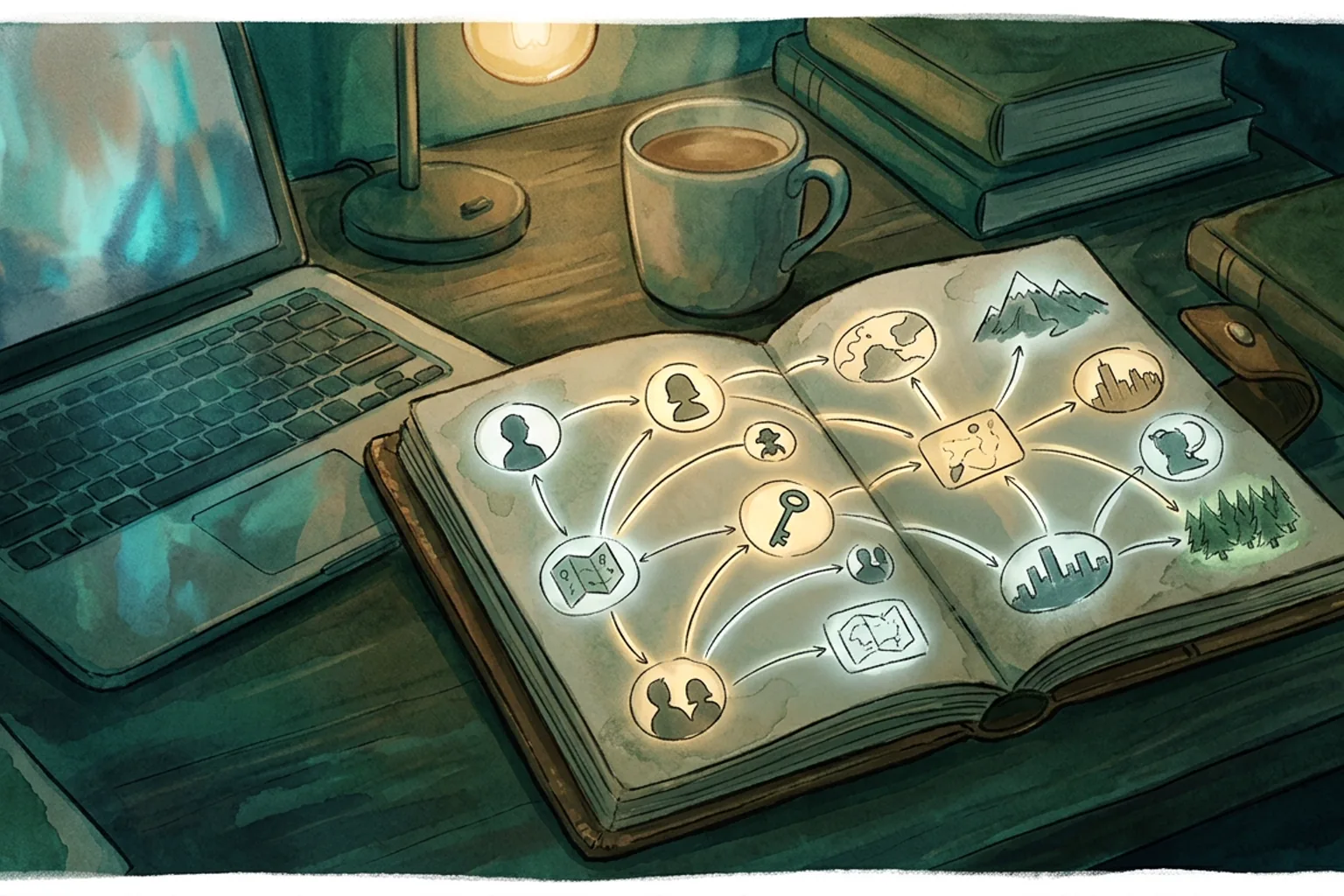
The generator is the easy half. The system that remembers your story is the one worth choosing.
The short version: an AI book generator can draft a full-length manuscript, and the genuinely free options have improved enough that a real book is possible at $0. What no generator does is finish the book for you. The dividing line in 2026 is not prose quality — it is whether the tool remembers the story across 60,000 words. This guide covers the honest free-vs-paid field and the workflow that turns a draft into a book.
What is an AI book generator?
An AI book generator is a tool built to produce long-form book content — outlines, chapter drafts, dialogue, and often exportable files — rather than short answers. The category spans general chatbots (ChatGPT, Claude, Gemini) used for book-length projects and dedicated platforms (Squibler, Inkfluence, NovelCrafter, Pacegram) that add structure, chapter management, and publishing features on top of the model. The market research site Inkfluence AI pitches the category with striking vendor numbers: a global AI writing tools market projected at $6.5 billion by 2030, and Amazon KDP self-publishing revenue above $4 billion in 2025 (vendor figures, worth treating as marketing). Either way, the demand is real.
Can it actually write a full book?
Yes — with a qualification that decides everything. A 100,000-word novel is roughly 130,000–150,000 tokens. Even the largest context windows (GPT-4 at 128K, Claude at 200K, Claude's newer 1M-token tier) cannot comfortably hold a full novel while generating, and quality degrades as the window fills. The practical 2026 consensus from tool tests is that AI can handle 70–80% of the drafting work while the author manages continuity, voice, and coherence — and the highest-risk moments are the first paragraphs of each new chapter, where the model transitions context and silently changes what came before.
The blunt answer from the 2026 review space: "Can I write a whole book with AI? Technically yes. Practically, the result will be unreadable unless you edit relentlessly." Realistic expectations: keep roughly 30–50% of raw AI output, rewrite the rest. A generator produces a strong first draft with an unreliable memory; authorship is what you do after.
Is there a free AI book generator?
Yes, and the free tier is genuinely usable in 2026. ChatGPT Free includes GPT-4o with roughly 16 messages per three hours — enough to draft chapters slowly. Claude Free produces strong prose but offers no export. Google Gemini gives unlimited free usage but no formatting. The paid-vs-free verdict from 2026 tests: "$0/month with the free tiers gets you further than most paid setups did two years ago," and $20/month for Claude Pro covers about 80% of what most writers need.
The honest caveat: most "free" AI book writers carry word caps, no export, or mandatory sign-up. A free tier that caps you at 6,000 words a month — barely two chapters — will frustrate more than it helps. Test the free tier on a real chapter before paying for anything; that single test tells you more than any feature comparison.
The consistency gap: the axis no generator advertises
Every mainstream generator shares one weakness: LLMs are stateless. Between generation calls there is no built-in recall, and recency bias means the most recent context usually wins against your notes. Character eye colors change between chapters, subplots vanish, and once drift embeds, the model stops contradicting your original character and becomes consistent with its own drifted version. Tool tests confirm the pattern: 25-chapter tests find most tools producing contradictions once a story exceeds a certain length. The mechanism is worth understanding before you trust any generator with a long draft — see why AI characters drift and how to stop it.
This is the difference between a generator and a book-writing system. A consistency-first tool makes story memory a feature — a queryable story bible the machine re-reads — instead of a file you maintain while the model forgets. That is the entire premise of Pacegram: structure first, then prose, with the story held in the system rather than in a chat history. The gap shows up fast: AI can generate 50,000 words with ease, but generating a good book is a different problem — and when the prose does come back generic, the fix is making the book sound like you, not like the model. Before you pick a tool, it is worth deciding which one you actually want: an AI book generator or an AI writing partner — because that choice decides who is actually writing the book. And if your instinct was one giant prompt, read why "write me a novel" is a terrible prompt.
Free vs paid: how to decide
Test the free tier on a real chapter. If your process stalls at the blank page, a paid generator that drafts fast pays for itself within one book. If you publish regularly, hours saved on drafting and formatting translate directly into more books. But if your pain is continuity, a cheaper tool with better story memory beats a pricier one with prettier prose — every time. For a fuller tool-by-tool breakdown across the category, see our comparison of the best AI novel writing tools and what drives authors away from the mainstream options.
How to actually finish an AI-generated book
- Write the structure first. Outline, characters, world, and arc before any prose — the machine cannot hold the plan for you.
- Keep a story bible that the system re-reads. A living record of characters, places, and plot threads, referenced at every generation call.
- Audit chapter boundaries. Read the first paragraphs of each new chapter carefully; that is where continuity breaks.
- Edit like a writer, not a reviewer. Keep 30–50% of raw output, rewrite the rest in your voice.
- Check the publishing pipeline. Export formats, KDP AI disclosure rules, and cover/interior quality are still your job.
A book generator writes fast and forgets constantly. The book gets finished by the author who planned first and edited last.
Key takeaways
- Full books are possible — AI handles 70–80% of drafting; the author owns continuity, voice, and coherence.
- Free is real — ChatGPT Free, Claude Free, and Gemini can produce a book at $0, with rate limits and no formatting.
- Consistency is the axis — every mainstream generator is stateless; tools that store the story in the system beat tools that leave it in a file you maintain.
- Test on a real chapter before paying for anything.
The generator is the easy half. The system that remembers your story is the one worth choosing. Try Pacegram free — structure first, then write.
SOURCES
- Inkfluence AI — "9 Free AI Book Writing Tools Tested (2026)." https://www.inkfluenceai.com/blog/best-free-ai-book-writing-tools-2026
- CreativeIndie — "Best AI Writer 2026: Honest Picks I Actually Tested." https://www.creativindie.com/best-ai-writing-generators-artificial-intelligence
- Inkfluence AI — "Best AI Tools for Writing Long Novels in 2026 (100K+ Words)." https://www.inkfluenceai.com/blog/best-ai-tools-long-novels-2026
- ManuscriptReport — "Best AI Tools for Authors 2026." https://manuscriptreport.com/blog/best-ai-tools-for-authors
- aibookgenerator.org — "Book Writing Software: Free vs Paid in 2026." https://www.aibookgenerator.org/blog/book-writing-software-free-vs-paid
- Inkfluence AI — "AI Book Writer" (landing page, vendor claims labeled). https://www.inkfluenceai.com/ai-book-writer
- Squibler — /ai-book-generator landing page (SERP observation). https://www.squibler.io/ai-book-generator
Researched 20 Aug 2026 via Tavily (queries on free vs paid AI book writers, long-form AI quality, and the AI-book-generator market). Free-tier descriptions, the 70–80% drafting split, the 30–50% keep-rate guidance, and the context-window math are attributed to the cited 2026 tests. The $6.5B market and $4B KDP revenue figures are vendor claims from Inkfluence and are labeled as such, not independently verified. The consistency mechanism (statelessness, recency bias, drift) reuses the evidence ledger from the character-drift article (E140–E146). No tool was tested first-hand; product claims are sourced. Pricing is volatile — verify before committing.
Before you choose a generator, decide how the book will be structured — read how to write a novel outline that survives a long draft. How to write a novel outline.