
Free AI Novel Writing Assistants: What You Actually Get
Every free tier promises more than it delivers. For a novel, here's exactly what "free" buys you — and the moment it stops being enough.
A free assistant writes the page in front of you. Something has to remember the book behind it.
"Free" is the most searched word in AI-assisted writing. Every tool in the category advertises a free tier, a free trial, or at least a free demo, and the marketing all sounds identical. But there is a quiet difference between a free assistant and a free novel pipeline, and the difference decides whether your free month is spent writing a book or endlessly re-explaining it to a chatbot.
What "free" actually means in this market
Start with the general-purpose assistants, because they have the only real free tiers in the category. ChatGPT's free plan gives you a limited number of messages on the flagship model — roughly ten every five hours at the time of writing — before falling back to a lighter model. Claude's free plan is arguably more generous for writers: a Sonnet-class model, roughly fifteen to a hundred messages a day depending on how complex each prompt is, a 200K context window, up to five Projects, and memory that carries across chats. The exact numbers change every few months, so treat them as a shape rather than a spec.
Fiction-specific tools are a different story. Sudowrite offers a trial of around ten thousand credits with no card required. NovelCrafter gives you twenty-one days. NovelAI's free access is minimal enough to feel like a demo. Of the dedicated novel-writing products, most simply do not have a permanent free tier at all — Squibler is the notable exception, with 6,000 AI words per month.
| Tool | Free offer (Aug 2026) | Genuinely good for | Where it stops |
|---|---|---|---|
| ChatGPT (Free) | ~10 messages every 5h on flagship, then lighter model | Brainstorming, outlines, scene drafts | Message caps; no persistent story memory |
| Claude (Free) | Sonnet-class model, ~15-100 msgs/day, 200K context, 5 Projects, memory | Long-form drafting, chapter-level revision | Usage limits at peak; no export pipeline |
| Sudowrite | Trial only — ~10,000 credits, no card | Fiction prose polish, rewriting | Trial ends; $10-59/mo after |
| NovelCrafter | Trial only — 21 days, no card | Structured outlining, BYOK drafting | No permanent free tier; $4-20/mo + AI costs |
| NovelAI | Minimal free access (trial-like) | Uncensored genre fiction drafts | Effectively a demo; $10-25/mo |
| Squibler | 6,000 AI words/month | AI within a structured book framework | Not enough for serious drafting |
| Pacegram (Free) | 10 AI credits/mo, 1 project, DOCX export | Full pipeline end-to-end on one book | 1 project; paid from $38/mo |
General assistants have real free tiers. Fiction-first tools mostly offer trials.
What free is genuinely good for
Free is not useless. It is genuinely excellent at the work that happens before a book exists and after a chapter is drafted.
Brainstorming and premise work burn almost no budget — ten messages is plenty to interrogate an idea. Outlines and beat sheets are cheap to produce and easy to save elsewhere. Single scenes draft well: give the model a clear prompt, get a page, move on. And revision is the sleeper: Claude's long context window means you can paste an entire chapter and get line-level feedback, which is where free genuinely competes with paid tools.
Notice the pattern. Free tools are excellent at producing text and feedback in short, self-contained sessions. That is exactly what a chat window is designed to be good at. The trouble starts when your book stops being a short session.
Where free stops being enough
Three walls stop a free tool from carrying a novel.
Message caps are the first. A real drafting session is iterative: draft, critique, revise, repeat. That loop burns through ten messages faster than people expect, and when the window resets, so does the model's working attention. Long-form writers on free plans describe the same rhythm — productive for forty minutes, then parked until the quota resets.
The second wall is memory. A chat window has no persistent record of your book. Within a long session, the model's effective attention to chapter one decays as chapter nine grows; between sessions, it forgets entirely. Characters drift, timelines contradict, subplots vanish. This is the wall every AI novel eventually hits, and it is not a prompt problem — it is a structural one.
The third wall is the manuscript itself. Free chat produces text, not a book. There is no story bible holding your characters and plot steady, no per-chapter drafting against that structure, and no export path to a formatted manuscript. You reassemble the scenes by hand, re-explain the premise each session, and maintain continuity yourself. The finishing work is usually where this bites first — the front and back matter a reader sees before they read a word.
The honest way to say this: free tools give you a brilliant co-writer with amnesia. Excellent for the page in front of you, no memory of the book behind you.
When free is the right tool
Free is the right tool while you are exploring: testing whether AI-assisted writing fits your process, developing a premise, drafting isolated scenes, revising. It is the wrong tool the moment the book needs to hold together — past page ten, across characters, through to an exportable manuscript.
For the story-writer side of the free field — short fiction, prompts, and the free tiers that genuinely hold up — see what free AI story writers actually do.
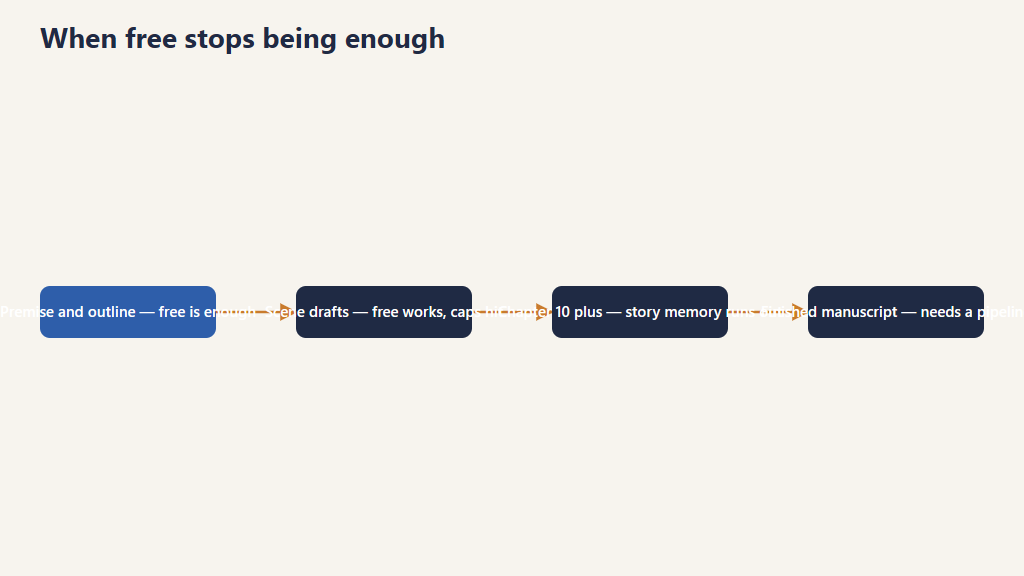
Free carries the beginning of a book, not the whole book.
A transparent data point from this article's own subject: Pacegram's free plan is deliberately small — ten AI credits a month and one book project, with export enabled. It exists to run a single book through the full structure-first pipeline end to end, so you can feel what that workflow is before you pay. That is what an honest free tier looks like: a real trial of the actual workflow, not a demo of a lighter model. Full plan details are on the pricing page.
Key takeaways
- Free general assistants are genuinely useful for brainstorming, outlining, and revision. Use them there.
- Fiction-first tools are mostly trial-only. A trial is a demo, not a plan.
- Free breaks at consistency: no story memory and strict message caps.
- The real cost of free is rework. The question is whether you spend it re-explaining your book — or writing it.
For the full landscape — paid tiers included — see the best AI novel writing tools in 2026, compared by what actually matters, where ChatGPT, Claude, Sudowrite and NovelCrafter are scored on prose, story memory, and true monthly cost.
Free tools give you a brilliant co-writer with amnesia. Excellent for the page in front of you, no memory of the book behind you.
The free tier that works is the one that lets you feel the actual workflow — structure, drafting, export — before you pay. Start the free Pacegram plan and run one book through the full pipeline.
Frequently asked questions
Which AI writing tools have a genuinely usable free tier?
The general-purpose assistants do. ChatGPT's free plan gives roughly ten flagship-model messages every five hours before falling back to a lighter model. Claude's free plan is more generous: a Sonnet-class model, roughly fifteen to a hundred messages a day, a 200K context window, up to five Projects, and memory that carries across chats. Fiction-first tools are mostly trial-only — Sudowrite ~10,000 credits, NovelCrafter 21 days — with Squibler the notable exception at 6,000 AI words per month.
Can you write a whole novel for free?
Free carries the beginning of a book, not the whole book. Free tools are excellent before a book exists — brainstorming, outlines, scene drafts, revision — and they break at the work a book requires: consistency and memory. A chat window has no persistent record of your book, and there is no story bible, no per-chapter drafting against structure, and no export path to a formatted manuscript.
Is ChatGPT's free tier good for novel writing?
Genuinely good for the parts that fit a short session: brainstorming, outlining, single scene drafts, and chapter-level revision. It breaks at the parts that need memory — multi-chapter consistency, character continuity, an exportable manuscript — because the tool holds none of the book itself.
What does Pacegram's free plan include?
Ten AI credits a month, one book project, and DOCX export enabled — deliberately small, so you can run a single book through the full structure-first pipeline end to end and feel the actual workflow before you pay. It is a real trial of the workflow, not a demo of a lighter model; paid plans start at $38/month.
SOURCES
- Inkfluence AI — "9 Free AI Book Writing Tools Tested (2026)" (Aug 2026). https://www.inkfluenceai.com/blog/best-free-ai-book-writing-tools-2026
- AIToolsRecap — "Claude Free Plan (2026) — Limits, API Access, Credits & What You Get". https://aitoolsrecap.com/Blog/claude-free-plan-limits-api-access-credits-2026
- AItomation Academy — "Claude Pricing in 2026: Free vs Pro vs Max". https://www.aitomationacademy.com/blog/is-claude-ai-free-pricing-guide
- Morph — "ChatGPT vs Claude vs Gemini (June 2026): Plans, Message Limits, and Models". https://www.morphllm.com/comparisons/chatgpt-vs-claude-vs-gemini
- Bleap — "How to Use ChatGPT for Free in 2026 (And When It's Worth Paying)". https://www.bleap.finance/en-us/blog/how-to-use-chatgpt-for-free
- Noveble — "5 Best Free AI Tools for Fiction Writers in 2026 (We Tested All of Them)". https://www.noveble.com/blogs/free-ai-tools-fiction-writers-2026
- Novel Mage — "NovelCrafter Pricing in 2026: What You Actually Pay". https://novelmage.com/blog/novelcrafter-pricing-in-2026-what-you-actually-pay
- Nerdynav — "Sudowrite Review 2026: Tested w/ 3 Stories". https://nerdynav.com/sudowrite-review
- Laterpress — "Best Writing Tools for Fiction Authors (2026): AI and Beyond". https://www.laterpress.com/craft-of-writing/best-ai-writing-tools-for-fiction
- Pacegram live plans API — verified 18 Aug 2026 (first-party). https://pacegram.com/pricing
Researched 18 Aug 2026 via Tavily (queries on free AI novel writing tools, Sudowrite/NovelAI/NovelCrafter pricing and trials, and ChatGPT/Claude free-plan limits). Free-tier message limits differ between sources and change frequently — the figures quoted are approximate ranges and are explicitly volatile. Sudowrite's trial is described as approximately 10,000 credits per Nerdynav and ~10 days per Noveble; the article cites the credit figure and relies on the trial-only status rather than a precise duration. NovelCrafter's 21-day trial is per Novel Mage. The "co-writer with amnesia" framing, the three-wall structure, and the decision guidance are this article's recommendations, not sourced claims. Pacegram's free-plan terms were verified against the live plans API on 18 Aug 2026; Pacegram appears as one row in the comparison table with its plan limits stated factually. No first-hand testing of every tool is claimed. The author is the founder of Pacegram, a story-architecture tool for novelists.