
How to Use an AI Novel Writing Assistant: A Working Method
Structure first, prose second, you last. The five-stage method every serious guide converges on — and the mistakes that quietly ruin AI novels.
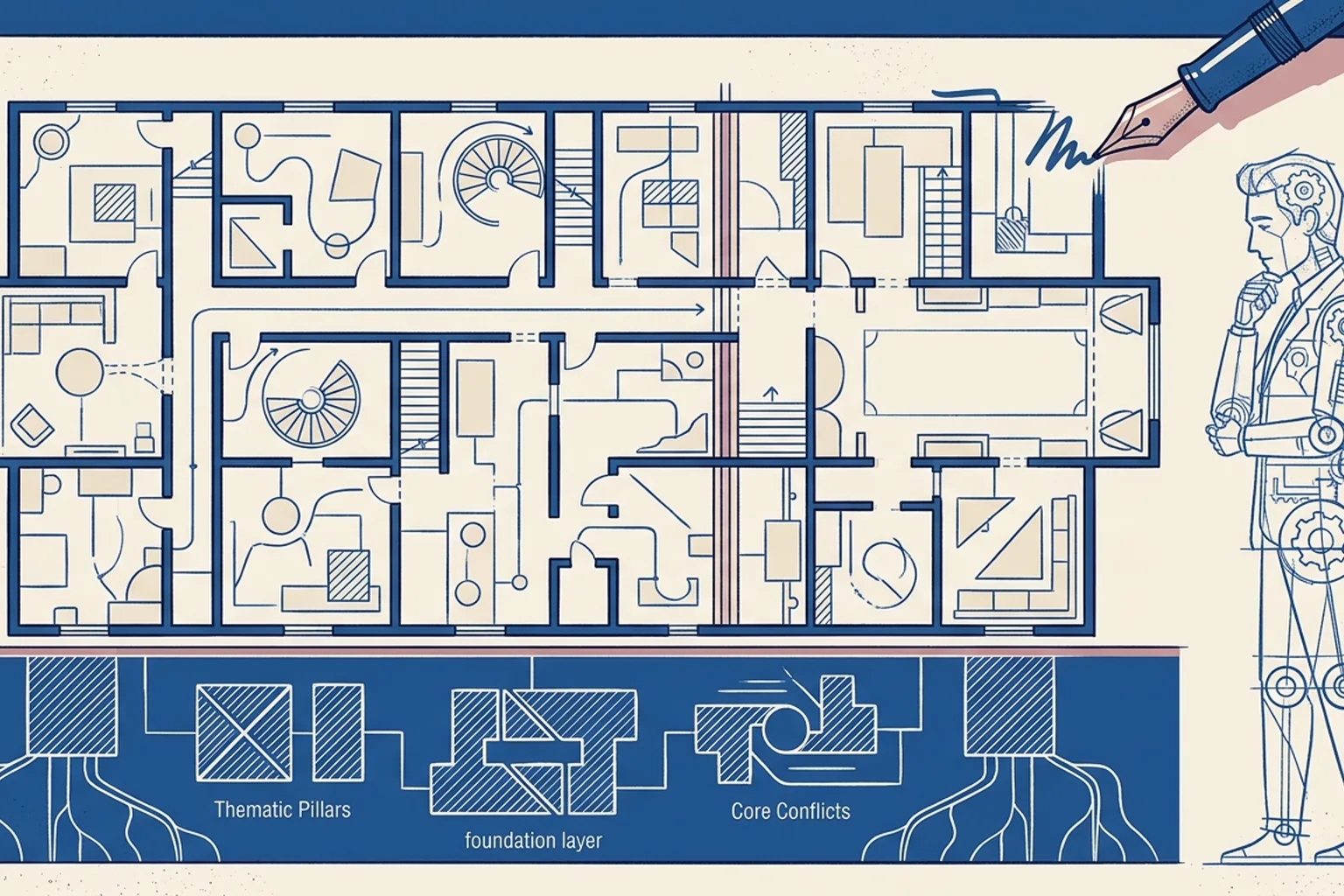
Plan the structure like an architect. Draft like a builder. Edit like an owner.
The Authors Guild's 2025 survey found that 45% of published fiction writers now use AI tools in some part of their process — mostly for brainstorming, beating writer's block, and developmental editing. The debate about whether to use AI is effectively over for a large share of working authors. The question that matters now is how, and the answer is more consistent than you might expect.
Read enough guides — from tool vendors, writing teachers, and platform publishers — and the same method keeps appearing in slightly different clothes. That convergence is the signal. Here is the version that survives contact with actual manuscripts.
Step one: write the premise like a thesis
Before any generation, spend five minutes making the premise specific. Genre, main character, central conflict, setting — two or three sentences, and the more precise the better. "A detective in 1920s Chicago investigates a jazz musician's murder" produces a fundamentally different novel than "a mystery novel." The quality ceiling of everything downstream is set here: vague input returns generic output, reliably.
Step two: build the story bible before the outline
This is the step most beginners skip and most failures trace back to. Build the reference document first: characters with goals and motivations, world rules, tone and voice. The guides that do this best make a telling suggestion — build a "Bible Forbids" list: the things your story will never do, which stops the AI from wandering into them.
Treat it as an iterative document, not a one-shot. Generate, review, tweak, regenerate; the outline quality correlates directly with the bible's quality. And keep the division of labor clear, as one guide puts it: the AI drafts the bible, but only the writer canonizes it. Every structural decision is yours.
Step three: outline, then draft chapters in order
Turn the bible into a chapter outline — AI does this quickly — then rearrange it until it is the skeleton you want. Chapter count, order, subplots, pacing: this is the cheapest place in the whole process to make structural changes, because no prose has been written yet.
Then draft sequentially. Chapter one, chapter two, chapter three — not scene forty-two because it excited you. Sequential drafting lets the tool carry context forward; the best fiction tools read the last two or three chapters before writing the next, and that continuity is the entire point. If a chapter comes out flat, regenerate it rather than accepting it. That discipline — one chapter at a time, in order — is the cheapest continuity system in AI-assisted writing, because it lets the tool's working context do the remembering. For a tool-level comparison — including which alternatives carry that context best — see Sudowrite alternatives for novel writing.
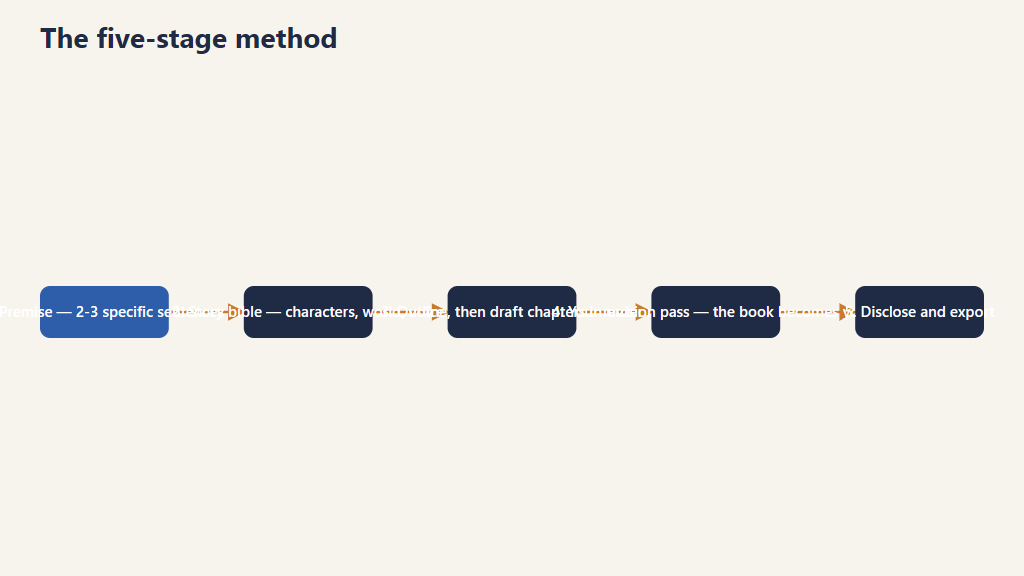
Every serious guide converges on the same sequence: structure first, prose second, you last.
Step four: the revision pass is where it becomes yours
Every honest guide agrees on this line: AI produces a draft, but the book becomes yours in revision. Budget real time here — an hour or two per chapter by most accounts, far more than the drafting itself.
The techniques that work: write the first paragraph yourself to anchor the voice, then let the AI continue from it. Tell it what a scene is not — "don't make Elena aggressive; she's scared but determined" — because negatives constrain better than vague positives. Generate two or three versions of a weak passage and assemble the best of each. Fix hallucinated facts by hand; AI confidently invents statistics. Cut the filler phrases and generic rhythm that identify machine prose. And per the guidance from Meta's own writing guide, keep AI output labeled and separate at first, so you always know what is yours and what is not.
Step five: disclose and export
Before you publish, handle the disclosure question deliberately. Amazon KDP requires authors to disclose AI-generated text at upload; content created by an AI tool remains AI-generated even after substantial human editing, while AI-assisted work — brainstorming, grammar checking, editing human-written prose — does not require disclosure. Failure to disclose can mean removal or account suspension. Decide your position before upload, not during it, and keep the record of how the manuscript was made.
Mistakes that ruin AI novels
The failures are almost never the AI's. They are sequence failures: drafting before structure, revising never, or publishing without disclosure. The table below is the short version of what every post-mortem of a bad AI novel has in common.
| Mistake | What it does | The fix |
|---|---|---|
| A vague premise | Generic output from generic input | 2-3 specific sentences: genre, main character, conflict, setting |
| Drafting before the story bible | Characters and world reinvent themselves mid-book | Front-load characters, world rules, and voice; iterate the bible |
| Generating chapters out of order | Continuity breaks between disconnected scenes | Draft sequentially; let the tool read the last 2-3 chapters |
| Skipping the revision pass | AI filler, flat dialogue, hallucinated facts survive | Edit each chapter; write the first paragraph yourself; verify facts |
| Skipping disclosure | Removal or account suspension on KDP | Disclose AI-generated text at upload; keep the record |
The failures are almost never the AI's. They are sequence failures.
This method is tool-agnostic by design — it works whether you draft in ChatGPT, Claude, Sudowrite, or NovelCrafter. For the honest limits of the most common starting point, read where ChatGPT works and where it breaks; for the memory wall the story bible exists to prevent, see why every AI novel hits a wall after page ten; and for the full field of options, the tools and assistants we compared in 2026.
Key takeaways
- The method: premise → story bible → outline → sequential drafting → your revision pass → disclosure.
- The bible is the difference between a book and a chat log. Build it first, iterate it, canonize it yourself.
- Revision is where ownership happens. Budget more time for it than for generation.
- Disclosure is not optional friction; it is part of the craft now.
The AI drafts the bible. Only the writer canonizes it.
The five stages work better when the story bible, outline, and chapters live in one place — so the structure is enforced, not remembered. Build your first story bible free with Pacegram.
SOURCES
- Inkfluence AI — "Best AI for Writing Novels in 2026: 6 Tools Tested". https://www.inkfluenceai.com/blog/best-ai-for-writing-novels-2026
- Inkfluence AI — "How to Write a Book with AI (2026)". https://www.inkfluenceai.com/blog/how-to-write-a-book-with-ai-2026
- Laterpress — "AI Writing for Fiction: How It Works, Best Tools, and Practical Workflows (2026)". https://www.laterpress.com/craft-of-writing/ai-writing
- EPOS-AI — "How to Write a Novel With AI: The Complete Workflow" (Feb 2026). https://epos-ai.ch/en/blog/writing-novel-with-ai-guide.html
- Sudowrite — "How to Outline a Novel with AI: Five Methods Compared". https://sudowrite.com/blog/how-to-outline-a-novel-with-ai-sudowrites-outline-feature-step-by-step
- BookBud.ai — "How to Create a Series Bible for Your Novel with AI". https://www.bookbud.ai/blog/create-series-bible-novel-with-ai
- Storyflow — "How to Build a Story Bible with AI: Step-by-Step Workflow (2026)". https://storyflow.so/blog/how-to-build-a-story-bible-with-ai-2026
- AI at Meta — "How to write a book or a novel using AI: From idea to draft". https://ai.meta.com/learn/ai-creativity/how-to-write-a-book-with-ai
- MyLifeNote — "Best AI for Writing Fiction 2026: 11 Tools Tested" (Authors Guild 2025 survey: 45% of published fiction writers use AI). https://blog.mylifenote.ai/the-11-best-ai-tools-for-writing-fiction-in-2026
- Amazon KDP AI-generated content policy (2026) — via univers.studio, Inkrify, WriterCosmos compliance guides.
Researched 18 Aug 2026 via Tavily (queries on step-by-step AI novel workflows and story-bible best practices). The five-stage method is a synthesis of the cited guides, which converge on the same sequence; each stage is cross-supported by at least two independent sources. Time estimates (premise ~5 minutes, revision 30 min-2 hrs per chapter, 1-2 days for a novel) are the sources' reported figures, presented as orders of magnitude rather than guarantees. The Authors Guild 45% figure is attributed to the 2025 survey as reported by MyLifeNote. KDP disclosure rules are summarized from 2026 policy documentation and compliance guides. The "sequence failures" framing and the mistake table are this article's synthesis. No fabricated quotes; no testing claims. The author is the founder of Pacegram, a story-architecture tool for novelists; this article is tool-agnostic and contains no product promotion.
The sequence works only when the outline is real first — see how to write a novel outline that holds through the whole book. How to write a novel outline.