
Your Book Isn't the Problem. Nobody Knows You Wrote It.
The brutal audience-building challenge facing independent AI authors.
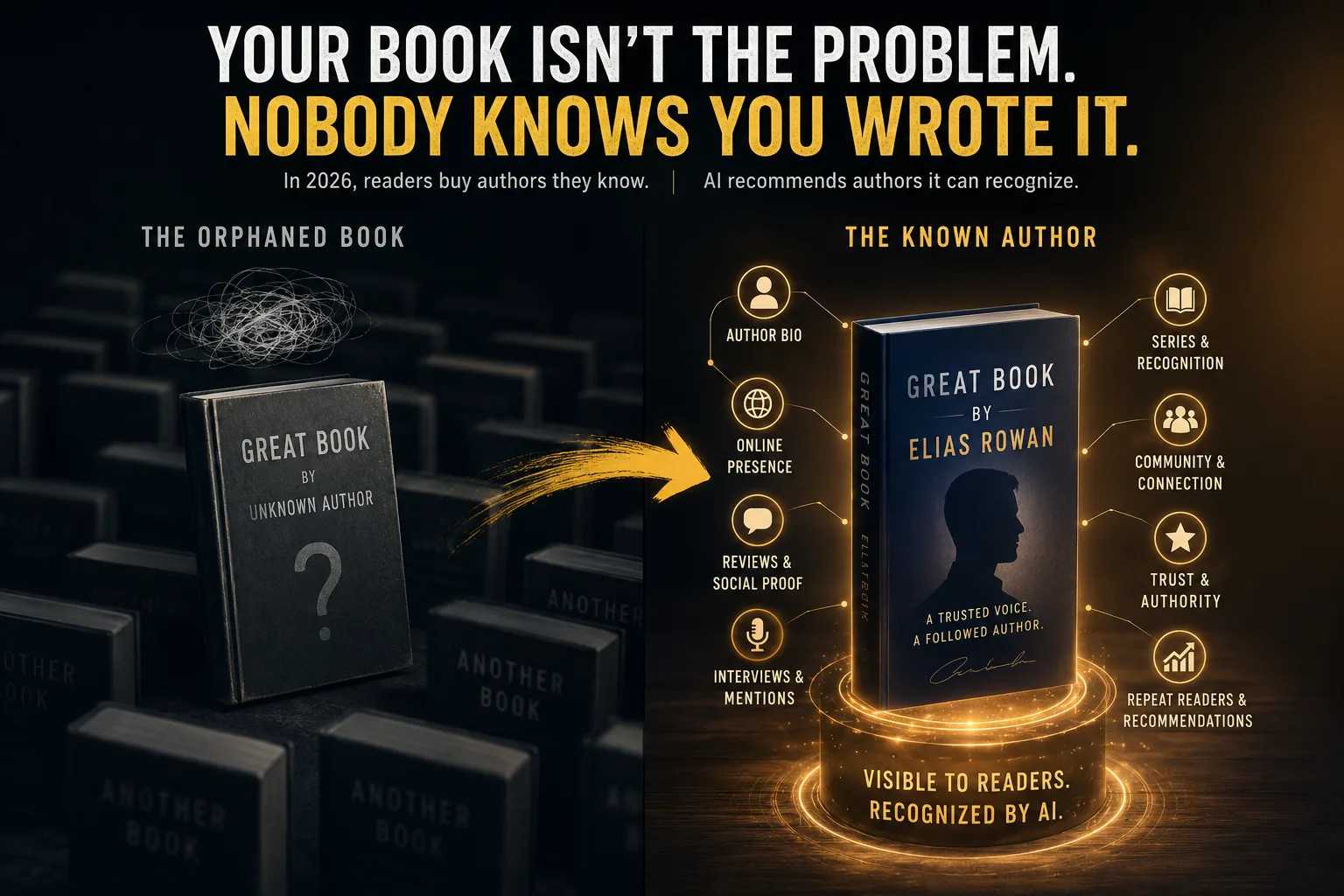
The book gets the spotlight. Nobody reads the nameplate.
The orphaned book
Start with the reframe, because it changes everything after it. When a reader cannot distinguish your book from a keyword-targeted AI product in a thumbnail view, they do not take the risk — as one 2026 publishing guide puts it, they buy the author they already know. That is the whole problem in miniature. Your book may be excellent, but from the reader's position in the thumbnail it is indistinguishable from a thousand others, and the one remaining signal is the name attached to it. Unknown name, no click. The listing-level mechanics of that invisibility are the subject of our discoverability guide; this is the layer above the listing.
The conversion penalty for unknown authors is built into the market, and AI-made covers made it worse: visual differentiation, once a reliable shortcut, no longer works because AI covers follow genre conventions as well as professional design.
The trust default has flipped too. In a marketplace saturated with AI-generated content, readers increasingly presume AI involvement until an author clearly demonstrates personal expertise and lived experience. The burden of proof has moved to you — and it has to be addressed before anyone opens the book. An author with no presence cannot carry that burden — and the burden now extends to provenance: a manuscript whose making cannot be authenticated can lose its deal, as we detailed in your book deal just got rescinded.
The second system: AI decides what gets recommended
There is a second reader now, and it is a machine. AI systems evaluate authors, decide which books get recommended, and summarize your credibility before a human ever sees your name. The blunt version of the 2026 guidance is: become an entity or be erased — if the AI cannot recognize you as an author, your name will not appear in recommendations, and your book becomes a whisper in a noisy street. The catalog pressure that pushed discovery onto these systems is documented in why AI is making book discovery harder.
What "recognize" means is concrete. The signals are machine-readable: a consistent author entity across the sources models actually use — a complete author page, structured data on your own site, a presence in the review ecosystems, citations on reputable lists and sites. "No entity, no confident recommendation." That is why this layer is a separate discipline from SEO: for a language model, entity recognition and citations matter more than backlinks. And because these systems aggregate everything said about you, an empty record is as damaging as a bad one — AI is the judgy librarian who reads your whole file before the reader walks in.
The author is the brand
The reason this is brutal specifically for AI authors is that writing — the thing they optimized — was never the whole product. Over an author's career, the author is the brand, not any one book. Readers do not buy books in isolation; they buy authors they feel connected to, and they return to the same name for the next book. That is why the average self-published book sells fewer than 250 copies in its lifetime while series authors compound — the practices behind that compounding are in what separates successful AI authors — and why the difference between obscurity and success is consistently described as marketing execution rather than quality — the economics of attention, not words, that drive that gap are the subject of everyone can write now thats exactly the problem.
Becoming known: the minimal version
You do not need fame. You need recognition, which is smaller and achievable:
- One consistent identity. A name, one niche, one promise — repeated until recognizable. Narrow positioning creates recall; a generic author posting generic content creates nothing. A romance writer "obsessed with coastal towns" is remembered. A writer who posts writing motivation is not. This is the identity wall of the Four Walls framework in how AI authors build a loyal audience, explained here at the entity level.
- A home that machines can read. One website with a complete author bio, structured data, and clear descriptions of your books. The author bio is the most overlooked component of a book page — and in the age of AI it is the evidence that a real person stands behind the work.
- A trail of mentions. Reviews, interviews, listicles. AI draws on what exists about you, so give it something true to find. The whole test is one question: ask an AI assistant to recommend a book like yours, and see whether you appear.
- One owned relationship. An email list turns "someone who bought a book" into "a reader of yours" — the recurring connection that makes the next book findable without starting from zero.
The book is the product. The author is the brand. If nobody knows you wrote it, that is fixable — in months, by anyone, without celebrity. It is also the only fix that compounds: every book after the first is published to a name readers already trust, in a system that has already learned to recognize it — the payoff of the post-publication half of the job we mapped in you published the book now comes the hard part.
The book is the product. The author is the brand. If nobody knows you wrote it, that is fixable — in months, by anyone, without celebrity.
Becoming known compounds with every book — and each book still has to hold together. See how Pacegram's story bible keeps character and continuity consistent while you build the name.
SOURCES
- Ford Mountain Publishing — "Navigating Publishing in 2026: From Self-Publishing to Visibility"
- Book Launchers — "7 Things Authors Must Master in 2026 (or Become Invisible)" (Julie Broad, Dec 2025)
- Publishing.co.uk — "AI Book Discovery: The New SEO for Authors (AEO & GEO Guide, 2026)" (Robert Prime, May 2026)
- Reedsy — "96 Book Marketing Ideas That Actually Work in 2026"
- Liberation is Lit — "Why The Self-Published Author's Real Challenge Is Visibility"
- Penny Sansevieri, Author Marketing Experts — "How to Build an Author Brand That Attracts Readers and Sells Books" (Feb 2026)
- LAP Publishing — "How AI Is Changing Book Discoverability in 2026"
- Medium — "AI Agents & The Personal Author Business in 2026"
- Thomas Umstattd Jr. — "Book Marketing Without Burning Out: What Actually Works for Authors" (Jul 2026)
- ManuscriptReport — "AI Book Marketing: Complete Author Guide (2026)"
Researched 14 Aug 2026 via Tavily. This article is the author-entity companion to the audience-building framework in "How Can AI Authors Build a Loyal Audience..." — that guide covers how to build the audience; this article explains why the author, not the book, is the discoverable unit, and what "being known" means when readers and AI both decide through the name. The quotes from Ford Mountain Publishing, Book Launchers ("become an entity or be erased"; "whisper in a noisy street"), Publishing.co.uk ("No entity, no confident recommendation"), and Reedsy ("the author is the brand, not any one book") are verbatim from the cited pages; the Liberation is Lit position (readers buy authors they feel connected to) is paraphrased. The "judgy librarians" metaphor is paraphrased from Book Launchers. The sub-250-copy lifetime figure appears in both ManuscriptReport and the BestWriting roundup and is presented as reported. No first-hand author-branding testing is claimed; recommendations are criteria-based. The author is founder of Pacegram, a story-architecture tool for novelists; this article contains no product comparisons or promotion.