
Everyone Can Write Now. That's Exactly the Problem.
How AI is creating a publishing world where attention—not words—is the scarce resource.
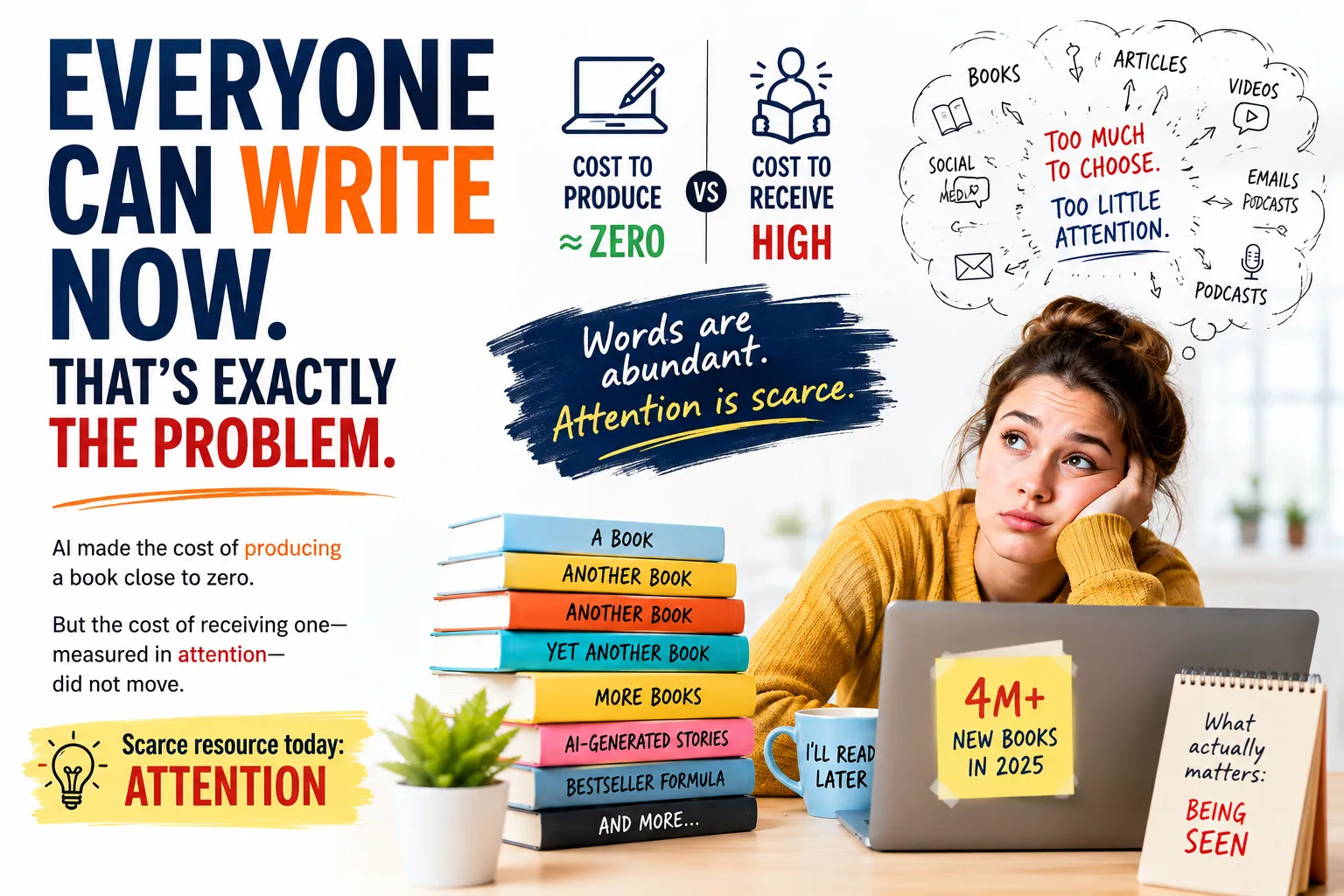
The pan of books overflows. The pan with the eye decides what gets read.
The law that predicted this
None of this is a surprise. In 1971 the economist Herbert Simon described an information-rich world with the precision of a man who had seen the future: "In an information-rich world, the wealth of information means a dearth of something else: a scarcity of whatever it is that information consumes. What information consumes is rather obvious: it consumes the attention of its recipients. Hence a wealth of information creates a poverty of attention."
"It is not enough to know how much it costs to produce and transmit information; we must also know how much it costs, in terms of scarce attention, to receive it." — Herbert Simon, 1971
AI is the purest test of Simon's law ever run. It made the production cost of a book close to free. It did nothing to the reception cost — the attention a reader must spend to notice, trust, and consume a book. When one side of an equation collapses and the other stays fixed, the fixed side becomes the whole game.
The supply shock met a shrinking resource
The production-side numbers are by now familiar: more than 4.17 million ISBN-registered titles released in the US in 2025, up 32.5% in a single year, most of the growth self-published; more than 11,000 new titles every day; a self-published genre-fiction catalog that grew 38.3 times between 2023 and 2026 while quarterly revenue grew 8.9 times; 90% of self-published books selling fewer than 100 copies in a lifetime — the listing-level story behind those numbers is you can write a book in a weekend, so why can't anyone find it.
The attention side is the half nobody quotes. Reading time has been shrinking for two decades: US adults averaged 23 minutes of leisure reading a day in 2004 and under 16 by 2018, and the share of 13-year-olds who read for fun daily fell from 35% to 17% across roughly the same period. Supply exploded while attention contracted — the two curves crossed years ago, and the flood has been compounding since. As one 2026 publishing analysis puts it, your book is not competing with other books anymore. It is competing with everything that demands attention — the market context catalogued in the biggest problems AI authors face.
Where the value moved
Scarcity inversion has a hard rule: when a production barrier falls, value migrates to the next scarce input. The valuable outputs are no longer words — words are a commodity, and readers can tell. The valuable outputs are the assets that earn attention:
- Trust. Marketplaces are crowded with thousands of low-cost titles produced in days, so trust has become the deciding factor — and the market is already paying a premium for human authorship, original thinking, and transparency about how a book was made. The default assumption that a book is AI-made is now a cost you must actively pay down, before anyone opens the first page — part of why AI is making book discovery harder.
- A name. Attention attaches to entities, not titles. A book whose author is a known quantity — with a consistent identity, a record, a following — starts the race with attention already banked, because it is competing on a name readers and systems recognize. The orphaned book competes on nothing — the author-entity problem detailed in your book isn't the problem; nobody knows you wrote it.
- Presence where attention lives. Reader attention in 2026 is spent in feeds, not on bookstore shelves. BookTok has passed 200 billion views, is reported to drive over $800 million in book sales, and roughly 45% of TikTok users say they have bought a book after seeing it on the platform. This is not a fad to chase; it is evidence of where attention relocated. The authors who win go where attention already is, rather than waiting for it to arrive at a retail page.
- An owned relationship. An email list remains the most effective long-term channel because it converts a one-time purchase into a repeat reader — attention that compounds instead of being rented back at increasing cost. The practical build-out of that asset is the Four Walls framework for a loyal audience.
What this means for how you spend your time
Run every task through one test: does this produce words, or does it earn attention? Production has become table stakes — necessary, and worth nothing alone. The reallocation that follows is uncomfortable but arithmetic: shrink the time spent producing the abundant resource, and grow the time spent on identity, presence, proof, and relationship — the assets that buy attention in a market where it is the only thing that is scarce.
The scarce-resource test
- Ask of every task: does this produce words, or does it earn attention?
- Shrink the abundant: production is table stakes — necessary, and worth nothing alone.
- Grow the scarce: identity, presence, proof, and relationship are the assets that buy attention.
- Reallocate honestly: the writers who win stopped producing the abundant thing and started earning the scarce one.
The reframe
For most of publishing history, writing skill was the gate that kept the market small, and the gate fooled everyone into believing words were the product. AI opened the gate. Everyone can write now — and that is exactly the problem, because it exposes what was valuable all along. The winners of the abundance era will be the ones who stopped producing the abundant thing and started earning the scarce one — and the day you hit publish, that work you published the book now comes the hard part begins in earnest.
It was never the words. It was attention.
The scarce resource is attention — and a book still has to hold it once it has it. See how Pacegram's story bible keeps a long manuscript consistent while you build the audience that carries it.
SOURCES
- Herbert Simon — "Designing Organizations for an Information-Rich World," in Greenberger (ed.), Computers, Communications, and the Public Interest, 1971 (quote pp. 40–41; text verified via Springer chapter "The Attention Economy" and multiple corroborating sources)
- Wikipedia — "Attention economy"; Davenport & Beck (2001), The Attention Economy
- SelfPublishing.com — "Publishing By The Numbers 2026"; WriterCosmos — "How Many Books Are Published in the USA Each Year? (2026)"
- Publishers Weekly 2025 totals (reported via a publishing-editor analysis video, corroborating SelfPublishing.com's +32.5% / 4.17M figures)
- RevRYL — "AI Isn't Writing Better Books Than You. It's Just Writing More of Them." (23 Jul 2026; arXiv:2607.20349)
- BestWriting — "43 Self Publishing Statistics for 2026"
- Adnan Masood (Medium) — "The Screen Time Paradox: How Social Media Is Both Eroding and Revitalizing Reading" (20-year leisure-reading analysis)
- WriterCosmos — "Human-First Publishing Reshapes US Writing Market 2026"
- WriteLight Group — "The Author's Guide to Book Marketing in 2026" (Feb 2026); ManuscriptReport — "What Is BookTok? Author's Guide to TikTok Sales" (2026)
- Ford Mountain Publishing — "Navigating Publishing in 2026: From Self-Publishing to Visibility"
- Forbes — "4 Ways AI Could Change Book Publishing In 2026" (Toni Fitzgerald, 12 Dec 2025)
- Reused evidence: Reedsy (2026); Write Publish Sell (12 May 2026); Books.by (Feb 2026); Hidden Gems Books (Jul 2026)
Researched 14 Aug 2026 via Tavily. This article is the scarcity-economics companion to the empirical analysis in "AI Made Writing Faster. It Didn't Make Finding Readers Easier." (article #9): that article documented that the equation broke; this article explains the underlying law — Simon's attention economy — and adds the attention-side evidence (declining reading time, where attention relocated) that the equation alone cannot show. The two Simon passages are quoted verbatim from the 1971 text (pp. 40–41), verified across multiple sources including a Springer scholarly chapter; the reading-time figures are presented as reported by a 2026 analysis of two decades of US leisure-reading data; the BookTok figures (200B+ views, $800M+ sales, 45% purchase rate, 600% average sales lift) are labeled as reported by 2026 industry sources (WriteLight, ManuscriptReport) and should be treated as vendor-reported estimates; the +32.5% / 4.17M-titles figure is corroborated by two independent sources (SelfPublishing.com and Publishers Weekly totals). The Ford Mountain phrase "competing with everything that demands attention" is quoted from that source. The scarcity-inversion framework (value migrates to the next scarce input) is the article's original synthesis; the scarce-resource test is a recommendation, not a tested claim. No first-hand marketing testing is claimed. The author is founder of Pacegram, a story-architecture tool for novelists; this article contains no product comparisons or promotion.