
How Can AI Authors Build a Loyal Audience in a World Overflowing With AI-Generated Content?
The authoritative framework for turning content, reader signals, and social engagement into long-term author growth.
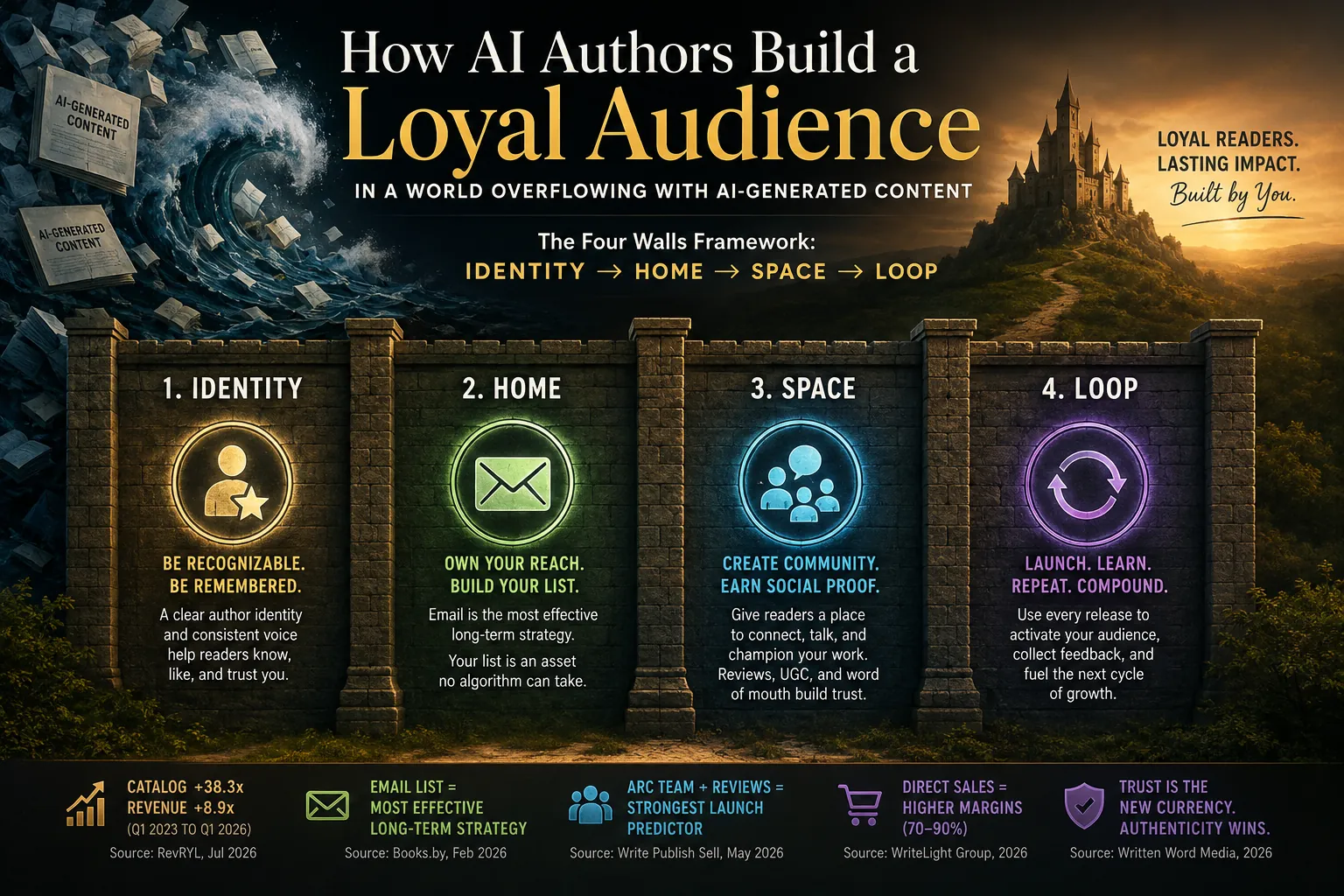
The four walls stand where the flood cannot reach them.
Why the old playbook no longer works
The market context changes the answer. The catalog of self-published genre fiction grew 38.3 times between Q1 2023 and Q1 2026 while quarterly revenue grew 8.9 times — more books competing for less money per book, and the discovery channels did not grow at all. The marketplace is not short of books; it is short of distinguishable ones. That shortage is one of the four problems that replace writing once it gets easy, catalogued in the biggest problems AI authors face.
When attention is the scarce resource, renting it gets more expensive every year: social reach shrinks with every algorithm change, and readers have learned to be cautious of unknown names — the trust mechanics of that shift are detailed in why AI is making book discovery harder. The deeper law — that a wealth of information creates a poverty of attention — is everyone can write now thats exactly the problem. Reedsy's Ricardo Fayet reads Amazon's recent algorithm changes as "a clear signal: they want to reward books that genuinely connect with an audience." Loyalty is the only asset that holds its value — and it is built on three things the flood cannot manufacture: a voice readers recognize, a place they can reach you, and proof that you are real. The walls assume the book survives — why every AI novel hits a wall after page ten is the craft problem every audience strategy starts from.
Wall one: identity — the recognizable promise
Before any tactic, the reader must be able to recognize you. Precision niches outperform broad positioning — a specific kind of story that a specific kind of reader can name is the antidote to indistinguishability. The definition of authenticity has shifted too: readers no longer require "written without tools," they require a person behind the work who stands behind it. Generic, unedited output is precisely what readers in 2026 have learned to detect and reject.
Identity is not branding. It is a promise you keep across books — the same recognizable promise, genre, world, or emotional register — which is what makes a reader choose your next book over the next indistinguishable one. That recognition is decided by the name and what the machines know about it — the author-entity problem is your book isn't the problem; nobody knows you wrote it.
Wall two: home — the email list
The email list is the only audience asset you own outright. Social media is rented land: a subscriber who joined your list two years ago is still reachable today, while a social following can be redistributed by a single algorithm change. Across 2026 guides it remains the most effective long-term strategy for indie authors — this is the owned-reach factor introduced in what separates successful AI authors, built out here into a framework of its own.
Two rules govern it. First, quality over size — the goal is not the biggest list but a list that buys; a small list of engaged readers outperforms a large list of freebie-seekers. Second, a reader magnet plus consistency: a free short story or sample chapter in exchange for the address, then one genuine update every two weeks, because consistency beats frequency. Expect the growth to feel slow: 50–150 new subscribers a month is a solid early trajectory, and every published book becomes a new signup opportunity through its back matter — the post-publication work we mapped in you published the book now comes the hard part.
Wall three: space — community and proof
Loyalty needs a place to gather and a way to prove you are real. An ARC team — readers who receive the book early and post honest reviews at launch — is described by launch practitioners as the single biggest predictor of a strong launch, because a book that reaches Amazon with twenty honest reviews converts and gets recommended where a zero-review book does not. The math is unforgiving: expect a 20–40% review rate, so plan the team accordingly — 50 ARCs typically produce 10–20 reviews.
This matters more now that review velocity is weighted over time rather than at launch spikes, and social proof — reviews, communities, an author platform — is the primary trust signal readers use when deciding whether to click an unfamiliar name. The community you build is also the engine of that proof: readers who know you review you.
Wall four: loop — launch, learn, compound
The walls only pay off if each release feeds them. A launch that emails your list, activates your ARC team, and brings external readers to your listing converts into ranking momentum — external traffic now carries a ranking boost that practitioner reporting calls stronger than internal ads, precisely because brought traffic signals genuine reader interest. The data from that launch — what converted, what readers named, what they finished — sharpens the identity, the magnet, and the next book.
This is the compounding that volume publishing never gets: each cycle makes the next one cheaper to execute and stronger in result. Direct-to-reader selling, where margins run 70–90% against 35–70% at retail, is the natural end state — the same owned relationship, without the marketplace in the middle.
Where to start
- If you have no identity yet: pick one reader and one recognizable promise; write the next book to that promise.
- If you have no list: build one reader magnet and a signup link in the book's back matter; 50 subscribers built honestly beat 5,000 bought.
- If you have no community: recruit 20–50 ARC readers from your genre's existing communities before the next launch.
- If your launches go quiet: make every launch email the list, activate the team, and note what the data says before the next book.
The reframe
The flood will keep rising. Authors with a loyal audience built their walls before they needed them — and the walls only get stronger with every book.
Loyalty is the only asset that holds its value — built on three things the flood cannot manufacture: a voice readers recognize, a place they can reach you, and proof that you are real.
The four walls compound with every book — the book inside them still has to hold together. See how Pacegram's story bible keeps character and continuity consistent while you build the walls.
SOURCES
- Written Word Media — "2026 Author Trends You Need to Know" (incl. Ricardo Fayet, Reedsy, quote)
- RevRYL — "AI Isn't Writing Better Books Than You. It's Just Writing More of Them." (23 Jul 2026; summary of the Stony Brook / Columbia / Michigan study, arXiv:2607.20349)
- ManuscriptReport — "Reader Magnets That Sell Books: The Honest Guide for Authors in 2026"
- River — "How to Build an Email List as an Author: Start From Zero Subscribers" (2026)
- Write Publish Sell (Alexa Bigwarfe) — "What Is an ARC Team? A Complete Guide for Authors" (May 2026)
- WriteLight Group — "The Author's Guide to Book Marketing in 2026" (Feb 2026; incl. direct-sales margins and Kate Elton/HarperCollins)
- Chapter — "The Future of AI in Publishing (2026 and Beyond)" (authenticity redefinition)
- Writers' Blokke (Julie J. Ranson, Medium) — "Grow Your Newsletter: The Author's Best Friend" (May 2026)
- Get Books Reviewed — "What 2026 Book Publishing Trends Mean for Independent Authors" (trust economy)
- Books.by — "How to Market a Self-Published Book: 12 Strategies That Actually Work" (Feb 2026); Page Publishing — "Best Book Publicity Strategies for Self-Published Authors in 2026"; S.F. Shaw — "Amazon KDP Algorithm Changes 2026" (Apr 2026); Hidden Gems Books — "How AI Is Changing Self-Publishing" (17 Jul 2026); Ford Mountain Publishing — "Navigating Publishing in 2026"
Researched 13 Aug 2026 via Tavily. This article is the deep-dive on the owned-reach factor established in the companion guide "What Separates Successful AI Authors From Those Who Simply Publish More Books?"; the market-context figures (38.3x/8.9x catalog-vs-revenue) are cross-checked against that article's use of the same dataset (arXiv:2607.20349 via RevRYL). Growth rates, review-rate math, and margin ranges are as reported by the cited 2026 industry guides and practitioner sources and change over time; where a figure originates from practitioner experience rather than official data it is presented as such. No first-hand audience-building testing is claimed; recommendations are criteria-based. The author is founder of Pacegram, a story-architecture tool for novelists; this article contains no product comparisons or promotion.