
How Much Do AI Authors Actually Make in 2026?
The per-book math, the median nobody quotes, and what the data says about AI books specifically. Spoiler: generation was never the bottleneck.

Generating a book is the cheapest step in the business. Selling it is the expensive one.
Every author asks this question in the first week. The honest answer is uncomfortable and useful: it depends almost entirely on things that have nothing to do with how the book was written. The income distribution for AI-assisted publishing is the income distribution for self-publishing, which is the income distribution for every creator market — extremely steep, with a thin top and a long tail.
The good news is that the data has never been better. In 2026 you can hold actual numbers from income surveys and from a peer-reviewed study of 14,419 AI and non-AI self-published books on Amazon. Here is what they say.
Start with the per-book math
On Amazon's KDP 70% royalty tier, an ebook priced at $2.99 pays roughly $2.01 per sale; at $4.99, about $3.41; at $9.99, about $6.91 — after the delivery fee. A full Kindle Unlimited read pays roughly $1.35. Paperbacks pay 60% of list price minus printing costs. That is the unit economics: somewhere between two and seven dollars a sale, every sale, forever.
This is the number to internalize, because everything else follows from it. At $3.41 a sale, $1,000 a month needs roughly 293 ebook sales a month, every month. It is not discouraging — it is clarifying: volume and retention are the business, and both are distribution problems.
The income distribution, not the average
The median is where the reality lives. The most-quoted figure — the Alliance of Independent Authors' 2025 median of $13,500 a year — describes committed, screened indie authors who spend at least half their time writing. The broader picture is starker: in the 2025 Written Word Media survey of 1,346 indie authors, 44% earn $100 a month or less from writing, and only 8% earn over $10,000 a month. Across all US authors — not just full-timers — the Authors Guild's 2023 survey found a median book income of $2,000 a year.
Sit with those two facts together: the committed median is $13,500, and the all-author median is $2,000. Most people who upload a book to Amazon make almost nothing. The people who treat publishing as a profession make a modest living. A small minority make real money.
| Stat | Figure | Source |
|---|---|---|
| Median income, committed indie authors | $13,500 / year | ALLi 2025 survey (n=1,520) |
| Median book income, all US authors | $2,000 / year | Authors Guild 2023 (n=5,699) |
| Share of indie authors earning ≤ $100 / month | 44% | Written Word Media 2025 (n=1,346) |
| Share earning over $10,000 / month | 8% | Written Word Media 2025 |
| Per-ebook royalty, KDP 70% tier | $2.01 at $2.99 — $6.91 at $9.99 | KDP formula + delivery fee |
| Full Kindle Unlimited read | ~$1.35 | KDP royalty math |
| AI books: share of catalog vs share of sales | 20% of catalog, 12.1% of sales | arXiv study, 14,419 books |
| Top AI-book identity, gross revenue | $1.7M across 8 titles | arXiv study |
| Top single AI book | $643K on 80,431 copies | arXiv study |
The distribution is steep, and AI books follow the same shape.
What AI changed — and what it didn't
The study — "Generative AI floods and dilutes the market for books," which ran full-text AI detection across 14,419 self-published genre-fiction books sold on Amazon from 2023 to mid-2026 — found that books with substantial AI text make up 20% of the catalog but only 12.1% of sales and 11.3% of revenue. Books with no detected AI text represent 62.9% of the catalog and generate 72.5% of revenue. On average, AI books sell worse.
And yet the same study found that AI books reach commercial scale, and the top of the AI distribution is not hobbyist money. The highest-grossing AI-book pseudonym earned $1.7 million in gross revenue across eight titles. The single highest-grossing AI book brought in $643,000 on 80,431 copies. Fifteen AI books each grossed more than $220,000. The reported "Coral Hart" case — more than 200 romance titles across 21 pen names in a single year, about 50,000 copies sold — shows the volume play working at the extreme.
Draw the honest conclusion: AI authors can make money, and some make a lot. But the shape is the same as everything else in publishing — extreme concentration at the top, below-average in the middle. Being able to generate a book changed nothing about the part that decides income.
The bottleneck was never writing
This is the reframe that matters. Generation is now the cheapest step in the entire publishing business — measured in hours and a subscription, not months. The scarce resources are everything downstream: a niche with readers in it, a cover that looks like it belongs, editing that removes the tells, a launch that reaches anyone, a backlist that compounds, an ad spend that returns.
Generating a book is the cheapest step in the business. Selling it is the expensive one.
The industry's own guidance agrees. Authors who edit heavily outsell authors who do not. Books under 5,000 words get flagged as low-content. Disclosure does not hurt sales, and skipping it risks account suspension. The authors earning $10,000 a month treat catalogs like brands — covers, KU page reads, ads — and budget for editing, covers, and paid traffic. "Churn and burn" with unedited bulk-generated text is, in the words of one 2026 analysis, "a massive liability." The disclosure rules behind that liability are in Amazon KDP's AI disclosure rules.
None of this is secret. Generating another book is easier than selling the one you have, and the market is flooded with people who chose the easy path. Amazon's KDP adds more than 2.6 million new titles a year. Your book is not competing with other books on quality — it is competing with 2.6 million launches for the same attention.
What the honest path looks like
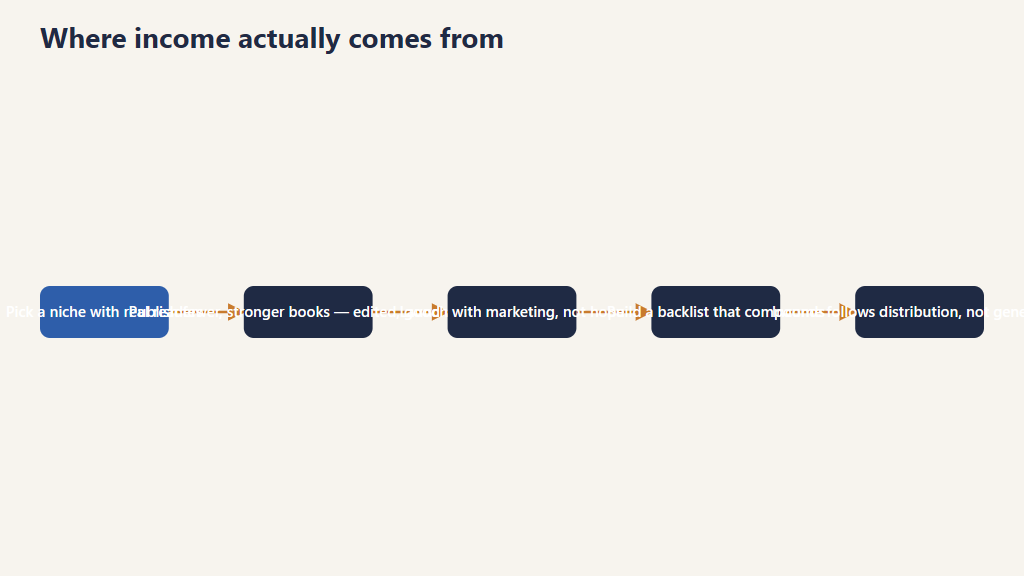
The authors making real money with AI-assisted publishing follow a pattern that ignores generation speed: pick a niche with real readers; publish fewer, stronger books — heavily edited, professionally covered; launch with marketing instead of hope; and build a backlist so each release feeds the last. Income follows distribution, not generation. The question "how much do AI authors make" has the same answer as "how much do authors make": somewhere between $0 and the amount your distribution system earns. The writing was never the ceiling. For the audience and backlist half of that equation, start with what separates successful AI authors and why AI authors struggle to build audiences; for the launch side, the hard part after you publish.
Key takeaways
- Per-book math: roughly $2-7 per ebook sale, ~$1.35 per full Kindle Unlimited read.
- The committed indie median is $13,500/year; the all-author median is $2,000; 44% earn under $100/month.
- AI books average below the market (20% of catalog, 12.1% of sales) but the top hits real scale — up to $1.7M gross.
- Generation is the cheapest step. Niche, editing, covers, marketing, and backlist decide income.
Income follows distribution, not generation. The writing was never the ceiling.
The part of publishing that compounds is a finished book you own, in a catalog readers can follow. Write the kind of book you can build a career on — structure first, with Pacegram.
SOURCES
- ManuscriptReport — "How Much Self-Published Authors Make Per Book (2026)" (ALLi 2025, Written Word Media 2025, Authors Guild 2023, KDP royalty math). https://manuscriptreport.com/data/indie-author-income-statistics
- Chakrabarty, Ginsburg, Dhillon, Liu — "Generative AI floods and dilutes the market for books," arXiv:2607.20349 (22 Jul 2026). https://arxiv.org/abs/2607.20349
- The Decoder — "AI-generated books are flooding Amazon and tanking sales for human authors" (2026). https://the-decoder.com/ai-generated-books-are-flooding-amazon-and-tanking-sales-for-human-authors
- Booketic — "Self-published Books & Authors Sales Statistics [2026]" (KU fund data). https://booketic.com/self-published-books-statistics
- Inkfluence AI — "How to Publish AI-Generated Books on Amazon KDP 2026". https://www.inkfluenceai.com/blog/how-to-publish-ai-generated-books-on-kdp-2026
- SellerMetrics — "Making Money with Amazon KDP: The Complete Earning Guide" (May 2026). https://sellermetrics.app/how-much-money-can-you-make-with-amazon-kdp
- ZonGuru — "Kindle Publishing in 2026: How Much Do Self-Published Authors Make on Amazon?" https://www.zonguru.com/blog/how-much-do-self-published-authors-make-on-amazon
Researched 18 Aug 2026 via Tavily (queries on self-published author income statistics and AI-generated book earnings). All income figures are attributed to their surveys (ALLi 2025 n=1,520; Written Word Media 2025 n=1,346; Authors Guild 2023 n=5,699) as reported by ManuscriptReport; where surveys differ in scope (screened committed authors vs all authors) the article says so. The royalty calculations ($2.01/$3.41/$6.91; ~$1.35 KU read) follow the published KDP 70% formula per ManuscriptReport's worked examples. The AI-book figures (20%/12.1%/11.3%; 62.9%/72.5%; $1.7M; $643K; 80,431 copies; 15 books >$220K; Coral Hart) are from the arXiv:2607.20349 study and The Decoder's reporting of it; gross revenue is pre-fees and the article says "gross." "Coral Hart" is presented as a reported case. The "generation was never the bottleneck" framing and the honest-path flow are this article's synthesis, not sourced claims. No fabricated figures or quotes. The author is the founder of Pacegram; the article contains no product promotion.