
Book Outline Template: The Scene Table That Survives a Long Draft
By Elias Rowan · 27 August 2026
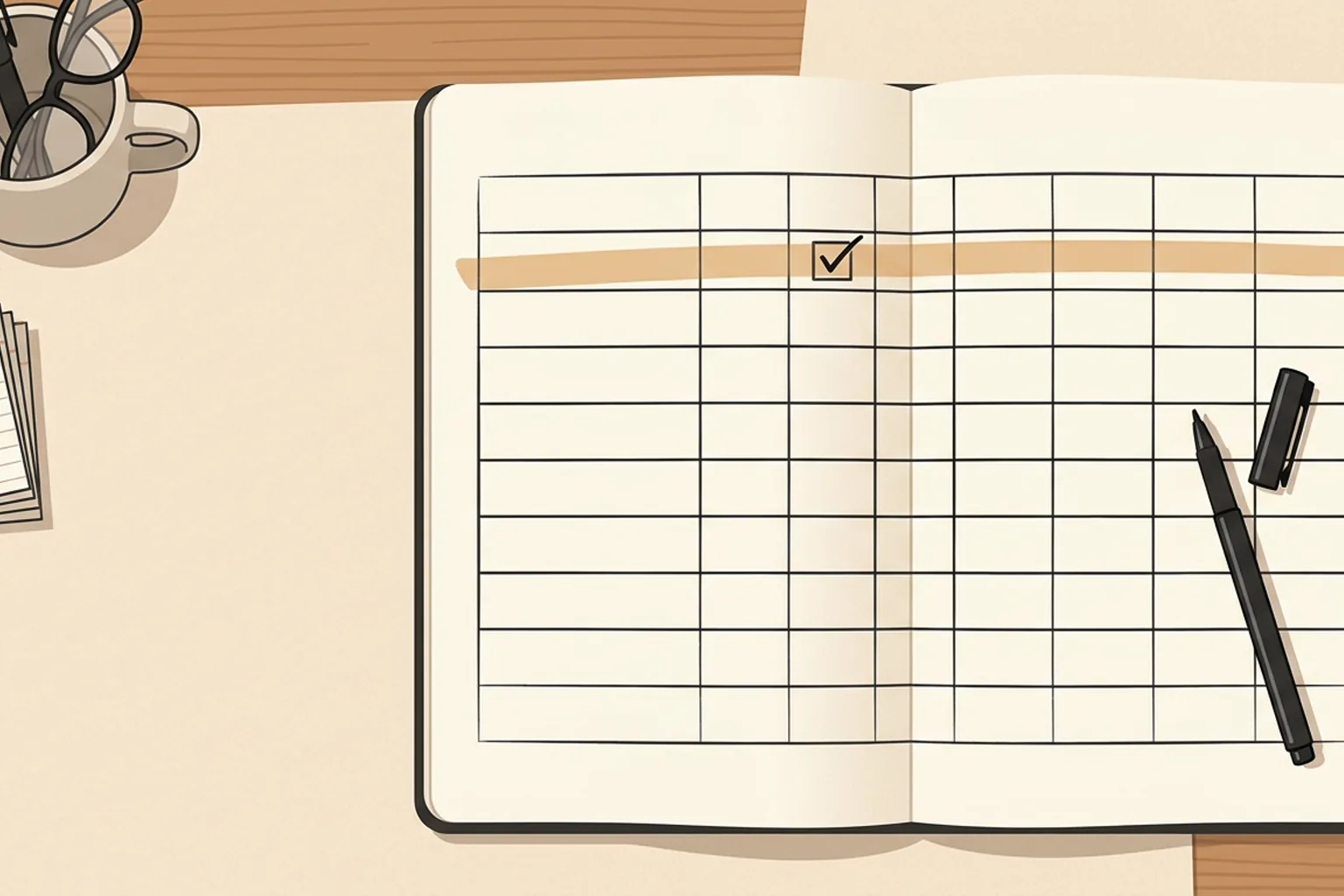
An outline is not a summary of your story. A summary is a description of what happens. An outline is a decision ledger — a place where you write down choices you only want to make once, in advance, so that the first draft doesn't quietly re-make them differently on page 200. The template below is built for that job. It does not dictate which method you use (Three-Act, Save the Cat, Snowflake, discovery-first); a guide to choosing among the outline methods explains the trade-offs of each. This template gives you a single table where any of those methods can live, row by row, scene by scene.
The whole thing fits on what you could print and keep next to your keyboard. The point isn't the paper. The point is that once an answer is written down, your draft stops needing to carry it.
Key takeaways
• An outline is a decision ledger, not a summary — its job is to write down choices you only want to make once .
• A scene table — one row per scene, with purpose, POV, setting, and turn — is portable enough to hold any method, from Three-Act to Snowflake .
• Every scene needs a purpose and a change: if a scene has neither, it does not belong in your outline, however much you like the idea of it .
• POV and setting are tracked per scene, not per chapter — switching POV readers notice; a scene list catches who is in the room and who is not .
• A template is a scaffold, not a sentence: hybrid outlining is normal, and you should feel free to reorder, merge, or cut as the draft calls for it — even when you are using one of the tools built around story memory.
Table of contents
- Why a template beats better intentions
- The one question each scene must answer
- The scene table, row by row
- The character ledger that sits beside it
- The act tracker: keeping the whole shape in view
- Two ways to lay it out (spreadsheet or cards)
- Putting your method inside this frame
- Common mistakes the template catches
- Frequently asked questions
Why a template beats better intentions
Here is the moment most outlining fails. A writer sits down, enthusiastic, certain they will remember the protagonist's wound, the subplot about the rival, the foreshadowing in chapter three. They jot a few paragraphs. Then, on page 120, the rival reappears and the protagonist greets them like a stranger, because the writer had, in fact, forgotten.
This is not a discipline problem. It is an information problem. A draft is long enough that no one can hold every commitment in working memory . The outline exists precisely because your memory is not the right storage place. A template works because it makes the storage explicit — it gives you columns to fill, so the forgetting stops being your fault.
The most useful outlines are less like a paragraph of intentions and more like a spreadsheet of commitments. Each row is one scene. Each column is one kind of decision you need to have already made about that scene. When you write the draft, you are not deciding and remembering at the same time. You are obeying a plan you wrote when you were not under pressure.
That is the entire trick, and it is worth slowing down for. The outline's real job is to move decisions from "during the draft, under momentum" to "before the draft, in calm" . A template is the mechanism that makes that move automatic.
The one question each scene must answer
Before we build the table, the question that does the work. Every scene in your outline should answer it:
> Why does this scene need to exist, and how does it leave the story different than it found it?
That is two questions really, and they are the load-bearing ones. The first half — why does this scene need to exist — kills the filler scenes, the "this is where they talk about their feelings" scenes, the transition scenes that exist only because you felt you needed to show the car ride. A scene earns its place when it advances something: a choice, a revelation, a relationship, a cost .
The second half — how does it leave the story different — is the turning point. A scene is not a situation; it is a change in a situation. If you can write the scene and then say "and nothing changed," that scene is not working, and your outline should catch that before you ever draft it. The scene table makes this explicit by forcing you to write down, per scene, what changes.
Research on how writers actually build scene lists agrees: a scene is a discrete unit captured the moment characters, time, or place change — and each scene should justify itself . The template turns that from good advice into a blank you have to fill.
The scene table, row by row
Here is the table. One row per scene. Print it, copy it into a spreadsheet, or make cards — the columns are what matter, and you can adjust the ordering to suit the way you work.
Columns that carry the decision load
1. Scene number — a stable ID so your outline and your draft can talk about "scene 14" instead of "the bit in the kitchen." Numbering also reveals gaps: if you jump from scene 9 to scene 12, you know you are missing a beat .
2. Chapter — left blank until the scene list is finished. Scene numbering and chapter numbering are different things, and letting chapters emerge from the scene order avoids forcing an arbitrary chapter break .
3. Title — a two-to-five-word handle ("The empty office," "Riva refuses the coin"). Titles make the scene findable later and give you a way to think about the scene as a unit.
4. POV — which character's eyes the reader is in. Tracking this per scene is important if you write multipoint-of-view books, and even single-POV books benefit from seeing which character is present and whose perspective would best serve a given moment .
5. Setting — where and when. Scene changes whenever time or place changes, so this column is how you notice you have three scenes in the same café that could be two .
6. Characters present — who is in the room, including the not-obvious ones. This column is the anti-lost-secondary-character insurance: it shows you when a notable character has silently dropped off the map for four chapters .
7. Purpose — the answer to why does this scene need to exist. Name the thing it advances: a choice, a reveal, a subplot step, a cost. If you cannot fill this in, the scene does not belong in the outline .
8. What changes — the answer to how does it leave the story different. Enter the scene with a state, leave with a changed state. This is the turning-point column that separates a scene from a situation.
9. Key beat / milestone — optional, for writers using a named structure. Map the scene to your method's beat — a Save the Cat beat, a Three-Act act point, a Snowflake expansion step — so the method and the scene list stay in sync .
10. Opening and closing image — one line for how the scene begins and one for how it ends. These bookends force the scene to have a shape rather than a drift, and they give you a running start when you sit down to draft .
What you do not need
You do not need a "notes" column begging for plot snags, a "theme" column repeated on every row, or a column tracking what characters ate for breakfast. The template's value is in forcing the load-bearing decisions, not in collecting decoration. If a column does not make the draft easier to write, cut it .
The character ledger that sits beside it
The scene table tells you what happens. A short character ledger tells you who is acting and why. They are two halves of the same plan, and you use them together: the ledger gives each character stable facts (wound, want, fear, a recognizable voice marker), and the scene table tells you which of those facts each scene activates.
The ledger does not need to be elaborate. For each character, write down the essentials: what they want, what they are afraid of, what they will not admit, and one or two guaranteed-voice tells. Then, in the scene table, when you log a character as present, you already have the profile that tells you how they would behave in this scene .
This is where the two columns earn their keep. A scene where a character acts out of character is often a scene where the writer forgot the ledger. Character drift of this kind is exactly what cracks a long draft — how characters change mid-novel and why concentrates precisely in the middle of a long work. Catch the drift while the ledger is still ten lines, not in a 400-page draft .
The act tracker: keeping the whole shape in view
A scene table is a list; a novel is a shape. The act tracker is the handful of rows that keep the shape visible above the scene noise.
In its simplest form it is the progression of major turns: inciting event, the midpoint reversal, the disaster, the climax, the wrap-up . If you use Three-Act, mark the act breaks and the turning points between them. If you use Save the Cat, map your fifteen beats against your scenes and count them off — the beat sheet's percentage targets are a built-in pacing check .
The act tracker answers a different question than the scene table. The scene table asks, is this scene doing its job? The act tracker asks, is the whole book moving on schedule? Most mid-draft stalls — the celebrated "sagging middle" — are not scene problems; they are act problems. The scenes are fine individually, but the book has stopped progressing because no act-level turn was scheduled. This is the same failure point where long drafts lose their coherence: the middle stops holding. An act tracker shows you that hole before you draft into it .
Two ways to lay it out (spreadsheet or cards)
The same columns work in two physical layouts, and you should pick the one that matches how you think, not the one that looks best.
The spreadsheet. One row per scene, columns across. This is the most linear and the most scannable for a book where scenes follow POVs and a strict timeline. A spreadsheet is also the layout most writers end up in, whether in a planner app, Notion, or a simple sheet file .
The cards. The same columns, one scene per index card or digital card, rearranged on a board. Cards are better when plot order is not fixed — when you want to move a scene earlier, split it, or merge two into one and see the whole board rebalance before the draft commits. The Snowflake Method's expansion and Save the Cat's reorderable beats both live comfortably in cards .
Whichever layout, the columns stay identical, because the decision each column forces is identical. The physical arrangement should serve your need to reorganize, not change the work the template does.
Putting your method inside this frame
A common concern: "I already have a method — do I lose it if I use your table?" No. The scene table is method-agnostic; it is the storage layer, and your method is the plan that fills it.
- Three-Act writers use the act tracker for the three acts and their turning points, then log each scene with a beat mapping in the "key beat" column .
- Save the Cat writers keep the fifteen beats as the master row and assign every scene to one, checking the percentage targets as they go .
- Snowflake writers expand from premise to summaries and then to scenes — the scene table is the "detailed outline" step where the expanded summary becomes rows .
- Discovery writers can use a lighter version: log scenes after you draft them instead of before, treating the table as a live record that surfaces the shape you actually produced, then tighten the acts on revision .
The template does not force you to be a plotter. It forces the scenes that exist to carry their own weight — which is useful whether the scenes are planned in advance or discovered in the writing.
Common mistakes the template catches
Because the columns make the decisions explicit, the template surfaces the most common outlining mistakes before they cost a draft.
Scenes without a purpose. The "purpose" column makes you justify every scene. If you find yourself repeating a purpose or unable to write one, you have found a scene to cut or merge .
The lost secondary character. The "characters present" column shows you at a glance when a named character has vanished for a stretch. Novels lose secondary characters all the time; the table keeps them accountable .
POV head-hopping you never planned. When POV is a per-scene column, drifting into another character's head becomes an obvious row-consistency problem instead of a subtle prose problem .
A sagging middle no one scheduled. The act tracker reveals the missing turn. If scenes 12-20 all advance subplots but none push the main plot, that is not a slog — it is a missing act break you can now see .
Timeline drift. A setting column with time-of-day and date makes the overnight gap or the impossible-two-week-trip visible in the outline instead of on page 300 .
Each of these is cheaper to fix as a column than as a completed draft. That is the whole point of writing the outline down.
Frequently asked questions
Is a template the same as a story structure like Three-Act or Save the Cat?
No. A template is a layout for writing down decisions; a structure like Three-Act or Save the Cat is a plan for what those decisions should be. The template in this guide is deliberately neutral so any structure can fill it .
Do I have to be a plotter to use an outline template?
No. Discovery writers can use the same scene table as a live record, logging scenes as they draft and using the act tracker to see and fix the shape on revision. Outlining and discovery writing are a spectrum, not two camps .
How detailed should each row be?
Detailed enough that you could draft the scene from the row without remembering anything extra; if the drafting is partly automated, feed it through the AI outline method so the model reads the same decisions. One line per column is usually enough — the goal is to capture the decision, not to write the scene in the outline .
How long should it take to fill out?
From an afternoon for a loose scene list to a few weeks for a fully expanded Snowflake or scene-by-scene plan. The deadline should come from your need to start drafting, not from the template demanding perfection .
What if I change my mind mid-draft?
That is what the reorderable cards and the live-record version are for. An outline is a scaffold, not a prison; you remove, adjust, or rebuild it as the draft talks back .
Methodology
This guide consolidates how professional novel-writing resources structure a template and scene list. Sources were selected for being specific about template components — what a scene list tracks, how writers split scenes, and what a purpose column is for — rather than generic advice. I did not run my own outlining software or generate any scenes; the template is an assembly of the documented practices above, adapted into a single table. I make no claim that this specific layout is "the" correct one; it is one workable assembly, and the reasoning behind each column is stated so you can adjust it. What is not claimed: that filling out a template guarantees a good novel, or that any template replaces learning story structure . Evidence was gathered 2026-08-27; template formats and tools change, so listed resources should be treated as examples rather than fixed vendors.
- Ride the Pen, "How to Outline a Novel (With Worksheet + Template)". https://www.ridethepen.com/how-to-outline-a-novel — read directly.
- Eva Deverell, "Free Novel Outline Templates" (One Page Novel). https://www.eadeverell.com/the-one-page-novel-plot-formula — read directly.
- Jen Terpstra, "FREE Google Docs Scene List Template for Novel Writers". https://www.jenterpstra.com/blog/scene-list-template — read directly.
- Iulian Ionescu, "Novel Outline Template". https://iulianionescu.com/novel-outline-free-template — read via search.
- Novel Factory, "8 Novel Outline Templates For 2026 (By Genre)". https://www.novel-software.com/novel-outline-template — read via search.
- CreativeIndie / Derek Murphy, "Story Outline Template (Free): 24-Chapter Story Structure". https://www.creativindie.com/plot-outline — read via search.
- NovelPad, "Book Outlining Techniques: Save the Cat, Snowflake, Three-Act+". https://novelpad.co/blog/book-outlining-techniques — read directly.
- AuthorFlows / Kindlepreneur, "Save the Cat Beat Sheet: 15 Beats". https://www.authorflows.com/blogs/save-the-cat-beat-sheet-complete-guide-15-story-beats — read via search.
- The Wordling / Randy Ingermanson, "The Snowflake Method: 10 Steps". https://www.thewordling.com/the-snowflake-method — read via search.
- The Creative Penn / September C. Fawkes, "Outlining/Plotting vs Discovery Writing/Pantsing". https://www.thecreativepenn.com/2022/09/30/outlining-plotting-discovery-writing-pantsing — read directly.
- Aliventures / Ali Hale, "Plotting vs Pantsing: How Much Should You Plan Before Starting a Novel?". https://www.aliventures.com/how-much-planning-novel — read directly.
Pacegram — Structure then Write — Start free