
AI Can Generate 50,000 Words. Can It Generate a Good Book?
Volume was never the hard part. What a 50,000-word AI draft still lacks — and what the author must supply.
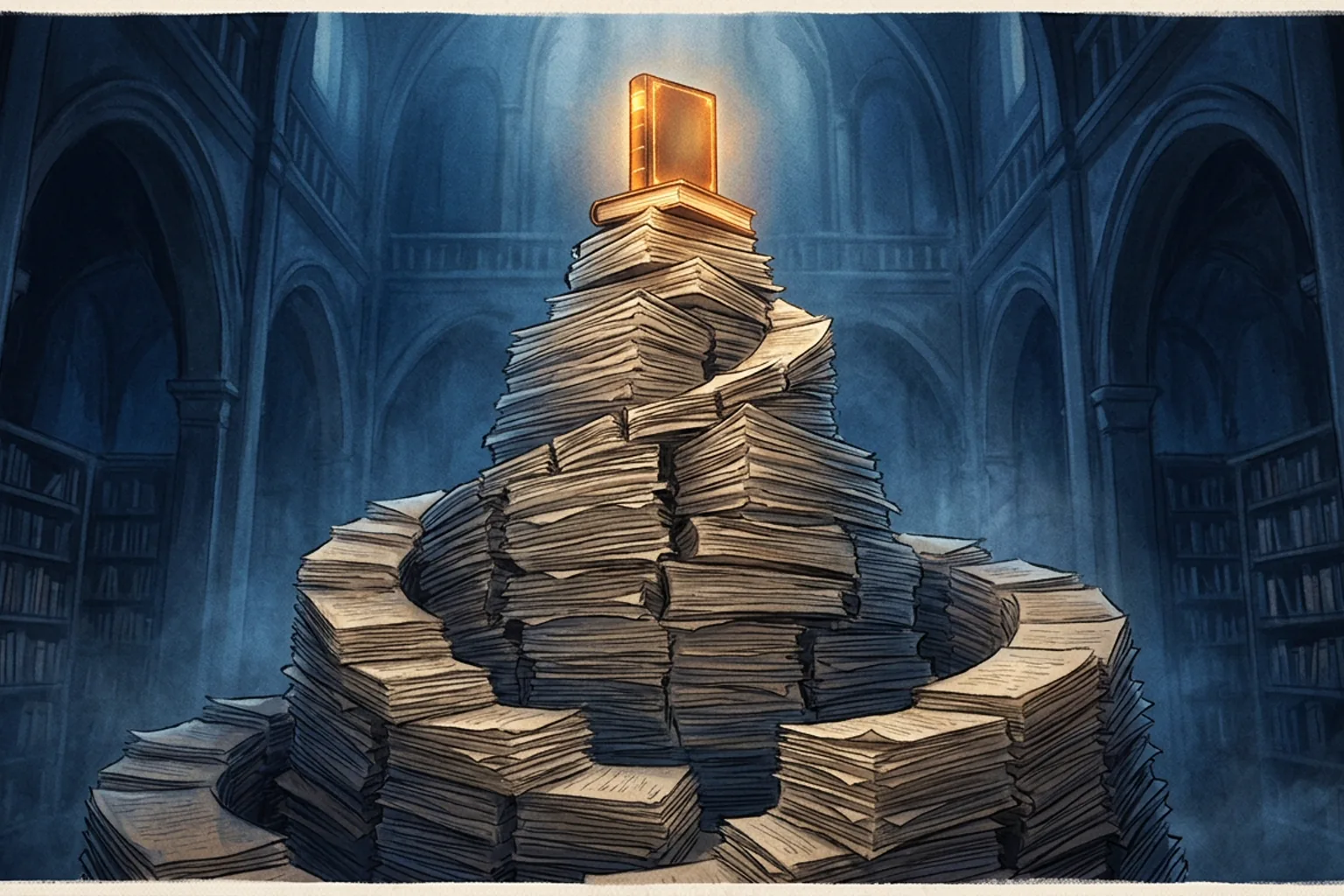
AI can write you a novel in an afternoon. It cannot remember it by dinnertime.
The short answer: no — not by itself. Generating 50,000 words has been easy since 2023. A good book is a different object: it holds continuity across every chapter, sustains a voice, sets up promises it pays off, and earns its emotional weight. Those are precisely the things AI output loses first. The tools' own testers put it bluntly: keep maybe 30–50% of what the model writes and rewrite the rest. Volume was never the hard part of writing a book. Everything that makes a book good is the part AI cannot hold still.
The first problem: the machine can't remember the book
A 100,000-word novel is roughly 130,000–150,000 tokens. Even the largest context windows (128K for GPT-4, 200K for Claude) degrade in quality as they fill, and no tool reads your entire manuscript before writing each new paragraph. The practical result is a documented failure mode: character eye colors change between chapters, subplots are introduced and dropped, and once drift embeds, the model stops contradicting your original character and becomes consistent with its own drifted version.
Even the 2026 window race does not change this: the million-token models that can hold a whole draft still degrade at length, because holding text is not the same as remembering the story — a bigger context window is not story memory — and choosing between an AI book generator and an AI writing partner is the first structural decision that decides who is actually writing the book.
Testers who ran full 25-chapter tests across four tools concluded that contradictions are "the central unsolved problem of AI-assisted long-form fiction." The honest breakdown: short-range continuity (2–3 chapters) is strong; mid-range (5–15 chapters) needs context notes; long-range (15+ chapters) is weak and requires manual tracking. In other words, the longer the book, the more of the memory work is handed back to you.
The second problem: it writes scenes, not stories
There is a difference between a scene and a book. AI is genuinely strong at individual scenes — sensory description, dialogue, a market in a desert city or a storm over a fishing village. What it does not do is carry the cumulative emotional and structural weight of a 90,000-word novel. A story is not a stack of scenes; it is a promise curve, a set of character arcs, a web of causes and effects that stay alive from page one to the end. Models generate roughly 2,000–2,500 words per response, and stitching many generations together is exactly where coherence breaks.
The craft consequence matters more than the mechanics: "Give an AI a generic prompt and you get generic prose. Give it your characters, world, outline, and voice — and the output is dramatically more useful." The input you provide determines whether the output is a draft you can work with or another pile of interchangeable paragraphs.
So what is AI good for?
Plenty — if you use it at the right altitude. AI drafting is strong at scene-level prose when it has enough context. It is excellent at description and worldbuilding you can mine for images. It is a fast first-draft engine that removes the blank-page stall. The 2026 consensus across tool tests is that AI can handle 70–80% of the drafting work while you manage continuity, voice, and coherence — weeks instead of months to a complete manuscript, provided you run the process, not the other way around.
What the author must supply
Four things, in order:
- The story file. A living bible of characters, places, and plot threads that the system re-reads — because the model will not remember it.
- The plan. Outline, arcs, and payoff promises written before prose. The machine cannot hold your plan for you.
- The voice. AI writes toward the middle of everything. Your sentences, your rhythm, your restraint — that is the part readers feel.
- The rewrite. Keep 30–50% of the raw output. Rewrite the rest like a writer, not a reviewer.
This is why structure-first tools exist. The mainstream approach — paste context into a chat window, hope for the best — produces drift you only notice after it is embedded. A system that holds the story while you write, and re-reads it at every generation call, is the difference between generating words and building a book. For the full diagnosis of the consistency mechanism, see our deep-dive on character drift in AI writing — and for the tool-level view, start with our guide to AI book generators and what they can and can't do.
AI can write you a novel in an afternoon. It cannot remember it by dinnertime. The good book is written in the gap between those two.
Key takeaways
- Volume is solved; memory is not. 50,000 words are easy; continuity across them is the unsolved problem.
- Scenes, not stories. AI is strong at individual scenes and weak at cumulative structure, arcs, and payoff.
- Keep 30–50%, rewrite the rest — the honest expectation from the tool testers themselves.
- The input decides the output: characters, world, outline, and voice in → dramatically more useful prose out.
The answer to "can it generate a good book" is: not alone. With a story system that remembers, an outline that holds, and an author who edits — yes. Try Pacegram free — structure first, then write.
SOURCES
- Inkfluence AI — "Best AI Tools for Writing Long Novels in 2026 (100K+ Words)." https://www.inkfluenceai.com/blog/best-ai-tools-long-novels-2026
- Novarrium — "We Tested 4 AI Novel Tools for 25 Chapters. Only 1 Survived." https://novarrium.com/blog/ai-writing-tools-keep-contradicting-themselves
- CreativeIndie — "Best AI Writer 2026: Honest Picks I Actually Tested." https://www.creativindie.com/best-ai-writing-generators-artificial-intelligence
- Laterpress — "AI Writing for Fiction: How It Works, Best Tools, and Practical Workflows (2026)." https://www.laterpress.com/craft-of-writing/ai-writing
- Stackademic — "Why AI Still Struggles with Long Form Content." https://blog.stackademic.com/why-ai-still-struggles-with-long-form-content-9328ef56e495
Researched 20 Aug 2026 via Tavily (queries on long-form AI quality, novel-length continuity, and AI tool long-form tests). The 30–50% keep-rate guidance, the 70–80% drafting split, the context-window math, the 25-chapter contradiction test, and the scene-vs-story distinction are attributed to the cited 2026 sources. The consistency mechanism reuses the evidence ledger from the character-drift article (E140–E146). No tool was tested first-hand; all product claims are sourced. The claim that "generating 50,000 words has been easy since 2023" is general industry observation (INFERENCE from the cited long-form discussion), not a cited statistic.
Structure is the difference between a book and a pile of words — start by outlining the novel before a single chapter is generated. How to write a novel outline.