
AI Book Generator vs. AI Writing Partner: Who Is Actually Writing Your Book?
One tool types an idea and prints a book. The other writes it with you, scene by scene. The difference is who makes the decisions — and it decides whether the book holds together past chapter three.
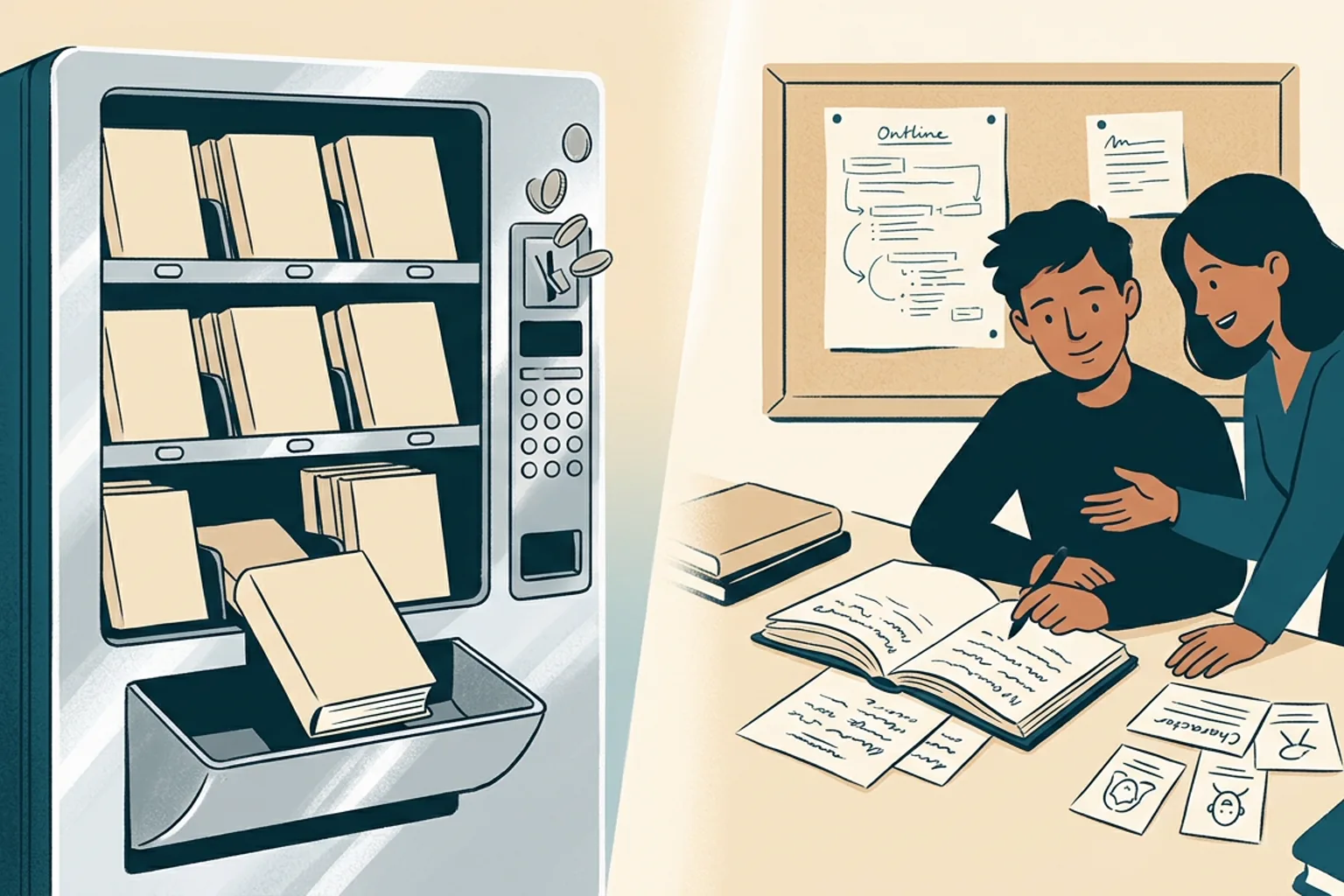
In a 25-chapter trial, four leading AI novel tools all produced consistency errors by roughly chapter fifteen — because a one-shot generator has no mechanism to hold a hard constraint. The difference between a generator and a partner is who makes the decisions.
An AI book generator produces a finished book from a single prompt. An AI writing partner drafts it with you, scene by scene, against a structure you control. That one difference — who makes the decisions — is the difference between a document and a novel.
I keep coming back to this because the two categories are sold side by side under the same label, and choosing wrong usually isn't discovered until chapter fifteen. So let me separate them clearly, show what each actually does to a long manuscript, and give you a criteria-based way to choose.
Two products wearing the same label
An AI book generator is a one-shot machine: you describe the book, it prints one. It may promise chapters, a cover, even a series — but the entire generation happens in one pass, from one prompt, with the author as a spectator.
An AI writing partner never produces the whole book at once. It works in units — a beat, a scene, a chapter — and each unit is generated against material you have already approved: the outline, the character sheets, the scenes before it. The term comes from tools that treat writing as a shared surface. Sudowrite's Story Engine, for example, takes your notes and builds a synopsis, character lists, an outline, and only then drafts prose — with the author editing at every step "as you and the machine work together as a team."
The industry itself has moved this way. What 2026 marketing calls a "writing assistant" is increasingly a stack of agents — one for structure, one for prose, one for continuity, one for editing — that reconcile their outputs, and honest product reviews now rank tools less on prose quality than on how well those agents talk to each other. Generative quality has largely converged; the architecture around it is what separates the tools — and how much of the writing surface they share with you.
You can feel the difference in the interfaces. The generator page is one text box and a button that says something like "Generate My Book." The partner workflow is a workspace: a canvas for the outline, a place for character sheets, a running draft, a side panel where the tool asks you to confirm a direction before it writes the next scene. One asks for your idea; the other asks for your decisions.
Why one-shot generation falls apart
The one-shot generator fails for a structural reason, not a quality one. A 100,000-word novel is roughly 130,000 to 150,000 tokens. Even the largest context windows can hold that — but research has repeatedly shown that holding is not the same as using.
Models recall the start and end of long contexts far better than the middle — the "lost in the middle" effect documented since 2023. Performance degrades as input grows even when retrieval is perfect, by 13.9% to 85% depending on the task. And a model that optimizes local fluency has "no mechanism inside [it] that says this is a hard constraint" — nothing enforces that the hero's eye color stays fixed between chapters.
The result shows up in every real-world test. In a 25-chapter trial, four leading tools all produced consistency errors by about chapter fifteen. In the "Lost in Stories" benchmark, consistency errors concentrate around the middle of narratives, with even the best model still erroring considerably — a roughly six-fold spread between best and worst, and no clean model in the set. The community says it plainly: stories "completely fall apart by chapter 20." This is why a one-shot book reads like a very long sample chapter — the same reason AI can generate 50,000 words and still not a good book.
A worked example: the same premise, two ways
Say the premise is a thriller: a retired codebreaker is pulled back when an encryption she designed twenty years ago starts appearing in ransom demands. The setup is identical in both approaches. Everything after it diverges.
With a generator, you type the premise, add "full novel, 90,000 words," and wait. What comes back has the shape of a book: chapters, scenes, an ending. But the testers' findings land on schedule. Around chapter fifteen, the codebreaker's eye color silently changes, or the mentor's backstory contradicts itself — the error pattern every tool in a 25-chapter trial produced. The subplot you would have cared about, the daughter who inherits the encryption, gets dropped around the middle — exactly where the consistency benchmark places errors. The ending lands, but it resolves a version of the plot that stopped being true in chapter two.
With a writing partner, the same premise goes through the front door. You fix the codebreaker's physical anchors and three core traits before any prose. You agree a chapter outline: what each chapter must set up, what it must pay off. The daughter's subplot is written into the outline as a constraint, not left to the model's attention. You draft scene by scene, keeping maybe 30–50% of the raw output and rewriting the rest. The book takes longer to draft and immeasurably less time to repair.
The one-shot book needed repairs that were structurally impossible — you cannot edit an eye color out of a narrative that depends on it. The partner book needed normal edits, the kind every manuscript needs.
The honest cost comparison
The one-shot generator looks cheaper. It isn't, once you count revision.
Generation is fast — a weekend gets you a full draft. But that draft arrives with a known defect list: middle-of-story contradictions, dropped threads, a voice that reads like the average of every novel the model has seen. Fixing that is not editing; it is reconstruction, because the errors are woven through the text rather than localized. Authors report keeping maybe 30–50% of raw output and rewriting the rest, and the one-shot draft gives you no structure to rewrite against.
The partner workflow spends the time upfront. Every scene takes longer because each one is generated against approved material — the outline, the character sheets, the scenes before it. The payoff is that revision becomes normal editing: strengthening scenes, cutting filler, sharpening dialogue. The rough rule from working authors: the generator saves drafting time and multiplies repair time; the partner spends drafting time and shrinks repair time. If you value your hours at all, the second trade is the one you want for a book-length project.
Head to head
| Dimension | AI book generator | AI writing partner |
|---|---|---|
| How it produces | One prompt, one pass, whole book | Scene by scene against an approved structure |
| Who decides | The model (premise in, everything else out) | The author (constraints in, execution out) |
| Story memory | None — one pass has nothing to remember | Persistent state: characters, world, earlier scenes |
| Consistency by ch. 15 | Erroring in real-world tests | Recoverable — structure is the fix |
| KDP disclosure | Full text is AI-generated | Depends on how much you keep and edit |
| Copyright | Weak — model-made text isn't ownable | Stronger — your decisions are the creative work |
| Learning curve | Minutes | Days — but it is writing skill, not tool skill |
| Revision cost | Reconstruction (errors woven through) | Normal editing against a structure |
| Best use | Ideation, short-form, prototypes | Full novels, series, voice work |
When the generator is the right tool
None of this means the one-shot generator is useless. It means its correct job is narrow and honest.
Use it for ideation — a premise test, three versions of a first chapter, a short story, an outline rendered as prose so you can feel the shape before committing. Product directories in the category are candid about this: one-shot generator listings are "useful for ideation, weak for books." Use it for anything under about 10,000 words, where the context window genuinely can hold the material and the lost-in-the-middle failure has no middle to hide in. Use it to prototype a series bible or a synopsis you will then write yourself.
The mistake is not using a generator. The mistake is using it as the whole pipeline for a 90,000-word book and discovering the architecture too late. Know which job you are hiring it for, and it earns its place.
Which should you pick?
Choose a one-shot generator for exploration — the ideation jobs above, or anything under about 10,000 words. It is an ideation tool, and it's honest about that.
Choose a writing partner when you want a book: something 70,000+ words, with characters who stay consistent, a plot that doesn't contradict itself, and a voice that reads like yours. That requires a memory system outside the model — an outline, character sheets, a running record of decisions — which is exactly what partner tools build in. Expect to keep maybe 30–50% of raw AI output and rewrite the rest; that ratio is not a failure, it's the workflow.
If you want neither, that's a legitimate answer too: many authors use AI for brainstorming and research, then draft without it.
How to run a writing-partner workflow
If you are not ready to adopt a dedicated novel tool, you can run the partner workflow with a plain chatbot and a document. The structure is the same; you just carry the memory yourself.
- Premise round. Ask for three premises, not one. Pick the strongest and edit it until it is yours. This is the only step where the model should generate the idea.
- Character anchors. Before any prose, fix what will otherwise drift: physical anchors, three to five core traits, a motivation, a fear. This list is what keeps the codebreaker's eye color stable in chapter fifteen.
- Chapter outline. Write the constraint system yourself: what happens, whose point of view, what must be set up, what must pay off. The model cannot hold this; the document can.
- Scene drafts. Generate one scene at a time, 300–500 words, pasting the relevant outline point, the relevant character sheet, and two or three lines of your own prose as a voice sample into every prompt. Draft in small units — never a full chapter in one shot.
- Commit and re-read. Keep the scenes you accept in the running document and paste the relevant slice into the next prompt. When the prose starts reading like the model rather than you, treat voice as a separate workflow step, not a better prompt.
This mirrors what the dedicated tools automate — Sudowrite's Story Engine takes your notes and builds synopsis, characters, outline, then prose, with you "working together as a team every step of the way." The chatbot version is the same method, "manual with a lot more prompting and cutting and pasting." The principle is identical: the human architect guides the vision, and the machine executes against the constraints — which is also, not coincidentally, the version that keeps the book yours.
Frequently asked questions
What's the difference between an AI book generator and an AI writing partner?
A generator outputs a complete book from one prompt in a single pass. A partner drafts iteratively, scene by scene, against structure and character material you control. The generator asks you to watch; the partner asks you to decide.
Who is actually writing the book?
Whichever side makes the decisions. In one-shot generation the model sets the situation, characters, and arc; in a partner workflow you set the constraints and the model executes. Publishing is starting to draw exactly this line — KDP disclosure and copyright both turn on how much of the creative work is yours.
Can an AI book generator write a full novel?
It can output 100,000 words. Whether it holds together is the question: consistency errors appear around chapter 15 in real-world tests, and even the best models err considerably on long-form consistency. Quantity and coherence are different outputs.
Is an AI book generator ever worth paying for?
Yes, for its narrow jobs: premise tests, short stories, prototype chapters, and outlines in prose form. The category is honest that one-shot generation is "useful for ideation, weak for books." Pay for it when the job is generating options quickly; don't pay for it as the production pipeline for a novel.
Does the partner workflow make the book legally mine?
It puts your decisions at the center of the work, which is exactly where the legal lines are drawn. AI-assisted work — where you supply the creative decisions and the model executes — sits differently from fully AI-generated text under KDP disclosure rules, and copyright protection rests on the creative choices being yours. No workflow guarantees ownership, but a book you structured and decided is a book you can claim.
The reframe
Every "AI book" is a collaboration; the only question is what the human brings. A generator lets the model make the creative decisions and the human do cleanup. A partner keeps the human in the decision loop — which is also where the author's name, the disclosure, and the copyright live. The tool that writes with you will always produce a book that is more yours than the tool that writes for you. That is not a taste judgment. It is the difference between being the author and being the audience. For the fuller picture of what the category can and cannot do, start with how to write a full book with an AI book generator.
§ How this was compiled
Researched 23 Aug 2026 via Tavily (queries on the "AI book generator vs AI writing partner" category, one-shot generation limits, and iterative drafting workflows). Category definitions, the multi-agent-stack framing, and the 30–50% keep-rate figure are attributed to the sources above; the "who makes the decisions" authorship framing and the criteria-based recommendations are this article's synthesis, not sourced claims. The 25-chapter trial, the "Lost in Stories" benchmark, and the context-window research are reported as published by their authors. KDP disclosure and EU transparency rules are summarized from 2026 policy documentation. No first-hand tool testing is claimed. The author is the founder of Pacegram, a story-architecture tool for novelists; this article contains no product comparisons or promotion beyond what the sources discuss.
§ Sources
- AIWriteBook — "AI Writing Assistant: 60+ Tools, Generators & Competitor Reviews" (2026). https://aiwritebook.com/en/ai-writing-assistant
- The Writing Asylum — "Novel Writing With AI (Free AI Options vs SudoWrite)" (2023). https://thewritingasylum.com/2023/05/26/novel-writing-with-ai-free-ai-options-vs-sudowrite
- QWE AI Academy — "ChatGPT to Write a Book: Why the #1 Mistake Ruins Your Manuscript" (2025). https://www.qwe.edu.pl/tutorial/chatgpt-to-write-a-book
- Coursiv — "How to Write a Book with AI, Step by Step" (2026). https://coursiv.io/blog/how-to-write-a-book-with-ai
- Kristopher Clark — "AI Can Build Your App in One Shot. Here's Why You Shouldn't Let It." (2025). https://kristopherclark.com/blog-1/ai-can-build-your-app-in-one-shot-heres-why-you-shouldnt-let-it
- my-book.ai — "Why ChatGPT Can't Write Your Novel in 2026". https://my-book.ai/en/blog/why-chatgpt-cant-write-your-novel-in-2026
- Li et al. — "Lost in Stories: Consistency Bugs in Long Story Generation by LLMs," arXiv:2603.05890 (Mar 2026). https://arxiv.org/abs/2603.05890
- Novarrium — "We Tested 4 AI Novel Tools for 25 Chapters. Only 1 Survived." (2026). https://novarrium.com/blog/ai-writing-tools-keep-contradicting-themselves
- WriteAIBook — "How AI Novel Generators Handle Character Consistency (2026)". https://www.writeaibook.com/blog/how-ai-novel-generators-handle-character-consistency.html
- Liu et al. — "Lost in the Middle: How Language Models Use Long Contexts," arXiv:2307.03172 (2023/2024). https://arxiv.org/abs/2307.03172
- Yu et al. — "Context Length Alone Hurts LLM Performance Despite Perfect Retrieval," arXiv:2510.05381 (Oct 2025). https://arxiv.org/abs/2510.05381
- "Can Good Writing Be Generative?" arXiv:2601.18353 (Jan 2026). https://arxiv.org/abs/2601.18353
- Publishers Weekly — "After the Cancellation of 'Call Me, I'll Hide the Body,' What Comes Next?" (Aug 2026). https://www.publishersweekly.com/pw/by-topic/industry-news/publisher-news/article/100983-after-the-cancellation-of-call-me-i-ll-hide-the-body-what-comes-next.html
- Amazon KDP AI-generated content policy (2026) — via univers.studio, Inkrify, WriterCosmos compliance guides.
- CreativeIndie — "Best AI Writer 2026: Honest Picks I Actually Tested". https://www.creativindie.com/best-ai-writing-generators-artificial-intelligence
- r/WritingWithAI — "I spent last 6 months researching what AI writing tools..." (2026). https://www.reddit.com/r/WritingWithAI/comments/1rlgqm2/i_spent_last_6_months_researching_what_ai_writing