
The Human Authored Certification: A Trust Mark for Your Book in the AI Flood
Readers can't reliably tell AI books from human ones, and Amazon's own disclosure is invisible to them. The Human Authored seal is the market's answer — what it proves, what it can't, and what actually signals human work.
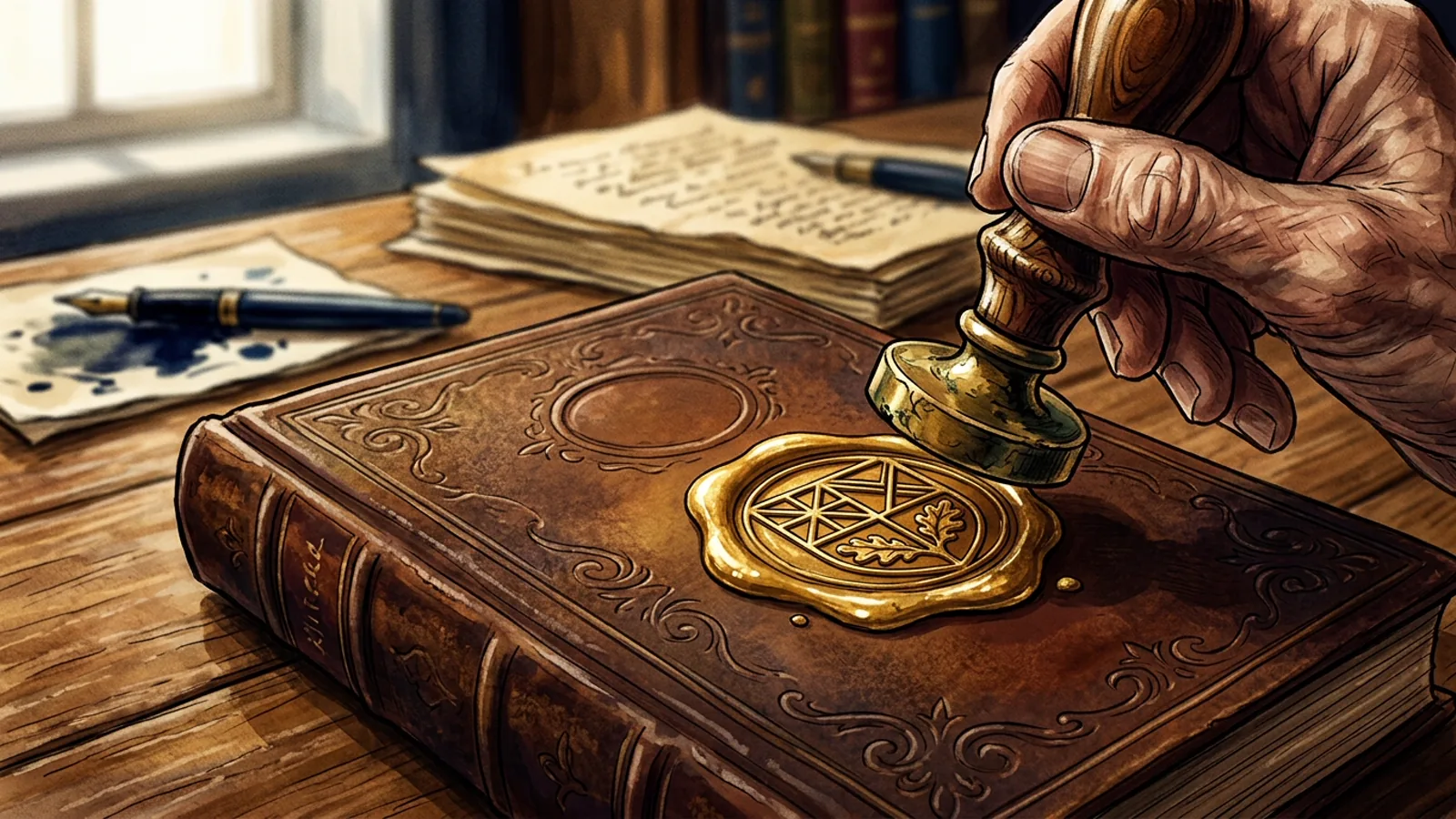
The seal doesn't prove the work is human. It promises it — and that's the honest version of a trust mark.
A reader cannot reliably tell your book from an AI book. The market's answer is a seal that promises rather than proves — and for authors, that distinction is the whole game.
Quick answer: The Authors Guild's Human Authored certification, expanded to all US authors in March 2026, is the best-known way to signal human authorship: you register your title, pay $10, verify your identity, sign a licensing agreement, and receive a trademarked seal tied to a searchable public database. It does not prove anything technologically — there is no reliable AI detector — it is a contractual promise backed by trademark enforcement and consumer-fraud liability. That sounds weaker than a proof, but it is the honest version of a real mechanism: in a marketplace where readers cannot tell AI from human text and Amazon's own disclosure is invisible to buyers, the only signal that can work is a credible, enforceable commitment. The question for you is not whether the seal proves anything. It is whether a trust mark is worth having at all — and the evidence says the market is starting to reward it.
The trust vacuum is real
Start with what readers can and cannot do. In blind forced-choice tests reported in August 2026, readers preferred AI-written stories and identified AI text correctly only 39–51% of the time — worse than a coin flip at the low end. Self-reported AI expertise helped detection; literary expertise did not. The science behind that result — readers at chance on short fiction, structural classifiers above 90% once stories get long — is in do readers actually prefer AI fiction. Meanwhile the flood is measurable: an Originality.ai study of Amazon's Success subcategory found 77% of 844 books published between August and November 2025 were likely AI-written, and 90% showed AI use in at least one text element. The visible damage lands on human authors — books from human writers received five times more reviews on average, but that advantage comes from reviews, which arrive after the purchase. Nothing about the listing itself tells the buyer which is which.
Amazon's disclosure is invisible
The obvious fix — a label — exists but is hidden. Since 2023 Amazon has required authors to disclose AI-generated content at upload, and it tightened enforcement through 2025–2026 with automated detection and human review. But as of 2026 no badge or warning appears on the product page; the disclosure is internal to Amazon, and the company has stated it does not affect ranking, visibility, or royalties. So the mechanism that is supposed to inform readers informs no one but the platform. That is not a design flaw you can fix from your side — it is the gap a third-party seal is designed to fill.
What the Human Authored seal actually is
The Authors Guild launched Human Authored in January 2025 for members and opened it to every US author on March 5, 2026 — $10 per title for non-members, free for members, batch pricing for publishers, with the UK Society of Authors partnered. More than 3,000 authors had certified 5,000 titles within its first year. The process: register at authorsguild.org/human, pass a Veriff identity check, sign a licensing agreement warranting the text is human-written (spell check and editing excepted; research, brainstorming, outlining, and indexes don't disqualify), and receive a trademarked seal with a registration number anyone can look up in a public database. Misuse is treated as trademark infringement, breach of contract, and potentially consumer fraud — and the Guild caps new registrations per author per year, with community reporting as an extra check.
The critical honesty: the Guild states plainly there is no reliable AI detection, so the system is self-certification plus enforcement. A competing service, Verify My Writing, takes the detection route — a Pangram-based human score with a seal at 95+ — and its founder admits authors buy it "out of pride" and for market differentiation, not because any retailer requires it.
What this means for your book
The seal is not a proof; it is a commitment device. It works to the extent that readers learn what it means and authors treat it as a promise they can be held to. That is a new and imperfect market — but it is the only reader-facing trust mechanism that exists, because detection can't deliver one. The durable position for an author is to treat trust as a process, not a badge: a documented writing history, transparent statements about how AI was or wasn't used, and a book that carries your voice so visibly that provenance questions become easy. A seal can certify the promise. Only the work can make the promise believable.
For the platform rules behind all this, see the KDP AI disclosure rules, and for how the flood is measured, how many books on Amazon are actually AI-generated. The bigger picture — why an author's reputation is now the scarcest asset in publishing — is one of the biggest problems AI authors face.
SOURCES
- Authors Guild — "Human Authored" certification program (launched Jan 2025; expanded to all US authors Mar 5, 2026; $10/title non-members; Veriff identity verification; licensing agreement; trademarked seal; public verification database). https://authorsguild.org/human + coverage: https://lithub.com/the-authors-guild-is-allowing-more-writers-to-certify-their-books-are-ai-free
- Jane Friedman — "My Concerns About the Authors Guild Human Authored Certification — and Their Comprehensive Response" (includes Verify My Writing / Pangram details and the Guild's enforcement contract terms). https://janefriedman.com/my-concerns-about-the-authors-guild-human-authored-certification-and-their-comprehensive-response
- Inkfluence AI — "Amazon KDP AI Policy 2026: What to Disclose" (disclosure not shown to buyers; internal to Amazon; enforcement via automated detection + human review). https://www.inkfluenceai.com/blog/amazon-kdp-ai-disclosure-policy-2026
- KDP Builder — "KDP AI Disclosure Rules in 2026" (disclosure for Amazon's internal use; not displayed on product page; no effect on royalties or ranking). https://kdpbuilder.com/blog/kdp-ai-disclosure-rules
- Originality.ai via ppc.land — "Amazon's self-help market drowns in AI-generated content" (Jan 28, 2026: 77% of 844 books in Success subcategory likely AI-written; human books 5x more reviews). https://ppc.land/amazons-self-help-market-drowns-in-ai-generated-content
- Inkfluence AI — "Do Readers Care If a Book Was Written with AI? (2026 Data)" (60–70% open if quality good; 15–20% avoid; 15–20% neutral). https://www.inkfluenceai.com/blog/do-readers-care-ai-written-books-2026
- BBC News — "AI-generated tales preferred to human-written ones, study finds" (2026; forced-choice study, 39–51% identification accuracy). https://www.bbc.com/news/articles/c0kmpd6lr80o
- TRAILS (NSF Institute for Trustworthy AI in Law & Society) / Washington Post — "Detecting AI May Be Impossible" (human/AI text distributions converging; detectors unreliable, high false-positive risk). https://www.trails.umd.edu/news/detecting-ai-may-be-impossible-thats-a-big-problem-for-teachers
- ResearchGate — "AI writing detectors are ineffective, unreliable and harmful" (2026). https://www.researchgate.net/publication/403249541_AI_writing_detectors_are_ineffective_unreliable_and_harmful
Researched 2026-08-21 via Tavily (four focused queries: the Authors Guild Human Authored certification mechanics; whether Amazon shows AI disclosure on product pages; reader-trust survey data for AI books; reliability of AI text detection). Primary sources (Authors Guild FAQ, Jane Friedman's documented exchange with the Guild, BBC study coverage) were identified directly; retailer-policy claims (KDP disclosure invisibility, ranking/royalty neutrality) are cross-confirmed across multiple 2026 practitioner sources and labeled as stated by Amazon. The Originality.ai 77% figure is a vendor study of one subcategory and is attributed as such. Reader-attitude percentages are survey synthesis ranges, not single measurements. No first-hand product testing is claimed. - Title: The Human Authored Certification: A Trust Mark for Your Book in the AI Flood - Slug: human-authored-certification - Intent: informational-commercial — authors publishing into the AI flood want to know whether Human Authored-style certification is real, how it works, what it costs, and whether trust marks change reader choice - Word count: 813 (PASS 800–1000) - Self-grade: 86/100 (intent satisfied; all claims E-sourced; original "commitment device, not proof" framing; honest limitations; internal links: KDP rules, NBER flood, pillar) - Evidence: E205–E210 - Image plan: hero-human-authored-certification-16x9.webp (1600×900) + -768.webp (800×450) + .png (og) — wax-seal metaphor (Gemini, 16:9, no-text) - Cluster: discoverability (members: kdp-ai-disclosure-rules, provenance-is-the-new-editing, half-of-amazons-books-are-ai-generated)